
Registration for the October 22 virtual event requires personal contact information and responses to questions about homelessness policy, including some with limited answer choices. Park’s office did not respond to two requests for clarification before the publication deadline.
Los Angeles City Councilmember Traci Park will host a State of Homelessness Virtual Town Hall on Thursday, October 22, from 6 to 7:30 p.m. The event is intended to provide information about homelessness in Council District 11 and an opportunity for constituent engagement.
However, residents seeking to attend must first complete a registration form requiring their name, email address, telephone number, and responses to a series of questions about homelessness policy. Unlike a voluntary survey, the questionnaire is a condition of registration. The form does not provide an option to skip the required questions or select “prefer not to answer.”
The requirements raise questions about barriers to participation, the collection of personal information, informed consent, and how the survey results may be used.
Survey Completion Required for Attendance
Requiring an email address to distribute a Zoom meeting link is a common registration practice. Park’s form also requires a telephone number and responses to multiple questions concerning homelessness, enforcement, services, and interim housing.
Residents who wish only to listen to the town hall must still complete the questionnaire. The form also requires registrants to enter a question they would like to ask the Councilmember, even if they have none. An optional field for additional feedback is provided, but the other required questions must be answered before registration can be submitted.
The Councilmember’s office could collect constituent feedback through a voluntary survey without making disclosure of policy preferences a condition of attendance.
Survey Questions Offer Limited Choices
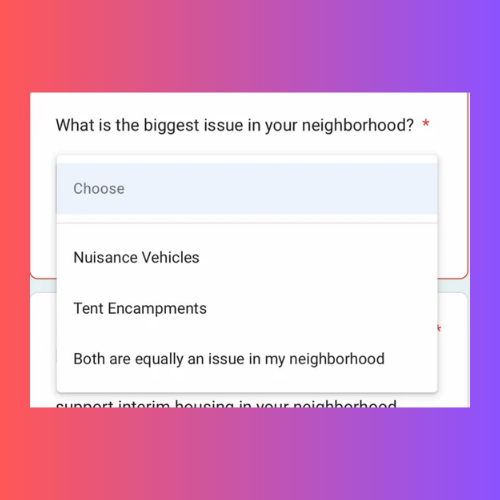
One question asks: “What is the biggest issue in your neighborhood?”
The available responses are:
- Nuisance Vehicles
- Tent Encampments
- Both are equally an issue in my neighborhood
What if your biggest neighborhood concern is unavailable affordable housing? Rising rents? Traffic safety? The lack of mental health services? Or perhaps you don’t consider either nuisance vehicles or tent encampments your neighborhood’s biggest problem.
There is no option for “Neither,” “Other,” or an issue unrelated to vehicles or encampments.
Consequently, every respondent must identify one or both of these concerns as their neighborhood’s biggest issue, regardless of whether that reflects their actual opinion.
This limitation matters when considering how the results might be interpreted. If presented without the original question and answer choices, the responses could suggest that all participants identified vehicles or encampments as their primary neighborhood concern.
Other questions ask residents to rate the adequacy of enforcement involving encampments near parks and schools, as well as RVs and people living in vehicles. The five-point scales range from insufficient enforcement to sufficient enforcement. They do not provide a separate option for respondents who disagree with enforcement as a policy approach.
The survey also asks about the availability of services for unhoused people and support for interim housing, both across the Westside and within respondents’ own neighborhoods.
These are legitimate policy questions, but their structure limits how participants can express views outside the provided choices. A survey intended to measure public opinion should allow respondents to express opinions that differ from the assumptions built into its questions.
Residents Question the Survey’s Design
The registration process has prompted criticism among residents discussing the survey. “This question is so biased. Why don’t people see through this sh*t?” one participant wrote to Mar Vista Voice.
Another resident writing to Mar Vista Voice described being unable to select an answer that reflected their views. “Just signed up and couldn’t believe this question! I felt trapped,” the resident wrote. “I clarified in the additional comments section that my actual answer was neither and that the questionnaire is flawed.”
While the additional feedback field allows respondents to explain their answers, it does not eliminate the requirement to select from the available choices. It is unclear whether written comments will be incorporated into any summary of the survey results or how the Councilmember’s office intends to use the information collected.
Privacy, Personal Information, and Informed Consent
Beyond the mandatory survey, the registration process requires residents to provide personally identifiable information, including their names, email addresses, and telephone numbers. An email address serves an obvious purpose for a virtual town hall: distributing the Zoom link and event information. The need for a mandatory telephone number is less apparent.
Collecting only personal information necessary for a stated purpose is a widely recognized privacy principle known as data minimization. Limiting unnecessary collection reduces the amount of personal information that must be stored, protected, and potentially disclosed.
The registration form does not explain why telephone numbers are required, whether they will be used to contact registrants, or whether they will be retained after the event.
The survey also collects identifiable registration information alongside responses to questions about politically contentious issues, including homelessness enforcement, encampments, and interim housing. That raises additional questions about whether individual responses can be linked to participants, who will have access to the data, and whether it could be used for purposes beyond planning the town hall.
There is also the matter of informed consent.
In academic and human-subjects research, informed consent is a fundamental ethical principle intended to ensure that participants understand the purpose of a survey, how their information will be used, what privacy protections exist, and that participation is voluntary.
Guidance from Western Washington University’s Human Research and Participant Protection program emphasizes informed, voluntary participation and the ability to withdraw from research. Although a councilmember’s constituent survey is not necessarily subject to the same research regulations, the underlying principles of transparency and voluntary participation remain relevant.
Residents registering for Park’s town hall are not offered an opportunity to decline the survey while still attending. The registration materials shown also do not explain how long responses will be retained, who will have access to individual answers, or whether the information will be shared outside the Councilmember’s office.
The form identifies itself as having been created within the City of Los Angeles, making these questions particularly relevant to the handling of information collected through an official government outreach event. Without clear information about the purpose and handling of the data, residents cannot fully evaluate the privacy implications of providing their responses.
Public Access and First Amendment Considerations
The October 22 event is a constituent outreach town hall hosted by an individual councilmember, rather than a formal legislative meeting subject to the Brown Act’s public-access requirements.
Elected officials generally have discretion to establish reasonable registration procedures for these events, including measures to manage attendance and collect feedback. However, the mandatory questionnaire raises questions about whether all the requested information is necessary for attendance.
The Knight First Amendment Institute at Columbia University has examined First Amendment protections in virtual town halls, particularly restrictions on government officials excluding participants based on their viewpoints. Whether those protections apply to a particular virtual event depends on its structure and purpose. Requiring a survey is not, by itself, evidence of a constitutional violation.
There is no evidence that Park’s office is using survey responses to screen or exclude participants. Nevertheless, requiring individuals to associate their identities and contact information with responses to politically sensitive questions raises concerns about privacy and whether such requirements may discourage participation.
Park’s Office Does Not Respond to Media Inquiries
Mar Vista Voice first contacted Councilmember Park’s communications team on Sunday, October 11, requesting clarification about the registration requirements and survey design. The inquiry requested a response by Thursday evening, October 15, ahead of the newsletter’s October 16 publication. After receiving no response, Mar Vista Voice sent a follow-up reminder on Wednesday, October 14, again requesting answers by the October 15 deadline.
The inquiries asked why telephone numbers and survey responses are mandatory, who developed the questions, and whether the office would consider allowing residents to register without completing the questionnaire. Additional questions addressed how the collected information will be stored and used, whether responses will be linked to registrants’ identities, and whether access to the town hall is guaranteed regardless of survey responses or political viewpoints. Mar Vista Voice also asked whether survey results would influence the town hall presentation or discussion and whether the results, including the complete questions and available answer choices, would be made public.
As of Thursday evening, October 15, after the stated deadline had passed, Councilmember Park’s office had not responded to either inquiry. The office’s reasons for requiring the additional information and mandatory survey therefore remain unknown.
Public Engagement Shouldn’t Require a Survey
Councilmember Park has an opportunity to hear from constituents with a wide range of perspectives on homelessness. An optional survey would allow her office to gather feedback without requiring residents to disclose their views simply to attend. A voluntary survey would also distinguish responses provided by people who want to share their opinions from those submitted solely to complete registration.
A survey can be a useful tool for understanding public opinion, but its value depends in part on whether respondents can express what they actually believe. Constituents should be able to hear from their elected representative without first being required to tell her what they think.
Want to attend the October 22 town hall? To register through Councilmember Park’s official form and complete the required survey, click here. But if you’d rather attend without providing your telephone number or answering a mandatory questionnaire, Mar Vista Voice has got you covered! Click here for the direct Zoom link. No survey required.