
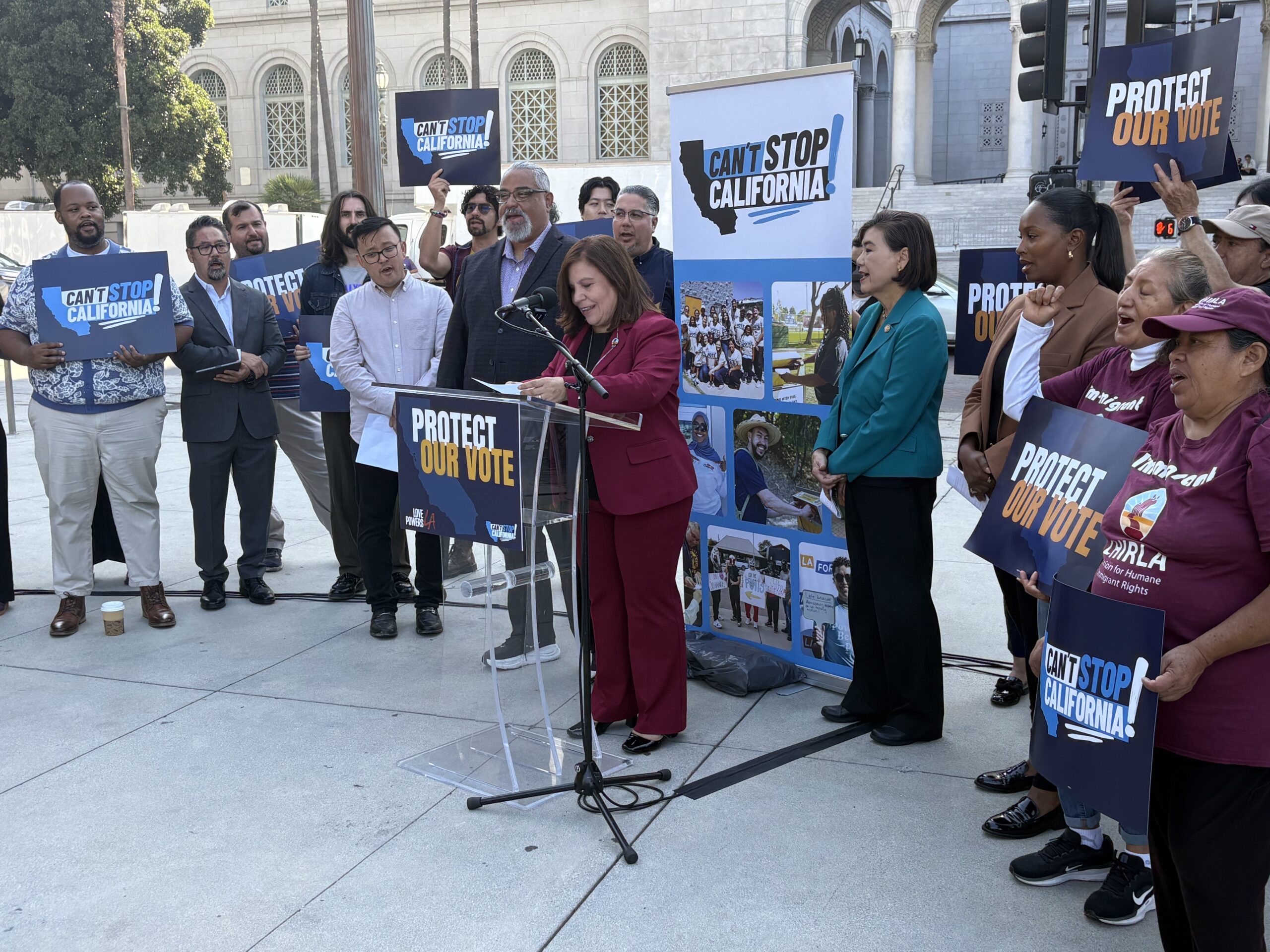
On September 23, 2026, outside Los Angeles City Hall, elected officials and labor leaders gathered to deliver a stern warning: the Trump administration is coming for your vote.
A decade ago, the concept of large-scale government election interference may have seemed like little more than an Orwellian cautionary tale–certainly not something that 21st century America, with its strong constitutional foundation and myriad checks and balances, could succumb to. But in 2026, when every other day headlines decry the president’s unprecedented flouting of ethical norms, it’s not so far-fetched to conceive that the same administration that ordered militarized raids in major cities and barred CNN, MS NOW, and Politico from the White House might try to hijack the midterm elections.
The seeds have already been planted. For years, the President has worked to undermine confidence in electoral institutions through a barrage of baseless “voter fraud” claims, with his refusal to accept the 2020 election results being the clearest example. At Wednesday’s press conference, LA County Registrar-Recorder/County Clerk Dean C. Logan detailed the lengths LA County takes to administer fair, secure, and transparent elections for all registered voters, regardless of their background or political affiliation:
“Things like maintaining accurate voter records, making voting accessible to all voters in the county, securing ballots throughout the process, verifying signatures, testing voting tabulation equipment, providing public observation, auditing election results and making sure that every valid vote is counted accurately and included before we certify the election.”
LA’s elections are provably sound. Yet, as the June elections demonstrated, that still doesn’t stop powerful individuals from crying “fraud” when voting doesn’t go their way. Along with sowing distrust, Republicans are pushing to impose additional proof-of-citizenship requirements for voter registration, through measures like the SAVE Act and Proposition 39, ostensibly to combat alleged fraud. Critics argue that these measures are little more than thinly veiled attempts to suppress voter turnout in blue states and that the added barriers disproportionately harm voters of color, young people, people with disabilities, trans people, and women.
Rather than simply painting a grim picture of an increasingly undemocratic future, the press conference also served as a call to action. Assemblymember Isaac Bryan talked about his meeting with Doris Crenshaw the year prior. She had been the youth organizer for the Montgomery bus boycott, operating out of Rosa Parks’ living room, and she continues to organize to this day. Crenshaw is a living testament to the effectiveness of people-powered movements in the fight against unjust institutions.
Crenshaw also recounted her own experiences with election interference growing up, such as mandated literacy tests and being asked to guess the number of jelly beans in a jar in order to vote. When Assemblymember Bryan said, “Thank goodness we don’t live in those times anymore,” Crenshaw responded, “But we do.”
Los Angeles, California, and the country as a whole need to focus and organize in order to anticipate threats and protect the integrity of our elections. This means building a local infrastructure capable of responding to those threats. In Los Angeles, such efforts are being spearheaded by Love Powers LA, a coalition of local organizations including ACCE, Catalyst California, Education Workers United, LA Forward, LA Voice, and many more. Their mission is to unite Angelenos and formulate a cohesive mobilization strategy ahead of the upcoming elections.
The first step is a mass public training on September 26, 2026, at the East Los Angeles College Auditorium. There, people from across the county will prepare for a range of scenarios that could arise before and after the election, such as ICE intimidation at polling places, or the outright denial of election results. Love Powers LA’s goal is to bring 1,000 attendees to the event, creating a foundation of trained individuals that can be built upon. You can register for the event here: bit.ly/lovepowersla.
From this coalition, LA Forward is taking the lead on the Westside. Deputy Director Godfrey Plata, who was in attendance at the press conference, sat down with Mar Vista Voice to explain the importance of the upcoming elections and what LA Forward has in store to make sure the Westside is ready to act:
Can you briefly describe LA Forward, and specifically its connection to the Westside?
LA Forward is a nonprofit organization. Often people don’t know that we are two organizations: LA Forward Institute and LA Forward. LA Forward Institute is a 501(c)(3) that can do community education and organize people to identify and work on issues that matter to them. We do that all over LA County. And LA Forward, the (c)(4), is where we do political work. So, are there particular candidates or electoral decisions that we can help support or oppose because of what our community members are saying? In tandem, both organizations really give us levers of power to support activating folks in our local democracy.
Our Executive Director is a Westsider. He has lived in Sawtelle for quite some time, and he started the organization there. He was living into the mission and vision of the organization, and I think a lot of his immediate networks began on the Westside. So, I think we’ve developed some really natural strengths there, and now we have some of the largest parts of our membership on the Westside.
What do you say to anyone who feels disillusioned by the current state of politics and who isn’t planning on voting, or is hesitant to do so?
I think voting is one of the most powerful pieces of our democracy that we can leverage. And it only comes every now and then. I think there’s so much that each of us has to juggle right now and problem-solve. If we connect the dots as to why these things are happening, it’s because people are not representing us or these issues and challenges that we’re facing. So, these two things are connected to me. I’d like for us to get out there and vote and do so in an informed way so that we can change the things that are jading us.
What does LA Forward have planned to encourage Westsiders to get out and vote this election cycle?
Yeah, we have a lot going on. Every election cycle, we release a voter guide. That’ll be accessible on our website. That has been used by a quarter of a million people each election cycle. So, we invite folks to use it as a resource as it works for them.
Regarding the ballot, this is such an intimidating document that comes into our mailboxes. It can be 6 to 9 pages, and understanding everything on there is tough. So, we have ballot parties, where you’re free to bring your ballot and, in community, folks will be walking through different parts of it. We’re not there to tell you how to vote, only to get you comfortable with your ballot. I’m so excited to support people that way on the Westside and elsewhere in LA County as well!
We also know that this year, because of election intimidation that might be coming down from the federal government, we are creating a cadre of 70 neighborhood vote protectors, meaning we’re going to be training up people in a large coalition across LA City and LA County to be poll watchers and observers, and be ready to document anything that feels strange and inappropriate that is happening at the polls. Hopefully it is the three most boring hours of your life, and you don’t catch anything, but we’ve got to be vigilant.
What are some tangible threats that you perceive could happen on Election Day or after, and how is LA Forward planning to address these?
I’ll start backwards there. LA Forward is not working alone, right? We’re one organization, and we know we’re more powerful together as an entire community, and so we’re part of a large coalition called Love Powers LA, which is banding organizations and groups and institutions together to meet whatever moment might face us. We’re preparing for anything, frankly. We know that our election system is strong, which means there’s a lot of places to try to sabotage it for folks who don’t want our votes to count. Some of those moments could include intimidation during the voting process, like putting falsities out there about mail-in voting, or sending people like federal agents, ICE, etc. to the polls. It could mean doing things with ballots once they’re actually in the hands of the registrar’s office, right? They could seize ballots that have already been sent in or inputted. Our voting machines are machines. So, what could they do with machines that have high levels of security? Well, you can damage machines. The federal government might decide that they are not going to certify the count. So, over the next few months, we want to be really vigilant about making sure our votes count, and we’re keeping an eye on each and every step of the process, as an entire coalition and working alongside our elected officials as well, to make sure that we’re as prepared as possible.
What is your response to voters who are concerned about the presence of ICE at polling stations and who might not want to show up for fear of being profiled?
We as a community have been vigilant about ICE for quite some time now, in particular since the ICE raids picked up like two summers ago. So, everything is still the same. Rapid response networks, supporting our neighbors in moments like that, where those types of interventions might be happening, poll center or not. Those things matter and are not different.
But in addition to that, we’re producing an extra layer of vigilance through a neighborhood vote protection program, where we’re training neighbors to be poll observers from the outside and be able to document things that they see and reach out to what we call a ‘nerve center’ in case they need additional help. And so, I think all that our community members have been doing in order to engage with ICE should remain the same.
The other thing I would add is you don’t have to vote alone, right? Go in community. There are a lot of community organizations organizing events in and around polling places. We at LA Forward are hoping to have an event in West Hollywood, right outside a voting center, for example. And so, if it’s helpful to have many people there and not feel like you’re walking in alone, that is something that folks can do as well.
What is the best way for people to get involved, aside from voting?
A couple of things. Follow us at laforward.org. We’re going to be releasing a sign-up form for folks to become neighborhood vote protectors and get that particular training. Sometimes it’s really confusing and intimidating to work your way through a ballot, so we’ve got a voter guide that we’ll be putting out on laforward.org as well. If you go to our calendar, it’s populated already with a bunch of ballot parties. Again, your vote is your vote, and you should choose whatever is best for you and your family. But you might not know what all these measures are. So, we want to support folks with that as well. So, lots of different ways to engage. Feel free to jump to laforward.org or follow us on Instagram @laforward. And, of course, people should just go do it. Go do the dang thing, go vote!
What are your top three voting tips?
- Prepare to vote early. Don’t wait until the last minute. It takes a while to understand everything on your ballot. So, once it comes into your mailbox, figure out a time in that first week to take a look at it if it’s new to you.
- Use voter guides. Again, we at laforward.org will have a voter guide to help to explain all these different races and measures on your ballot. And you don’t have to guess just based on what’s there, so use other resources that are at your fingertips.
- Do this with other people. It does not have to be an independent venture at all. You’ll get stuck, you’ll get analysis paralysis. It is much easier to talk with other people along the way. So, we invite you to ballot parties or other events, where you can get a sense of what you want to do with your ballot.
What is a message of hope that you have for Westsiders and Angelenos in general this coming election?
I think the way we fight any sort of fear is with power. And I think over and over again, you know, we aren’t the only ones who have seen the power of people rise in moments of challenge, and that’s the same thing here. We’re not helpless. And Westsiders know that. The Westside knows how to make it work for themselves. We’ve been surviving.