
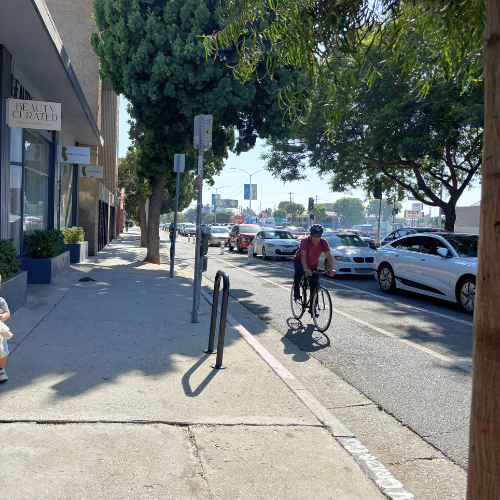
Los Angeles voters have repeatedly demanded more safe streets infrastructure, but year after year, elected officials have dragged their feet. Even as the city prepares to welcome the world for the 2028 Olympics, it added barely more than one net mile of meaningful new bike infrastructure last year.
According to Streetsblog Los Angeles’s annual review, LA installed 7.5 lane-miles of new bikeways during the fiscal year that ended in June, while removing 5.3 lane-miles and upgrading another 14.1. Once routes consisting largely of painted “sharrows” are excluded, Streetsblog calculated that the city expanded its network of bike lanes and paths by only 1.1 net lane-miles. The city’s 16.2 lane-miles of new or improved facilities represented less than half the previous year’s output and the lowest annual total since the 2018-19 fiscal year.
The numbers are especially troubling in light of Measure HLA, which 65% of Los Angeles voters approved in March 2024. The measure requires the city to install the pedestrian, bicycle and transit improvements identified in its Mobility Plan whenever it makes qualifying street improvements of at least one-eighth of a mile. Two years after voters approved the measure, Streetsblog reported that the city had completed just 300 feet of improvements clearly attributable to HLA.
The Westside is largely absent from the list of projects completed during the last fiscal year, even as several long-promised local connections remain unfinished. One example is the Northvale Gap, a missing section of the Expo bike path that the city has failed to complete since the path opened in 2016. For the past decade, riders traveling between Motor and Overland avenues have been directed onto Northvale Road, where signs and painted bike symbols substitute for an actual protected path.
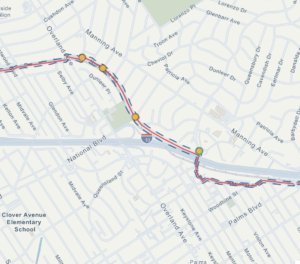
The city has spent years planning a permanent fix, including a separated, two-way bike path with space for pedestrians, better lighting, new access points and a safer crossing at Motor Avenue. Funding was secured in 2021, and construction was supposed to begin in early 2026. But nearly a decade after the Expo path opened, the Northvale Gap remains.
There has been some recent progress near LAX. The city closed a gap in the Imperial Highway bike lane in 2025 and recently installed concrete barriers to strengthen protection along part of the route. That is a meaningful safety improvement on a particularly hostile stretch of road. But hardening an existing route does nothing in terms of creating the sort of connected Westside network residents have been promised.
Even the projects that appear to be moving forward do not necessarily reflect a coherent safety agenda. For example, Councilmember Traci Park’s office has promoted a protected bike lane along Jefferson Boulevard connecting Playa del Rey and Playa Vista. As Mar Vista Voice previously reported, however, Park’s support followed a large-scale sweep that removed unhoused people living in RVs along the corridor, and she cited the former encampment when discussing the lane.
The Jefferson proposal also fails a basic test of transportation safety because it doesn’t connect people to a usable network. Cyclists say it would connect to no bike facility at either end. One end stops near the already-separated Ballona Creek path, and the other releases riders onto Jefferson itself, a high-speed arterial. No route map or clear timeline has been made public, but based on the available record, the project looks less like part of a coherent safety network and more like an isolated facility serving an effort to displace unhoused residents and sweep visible poverty out of view.
Park’s office has also pointed to Connect Del Rey, a planned 2.5-mile route through Playa Vista and Del Rey, while improvements are planned for Vista del Mar. Those projects could eventually close important gaps. But “eventually” seems to have become a defining feature of street-safety policy in this city. Projects can spend years cycling through studies, surveys, community meetings and redesigns before anything appears on the street.
Those delays can have deadly consequences. In January, a driver struck and killed cyclist Regan Cole-Graham, who was pregnant, on Pershing Drive in Playa del Rey. Bike lanes were briefly installed on the street in 2017 as part of a broader safety project, only to be removed after backlash from drivers.
After Cole-Graham’s death, Park wrote that it was “time to re-open that conversation” and said her office was working with city departments to examine lighting and speed-safety improvements. Park and LADOT later presented possible changes at a March neighborhood meeting, where residents favored lighting, speed tables, and reducing traffic lanes to restore a bike lane. Six months later, however, the public record shows no final design, funding commitment, construction timeline, or changes on Pershing Drive.
Ironically, bike-lane construction has collapsed in large part because voters made safer streets legally mandatory, approving Measure HLA with 65% of the vote in 2024. Rather than follow the law, the city changed how it repairs streets to avoid triggering its requirements.
For years, Los Angeles installed bike improvements when it resurfaced streets. That made practical sense, since it was less expensive and disruptive to add improvements called for in the Mobility Plan at the same time the street was being repaved and restriped. But after Measure HLA made many of those improvements mandatory, the city largely stopped fully resurfacing major streets. The department shifted toward shorter “large asphalt repair” projects, many of them below the one-eighth-mile threshold that triggers HLA. Streetsblog found that none of the city’s new bike lanes during the last fiscal year were installed in conjunction with street resurfacing. The city’s end run around HLA seems to have worked.