
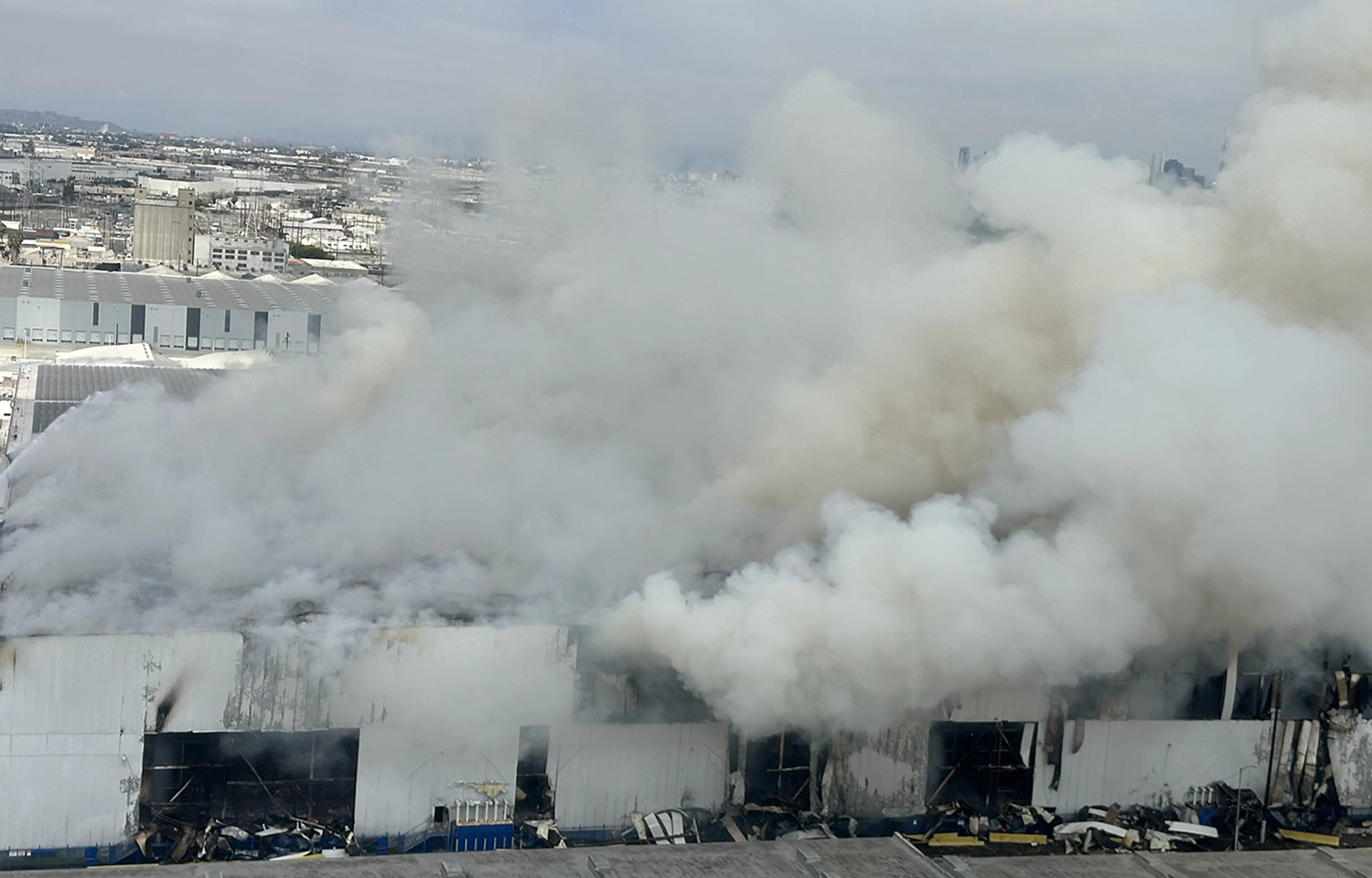
More than a week after it began, the Lineage fire is finally out. Firefighters extinguished the warehouse blaze in Boyle Heights on Wednesday evening, and the column of black smoke that hung over the Eastside since June 17 has cleared. But putting out the fire does not end the story. For more than a week, the people living closest to the warehouse were repeatedly told the air was safe to breathe even as smoke from a burning facility containing ammonia, refrigerant, insulation foam, and lithium batteries drifted through their neighborhood. The fire is over, but the questions it raised about what people breathed, how officials responded, and who bears responsibility remain.
The fire started June 17 on the roof of the 500,000-square-foot warehouse, a facility Lineage calls Big Bear that holds as much as 85 million pounds of frozen seafood, pork, beef, and poultry bound for grocery stores and restaurants up and down the West Coast. Lineage, the cold storage giant once known as Lineage Logistics, says it believes the blaze began when a subcontractor was testing the building’s rooftop solar array on June 17, and that the flames soon reached an ammonia line. The array belongs to Altus Power, and the workers testing it were employed by Pearce Services. Four were onsite when the fire started. Altus Power has since disputed Lineage’s account of how it started, the official cause has not been determined, and fire officials say only that they suspect the roof. LAFD Chief Jaime Moore described a crew that tried to knock the fire down, dialed 911, and then lost control of it.
For most of that week the fire would not stop. Firefighters never entered the building. The roof had collapsed onto rows of steel racks standing 65 feet tall, the freezer insulation trapped heat and smoke inside the sealed structure, and Moore said early on that he did not expect that to change. “I don’t foresee ever putting our firefighters in that type of danger,” he told reporters. So the department stripped away the building’s outer walls and poured water in from the edges while the frozen contents, the foam, the refrigerant, and the batteries inside continued burning until crews finally extinguished the fire on Wednesday. The smoke thinned from its worst toward the end, but only after a week in which it never fully lifted.
Officials have been far less clear about what was actually in the smoke. The foam packed around the freezer can release hydrogen cyanide and isocyanates as it burns. Ammonia, the refrigerant that runs through a plant like this, leaked in the first hours and forced an early shelter in place order, and authorities say it has since been moved offsite. A second order followed the next day as crews worked to ventilate the building. The racks inside held lithium-ion batteries, and underneath all of it was fine particulate matter known as PM2.5, small enough to pass from the lungs into the bloodstream. The South Coast Air Quality Management District has kept a particulate advisory in place from central Los Angeles east toward Riverside.
None of that stopped officials from reassuring the public. Moore repeatedly said there was nothing in the air dangerous enough to require an evacuation or even a shelter in place. Mayor Karen Bass, asked directly whether the air was dangerous, said it was not to a degree that called for a mandatory evacuation. At a county briefing, officials went further still, describing the fire as a Class A combustible, an ordinary solid that leaves ash behind, and saying it involved no dangerous chemicals. That characterization came even though the building contained ammonia refrigeration, lithium-ion batteries, and insulation capable of releasing hydrogen cyanide as it burns. All of it was said in front of a building throwing black smoke over Boyle Heights for more than a week, and all of it relied on air monitoring that captured less than it appeared to.
The Air Quality Index measures the amount of particulate matter in the air. It does not measure what is in those particles. Yifang Zhu, who studies air quality at the UCLA Fielding School of Public Health, has been clear that a fire like this one most likely releases toxins the standard readings never capture, requiring specialized instruments that regulators don’t typically deploy. After the January 2025 firestorm, research out of Rutgers found that conventional readings can understate the hazard when what is burning is a neighborhood’s worth of manufactured material rather than brush. The crowdsourced maps many residents relied on—AirNow and PurpleAir—carry the same blind spot, tracking the fine particle pollution in the smoke but not the chemical irritants released by a burning warehouse full of refrigerant and batteries. Zhu’s advice has been to stay cautious even when the index settles into the yellow “moderate” range.
What that smoke does once it is inside a body is not in dispute. “There’s no safe level of exposure to particle pollution,” Will Barrett of the American Lung Association told the Los Angeles Times. Dr. Afif El-Hasan, a Kaiser Permanente pediatrician, warned that the particles, carbon monoxide, and chemical gases coming off incinerated insulation and plastics can irritate and scar the lungs and, over time, increase the risk of cancer, and that children breathe more air relative to their size than adults. Jill Johnston, an environmental health researcher at UC Irvine, made the point that matters most during a fire this long: every additional day of smoke increases the amount people are exposed to. Pregnant women and the babies they are carrying are among the most exposed, and Diana Rodríguez, who lives blocks from the warehouse and is six months pregnant, has spent the week shut inside with her air conditioning off in the heat, because turning it on would pull the smoke indoors.
For anyone with room to maneuver, the safest approach has been to treat the official reading as one input among several. Sam Silva, an air quality researcher at USC with young children, has been checking the regulatory grade number and then opening his door to smell the air before deciding whether to let his kids outside. On Sunday that meant keeping them in through the morning and letting them out by afternoon, once both the number and the air had improved. Then he named the thing at the center of this whole episode. “I think I would make a different decision if I lived in Boyle Heights.” Even the county’s own health officer, Muntu Davis, has described readings that swing with the wind from good to very unhealthy and back within a single day, and told a briefing that what matters is where you happen to be standing. Silva has the distance to weigh all of that. The families across from the warehouse do not.
A facility this size, full of ammonia and lithium, does not go up across the street from homes in Bel Air. It goes up in Boyle Heights and East Los Angeles, neighborhoods that are overwhelmingly Latino and working class. “They always under-warn, they under-evacuate, they bring people back too fast,” said Jane Williams, who directs California Communities Against Toxics. Mark Lopez of East Yard Communities for Environmental Justice was blunter, pointing out that the firefighters reassuring residents about the smoke are not the people qualified to make those determinations. “They aren’t public health experts,” he said.
The Lineage fire is a textbook example of environmental racism. In 1987, a landmark study by the United Church of Christ found that race was the strongest predictor of where hazardous waste facilities were located in the United States, more predictive than income. A decade later, geographer Laura Pulido argued that environmental racism in Los Angeles is rarely the result of one bad actor or one bad decision. It is structural, the accumulated result of decades of decisions about where people could live, where industry would be permitted, and whose objections carried political weight. The Lineage warehouse sits here less because anyone deliberately chose this block than because everything upstream was built to send industrial uses here.
You can read that design in the map. Redlining and racial covenants confined Black, Latino, Japanese, and Jewish residents to a handful of Eastside and South Los Angeles neighborhoods in the first half of the twentieth century, and those same neighborhoods were the ones zoned to sit against industry, so that homes and rail yards and rendering plants share a fence line in ways they never would in Pasadena or on the Westside. Then in the 1950s the 5, the 10, the 60, the 710, and the 101 were driven straight through Boyle Heights, displacing thousands and blanketing what was left in car exhaust. The pattern continued decades later when an oil pipeline originally planned to run from Santa Barbara to Long Beach was rerouted through East Los Angeles after meeting resistance in wealthier Santa Monica.
That pipeline is also where one of the country’s defining environmental justice movements was born. The Latina mothers who organized in the mid-1980s as the Mothers of East Los Angeles first came together to stop a state prison the Deukmejian administration wanted to drop near Boyle Heights, and after they won that they kept going, beating back the rerouted pipeline and a hazardous waste incinerator that California Thermal Treatment Systems had gotten permitted for Vernon in 1987 without an environmental impact report. They marched, packed hearings, and sued, often alongside the Black organizers of Concerned Citizens of South Central Los Angeles, who had stopped a giant garbage incinerator in their own neighborhood. Aurora Castillo, one of the East LA mothers, won the Goldman Environmental Prize for that work in 1995. The historian Ann Carlson credits their generation with helping put environmental justice at the center of nearly every air pollution decision Southern California has made since.
A mile and a half from the Lineage warehouse sits the former Exide battery recycling plant, where lead contamination spread into thousands of homes across Boyle Heights, East Los Angeles, Maywood, Commerce, Bell, and Huntington Park. The plant closed in 2015, and California has since spent more than $772 million on what is now the nation’s largest residential lead cleanup. Yet a study released this spring found that many properties already remediated still exceeded the state’s lead standard. A month before the warehouse caught fire, a ruptured oil line sent thousands of gallons down Avenida Cesar Chavez and into the Los Angeles River. That is the backdrop against which Jessica Caloza, who represents the area in the Assembly, stood at a Saturday news conference and named the pattern again, that it is immigrant, Latino, working class communities like these that keep being handed the brunt of the region’s environmental hazards.
The warehouse itself is new. County assessor records show the freezer on Los Palos Street was built in 2018 on a parcel long zoned for industry in a part of Boyle Heights that had been residential for more than a century. Because the land already carried that zoning, the project didn’t require the rezoning that forces a public hearing, and the families across the street were never asked whether they wanted a 500,000-square-foot freezer running on ammonia next door. What the warehouse contained became a public question only after it caught fire.
The contrast is striking. Last year, Lineage proposed a similar cold storage warehouse in Olathe, Kansas. Because the land there was not already zoned for it, the company had to win a rezoning, giving neighbors a chance to object. A city staff report conceded the freezer would bring significant noise and light to the homes beside it, residents packed meetings to object. Residents packed public meetings, and although the city ultimately approved the project over the planning commission’s recommendation, the debate happened in public. The families on Los Palos Street never got that opportunity because their block had been zoned for industrial use generations before the warehouse was built.
The difference between those neighborhoods and the rest of the basin is not just where the smoke went, but who had to keep living in it. People passing through could roll up their windows and keep driving, as Los Angeles Times columnist Gustavo Arellano described after passing the fire on the 5. The people who live and work on the blocks around the warehouse couldn’t. Stores stayed open and street vendors kept working the smoke-filled sidewalks because, as one vendor told L.A. Taco, they still have to make money. Juan Cadil, who runs a body shop a block from the epicenter, was told to clear out the day the fire started and was back the next morning, because, as he told Caló News, he has rent on the shop, rent at home, and bills to pay either way. A worker in the area, who would not give their name for fear of retaliation, said the smell made it hard to sleep and that neighbors were still walking around without masks, and described watching officials drop off a box of masks, take a photo, and leave. Residents told the outlet they felt used.
There is a recent precedent for what a more protective response looks like, also here in Los Angeles. In 2015, a SoCalGas well above Porter Ranch, an affluent suburb at the north end of the San Fernando Valley, blew out and spent nearly four months venting what became the largest methane leak in the country’s history. Residents there reported the same headaches, nosebleeds, and nausea being described now in Boyle Heights. The governor declared a state of emergency, county health officials directed the gas company to relocate residents at its own expense, and roughly 8,000 households were moved into hotels and rental homes while the leak was brought under control. Boyle Heights got emergency declarations too, but not the same level of protection.Boyle Heights got emergency declarations too, but not the same level of protection.
Mayor Bass and Governor Newsom issued emergency declarations last Saturday, and LA County followed on June 23rd. Yet what reached residents was a pair of respite centers, masks, and roughly 1,100 air purifiers for a community of tens of thousands. No family was relocated at the company’s expense, and no one came to test the inside of homes for hundreds of chemicals. The declarations mobilized firefighters and cleanup crews. They did not get residents out of the smoke.
The official response has left some residents with even less than others. East Los Angeles is unincorporated, with no mayor and no council of its own, and when Christopher Alvarado tried to get one of the free air purifiers the city of Los Angeles was handing out, he was turned away for living on the wrong side of the city line. His three month old’s eye was already irritated from the smoke. Calls to County Supervisor Hilda Solis, he said, went unanswered. “We felt lesser-than,” he said. Wendy Carrillo called the county’s failure to provide air purifiers, health guidance, and relocation assistance “clear environmental racism.” Solis has disputed that, saying her staff distributed masks and purifiers and opened a respite shelter the night the fire began.
Where government fell short, the neighborhood stepped in. Community members have been handing out masks, distributing donated purifiers, and building Corsi-Rosenthal boxes out of box fans and filters, while the offices of Assemblymember Mark González and Councilwoman Ysabel Jurado organized free mask and purifier giveaways and the city opened shelters at City Terrace Park and the Pecan Recreation Center. It is the same arrangement the Eastside has run for decades, neighbors covering for a government that arrives late and leaves early.
Jurado, who represents Boyle Heights, has spent the week asking the same question her constituents are asking, which is what actually burned and what is still burning, and demanding that the air quality data be released in plain language in both English and Spanish so the people breathing the smoke can understand it. A week in, that information still has not fully come, and she has described constituents who are tired, who are anxious, and who deserve answers.
The company at the center of those questions is not a small operator caught off guard. Lineage is the world’s largest owner of cold storage space, and in 2024 it raised $4.44 billion in the largest U.S. stock market debut of the year. It became that large by buying competitors as the cold storage industry consolidated. Backed by the private equity firm Bay Grove, Lineage grew from a single warehouse in 2008 into a network of more than 400 facilities through dozens of acquisitions. Together with its largest rival, Americold, it now controls roughly 70 percent of North America’s rentable refrigerated warehouse space, a level of concentration that has led critics to describe the industry as a “freezer duopoly.”
The building on Los Palos Street joined that empire through one of those acquisitions. Preferred Freezer Services built the warehouse as Big Bear No. 7, and Lineage acquired it in 2019 when it purchased Preferred Freezer for more than $1 billion, a purchase financed by a $2.35 billion loan that Wall Street bundled into the largest commercial mortgage backed securities offering of that year. The ownership structure is more complicated than it appears. The warehouse is owned by a single-purpose entity called Chill Build Los Angeles. Lineage operates it as a tenant, while the rooftop solar array where the fire started belongs to Altus Power. Responsibility is spread across multiple companies, making it harder to identify who ultimately answers for what happened.
The Boyle Heights warehouse also carries its own history with regulators. In 2020, Cal/OSHA cited the facility for 12 workplace safety violations, four of them classified as serious, including failures to maintain an effective emergency action plan and to train workers expected to respond during an emergency. Most of those citations were later withdrawn after the company challenged them. L.A. Taco has also reported that the warehouse’s rooftop solar equipment caught fire roughly two years ago.
The pattern extends beyond Boyle Heights. In 2024, a Lineage cold storage warehouse in Finley, Washington burned for eight weeks after a massive fire. Residents represented in subsequent litigation say they continue to suffer respiratory problems, while some reported illnesses and deaths among pets and livestock. Lineage disputes those allegations.
The lawsuit also points to a broader history of incidents, including an ammonia release that killed a contractor in Statesville, North Carolina, in 2020 and another hazmat response in Forest Grove, Oregon, in 2022. Federal enforcement records show additional actions. The EPA fined Lineage more than $170,000 in 2023 for Clean Air Act violations in Altoona, Iowa. OSHA penalized the company after an ammonia release in McAllen, Texas. Last year, the EPA settled alleged ammonia piping violations at Lineage’s Vernon facilities for a civil penalty of $3,420.
Lineage says that record does not reflect how it operates. The company points to more than 200 routine regulatory inspections across its North American operations in 2024 and 2025, an injury rate it says is 14 percent lower than the industry average, and maintains that the safety of its workers and surrounding communities is its highest priority. It also vigorously disputes the allegations in the Finley lawsuit.
Accountability efforts are now accelerating. Cal/OSHA has opened inspections into both Lineage and Pearce Services over the fire. City Controller Kenneth Mejia has said his office is tracking the public cost of the response and has called on every company involved to help the communities affected. Marissa Roy, a deputy state attorney general and candidate for Los Angeles city attorney, has gone further, saying that if negligence contributed to the fire, the companies responsible should be held accountable.
The smoke reached far beyond Boyle Heights, drifting into Dodger Stadium on Father’s Day, east toward San Bernardino County, and west to Simi Valley. Now that the fire is out, another challenge remains. The warehouse still holds 85 million pounds of spoiled food that sat without power for more than a week, creating a biohazard that must be removed before the site can be cleared. The fire department has said it hopes to return the property to its owner by Friday.
When the cleanup is finished, the land-use rules that allowed this warehouse to be built will remain unchanged. The reason a 500,000-square-foot freezer cooled by ammonia could rise across the street from homes in 2018 is that it never required public approval. The parcel was already zoned for industrial use, and a cold storage warehouse is a permitted use. The project moved forward by right, the planning term for a development that requires no public hearing, no discretionary environmental review, and no notice to nearby residents. The decision to place hazardous industrial uses beside homes was made generations ago through redlining and industrial zoning. By-right development is the mechanism that keeps those decisions in place without requiring anyone to defend them again.
That does not mean the rules cannot change. After years of organizing, coalitions led by Communities for a Better Environment, Unión de Vecinos, and Pacoima Beautiful won Los Angeles’ Clean Up Green Up ordinance in 2016, creating green zones in Boyle Heights, Wilmington, and Pacoima with stronger standards for new and expanding polluters. Los Angeles County followed with its own Green Zones ordinance in 2022 covering unincorporated East Los Angeles.
Yet the Lineage warehouse still went up by right in 2018, despite sitting in one of those communities. That underscores how much work remains. One reform would be straightforward: require any large or hazardous industrial use proposed near homes or schools to obtain a conditional use permit before it is built. That would guarantee the public hearing Boyle Heights never received. Another would be to establish meaningful buffer requirements between ammonia refrigeration facilities and nearby homes through community plans and the zoning code. California law already points in that direction. SB 1000 requires cities and counties to incorporate environmental justice into the general plans that guide land use decisions.
The organizations pushing for those changes already exist. East Yard Communities for Environmental Justice, Communities for a Better Environment, and Unión de Vecinos have spent years organizing around these issues. Their demands include a public inventory of ammonia refrigeration systems and other hazardous industrial facilities operating near homes and schools, disclosure of emergency response plans and inspection records, stronger buffer requirements, and public hearings before similar facilities can be approved in residential neighborhoods.