
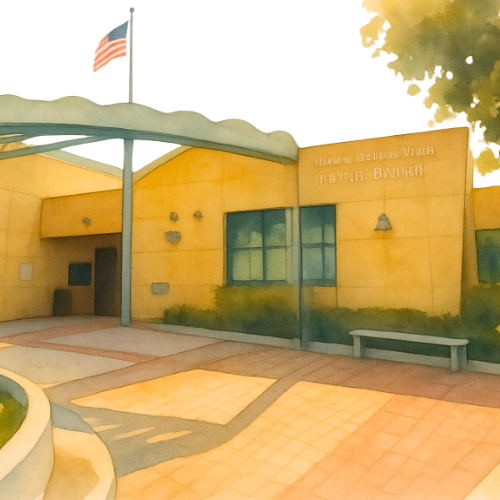
As an extreme heat warning stretches across Los Angeles, one of the most important pieces of the city’s emergency infrastructure is already sitting in nearly every neighborhood: the public library.
Libraries are commonly thought of as places to borrow books, use a computer or bring children for storytime. But as heat waves become longer and more dangerous, they are also serving as one of the last free, air-conditioned places where anyone can spend hours indoors without being expected to buy something.
A recent Next City article describes how libraries around the country are increasingly becoming formal cooling centers and informal daytime shelters. Some extend their hours during heat emergencies. Others distribute water and electrolytes, provide places to charge phones and medical equipment or make accommodations for people with pets.
Even when a library has not been formally activated as an emergency cooling center, people without air conditioning, including unhoused people and tenants living in older, poorly insulated apartments, use it to escape dangerous temperatures.
That matters this week. The National Weather Service has issued an extreme heat warning for most coastal areas of Los Angeles through 8 p.m. Friday, with temperatures between 92 and 102 degrees and unusually warm nights offering less relief. Los Angeles County warns that climate change is producing hotter and longer heat waves. Coastal and central Los Angeles are projected to experience three times as many days above 95 degrees.
The City says its more than 70 public library branches are available for cooling and shelter during their regular operating hours. Most Westside neighborhood branches are open from 10 a.m. to 8 p.m. on Mondays and Wednesdays, noon to 8 p.m. on Tuesdays and Thursdays and 9:30 a.m. to 5:30 p.m. on Fridays and Saturdays. They are closed on Sundays.
Those branches include the Mar Vista Branch Library at 12006 Venice Boulevard, the Venice Abbot Kinney Memorial Branch Library at 501 S. Venice Boulevard, the Palms Rancho Park Branch Library at 2920 Overland Avenue, the Playa Vista Branch Library at 6400 Playa Vista Drive, the Westchester Loyola Village Branch Library at 7114 W. Manchester Avenue, the Westwood Branch Library at 1246 Glendon Avenue and the Donald Bruce Kaufman Brentwood Branch Library at 11820 San Vicente Boulevard.
The West Los Angeles Regional Branch Library at 11360 Santa Monica Boulevard normally has longer weekday hours and is the only Westside branch regularly open on Sundays, from 1 to 5 p.m.
During the current heat emergency, the City has designated West LA Regional as an augmented cooling center and extended its hours to 10 a.m. to 9 p.m. through Friday, August 28. Current information is available through the City’s extreme heat page.
The County also maintains a live cooling center map. Listed centers generally have air conditioning, bathrooms, drinking water and ADA access. Residents can also call 311 within the City of Los Angeles or 211 anywhere in the county to find an open location.
Libraries are particularly useful as cooling spaces because people already know where they are. They are usually reachable by public transit and do not require visitors to buy a coffee, explain why they are there or demonstrate that they are experiencing an emergency. That makes them fundamentally different from the other air-conditioned spaces officials sometimes suggest, such as malls and movie theaters.
But there is an enormous gap between saying that libraries are available during the heat and adequately funding them as emergency infrastructure. Most Westside branches remain closed on Sundays. They close at 5:30 p.m. on Fridays and Saturdays, even though buildings and pavement continue releasing stored heat into the evening. On Tuesdays and Thursdays, most do not open until noon, two hours after the period when the County advises people to begin avoiding the sun.
As Next City reports, librarians around the country are increasingly being asked to perform disaster response work without dedicated funding, additional employees or sufficient training. Libraries cannot serve as reliable climate shelters based solely on the willingness of already stretched workers to take extra shifts.
If Los Angeles expects libraries to help keep people alive, the City should fund extended hours, adequate staffing, water, charging stations, emergency supplies and trained social service support at branches throughout the city. It should also make sure people seeking relief, including unhoused residents, are welcomed rather than treated as a security problem.
Cooling centers are necessary, but they are not a substitute for housing, tenant protections, safer working conditions, more trees or affordable access to air conditioning. They are an emergency response to a crisis produced by climate change and deepened by inequality. But on a dangerously hot day, the ability to walk into a nearby public building, sit down, drink water and cool off can be the difference between discomfort, serious illness and death.