
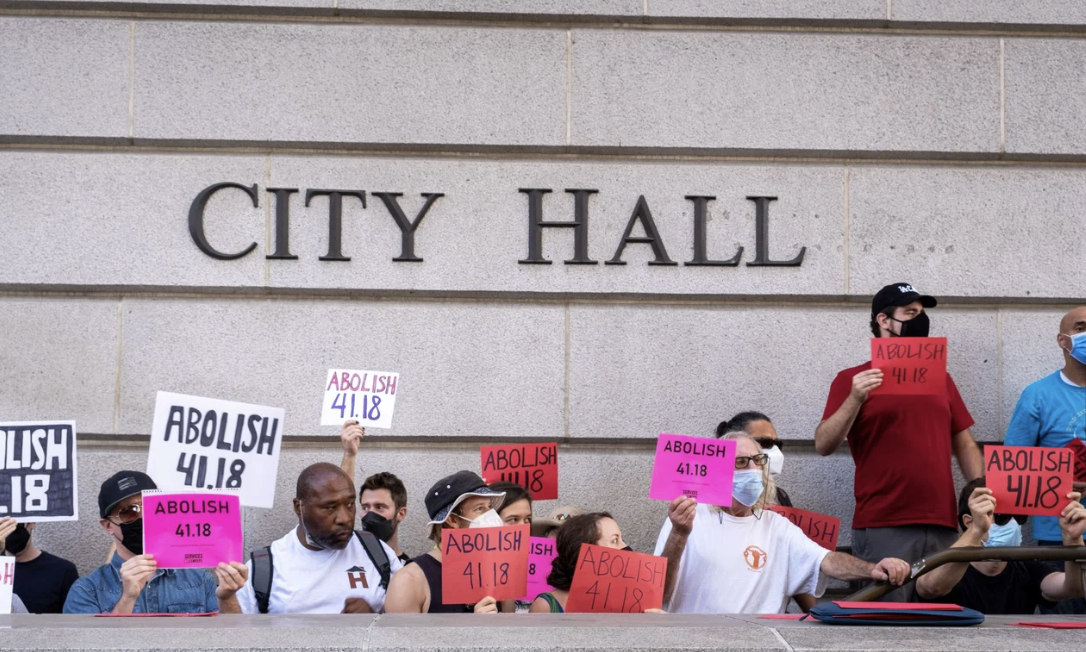
Los Angeles City Councilmembers John Lee and Monica Rodriguez are pushing to dramatically expand the city’s anti-camping law through a proposed 2026 ballot measure that would broaden enforcement around schools and parks while effectively banning camping citywide during daytime hours. The proposal, introduced May 1 as Council File 26-0652, would significantly expand LAMC 41.18 and place the question before voters just weeks before the June primary election.
The motion is framed around protecting children. It would expand encampment-free “buffer zones” around schools and daycare centers from 500 feet to 1,000 feet and create a “Safe School Passages Program” focused on enforcement along routes students use to travel to school. But critics argue the focus on schools functions as a political and emotional shoehorn for a far broader expansion of anti-homeless enforcement citywide. Embedded within the proposal is a much more sweeping policy change: aligning 41.18 with Section 56.11 to prohibit camping citywide between 6:00 a.m. and 9:00 p.m., effectively restricting visible homelessness across nearly the entire city for most waking hours.
Repeated emphasis on children obscures the fact that thousands of unhoused Angelenos are children themselves. According to figures cited in the motion analysis, roughly 3,000 to 3,500 children under 18 were counted as homeless across LA County on a single night in January 2024. Under the broader federal education definition used by school districts, Los Angeles Unified School District identified between 13,000 and 15,000 students experiencing homelessness in a single school year, while the countywide number exceeds 50,000 public school students annually. Children walking to school are invoked as justification for expanding enforcement, while unhoused children and families living in vehicles, shelters, motels, or encampments remain largely absent from the policy conversation itself.
The proposal arrives amid a broader political shift in how cities across the country are responding to visible homelessness. Over the last several years, Los Angeles has increasingly embraced a model centered on sweeps, exclusion zones, policing, and displacement rather than permanent housing production or long-term affordability measures. Advocates opposing the expansion argue that LAMC 41.18 does not solve homelessness so much as criminalize the realities of poverty in public space, prohibiting unhoused residents from sitting, sleeping, resting, or storing belongings across large portions of the city.
The debate intensified following the Supreme Court’s 2024 ruling in the City of Grants Pass v. Johnson decision, which opened the door for cities to criminalize sleeping outside even when adequate shelter is unavailable. Los Angeles officials have increasingly pointed to the ruling as justification for expanded enforcement. Housing advocates, however, argue that the decision accelerated a dangerous national trend toward punishment-based governance that treats homelessness primarily as a visibility problem rather than the result of a deepening housing and economic crisis.
That broader context is central to the fight over 41.18. Homelessness in Los Angeles exists alongside soaring rents, stagnant wages, medical debt, rising evictions, and widening wealth inequality. In this context, unhoused residents are not separate from the city’s broader economic reality but rather represent its sharpest edge. Millions of Angelenos live paycheck to paycheck, and many housed residents remain far closer to housing instability than public discourse often acknowledges.
The debate has become especially visible on the Westside, where Councilmember Traci Park has aggressively expanded 41.18 zones throughout Council District 11. According to remarks Park made to supporters at Rick Caruso’s home on May 4, she has implemented the ordinance around “every school on day one on the west side,” including areas near the Mar Vista Branch Library, Ballona Creek, and Dockweiler Beach. In the recording cited in the motion analysis, Park described 41.18 as central to her approach to homelessness enforcement in CD11.
Advocates opposing the expansion point to years of evidence showing that sweeps and exclusion zones do little to reduce homelessness itself. Instead, they argue, the policies repeatedly force unhoused residents from block to block while destroying what little stability people have. Sweeps routinely result in the loss of medications, identification documents, phones, tents, clothing, food, and other essential belongings needed to survive or secure housing and employment.
A January 2026 report by the CD11 Coalition for Human Rights, the Venice Justice Committee, and the UCLA Luskin Institute on Inequality and Democracy documented CARE+ operations in Venice and found that outreach workers were present on fewer than 40 percent of observed operation days. Fewer than 10 percent of surveyed unhoused residents said they had been offered any help accessing shelter or housing, while nearly 30 percent reported having belongings discarded during sweeps, including medications, identification documents, clothing, and work supplies.
Critics also argue that enforcement-heavy homelessness policy cannot be separated from Los Angeles’ broader history of racial exclusion and displacement. Black Angelenos remain dramatically overrepresented within the city’s unhoused population, a reality advocates tie to decades of redlining, segregation, overpolicing, disinvestment, and housing discrimination. Against this backdrop, contemporary language around “cleanliness,” “quality of life,” and “encampment resolution” echoes older patterns of exclusion under new terminology.
The growing use of sweeps and criminalization has also become intertwined with larger concerns about surveillance, policing, and the normalization of state violence. Some organizers have drawn connections between anti-homeless enforcement and broader systems of displacement, including aggressive immigration enforcement and ICE raids, arguing that both rely on treating vulnerable populations as problems to be managed or removed from public visibility. That logic of removal is only intensifying as the 2028 Olympics approach. With city leaders increasingly focused on presenting Los Angeles as a safe, orderly global city for tourism and investment, advocates fear the lead-up to the Games will accelerate sweeps and displacement operations throughout the city, reducing what is fundamentally a humanitarian crisis to a question of optics and public relations.