
A new public dashboard released Thursday by Los Angeles City Controller Kenneth Mejia is pulling back the curtain on one of the city’s most persistent but often hidden crises: the concentration of tenant complaints, housing code violations, harassment allegations, and illegal eviction cases tied to a relatively small number of rental properties across LA.
The new “Top 100 Problem Rental Properties” dashboard compiles more than a decade of public housing enforcement data into a searchable public tool that allows tenants, organizers, journalists, and policymakers to look up addresses across the city and see patterns of reported violations over time. The data covers the period from December 2013 through November 2025 and includes complaints connected to the city’s Rent Stabilization Ordinance (RSO), Just Cause Ordinance (JCO), and building code enforcement systems.
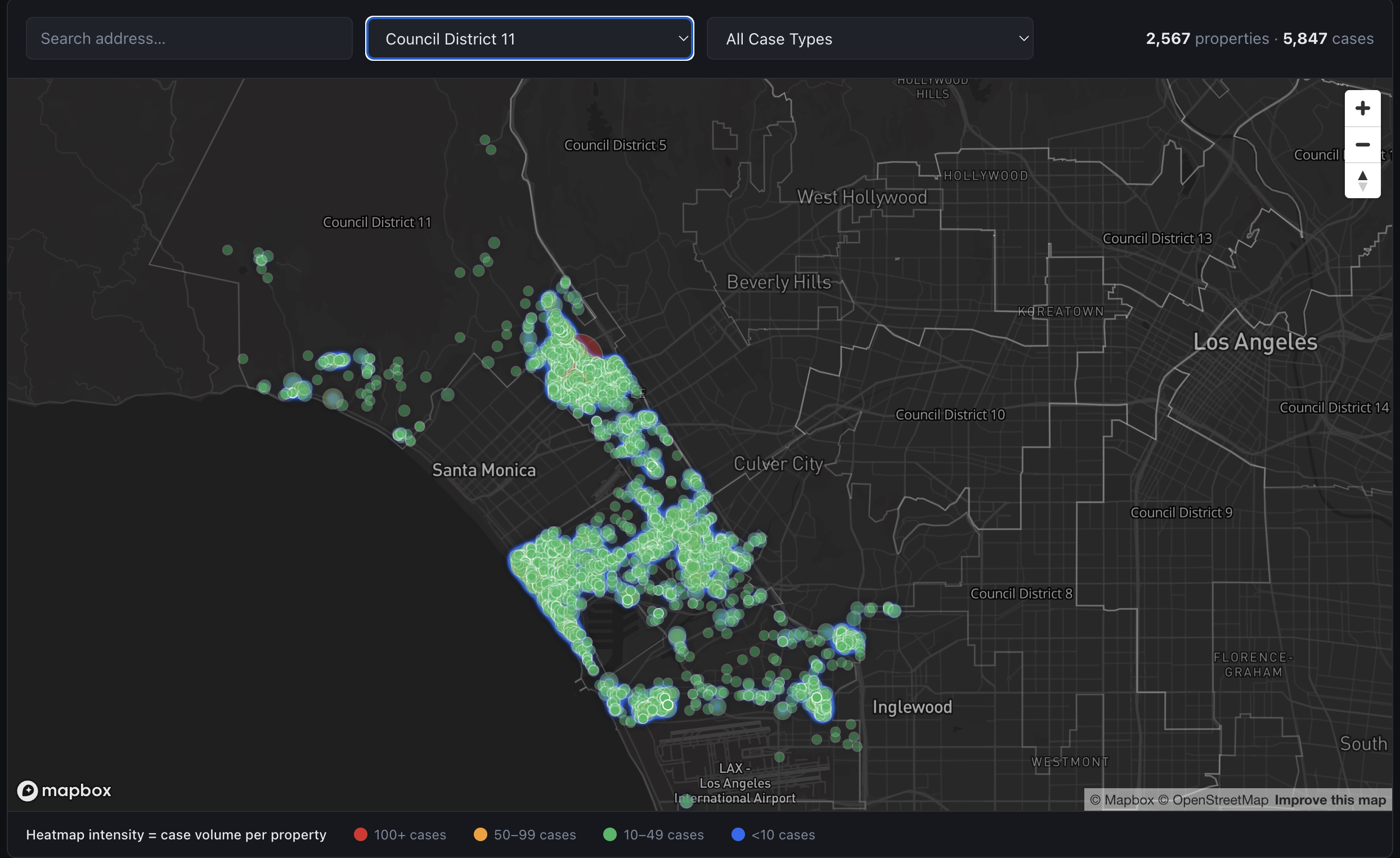
The result is a striking visual map of concentrated housing distress across Los Angeles, including large clusters throughout the Westside.
The dashboard shows 5,847 total cases tied to 2,567 properties in CD11 alone, underscoring the sheer scale of unresolved tenant complaints and code enforcement issues in one of the city’s wealthiest council districts.
While public conversation around housing on the Westside often centers around new development, homelessness, or neighborhood character fights, the dashboard highlights the condition and management of the housing that already exists.
According to the Controller’s Office, the most common categories citywide were illegal eviction complaints (55,018 cases), illegal rent increase complaints (37,876), reduction of services complaints (32,015), and harassment complaints (24,179). Those categories closely mirror what tenant organizers across Los Angeles have been warning about for years.
Many of the city’s housing battles are not simply about whether enough housing exists, but about whether tenants can remain stably housed in the homes they already occupy. Illegal evictions, neglected repairs, harassment campaigns, utility shutoffs, withheld services, and aggressive pressure tactics have increasingly become central features of the city’s housing politics, especially in neighborhoods where landlords see opportunities to raise rents or reposition older buildings for wealthier tenants.
The timing of the dashboard’s release is also politically significant. It arrives as some of Los Angeles’ most powerful real estate interests continue aggressively pushing to weaken tenant protections on multiple fronts, including ongoing efforts to gut Measure ULA and expand short-term rentals across the city.
That broader context helps explain why a public database documenting years of alleged landlord abuses matters beyond just individual buildings. For years, tenant advocates have argued that Los Angeles’ housing crisis is not simply the result of supply shortages, but also the product of speculative real estate practices that treat housing primarily as an investment vehicle rather than a human necessity. Illegal evictions, harassment complaints, rent gouging, neglected maintenance, and the conversion of long-term housing into tourist accommodations are all part of that ecosystem.
In that sense, the dashboard functions as more than just a transparency tool. It is also a snapshot of the real-world conditions tenants are experiencing at the very moment political leaders debate whether to further deregulate the housing market and weaken funding streams intended to keep people housed.
The Controller’s Office said one goal of the dashboard is to make those patterns easier to track publicly.
“There has never before been an uncomplicated way for anyone to look up years’ worth of violations by address,” Mejia said in a statement announcing the launch. “Our new dashboard is an easy-to-understand public tool that we hope will help renters and organizers document patterns of harm, as well as put pressure on both landlords and the City to act.”
Importantly, the dashboard also attempts to cut through the layers of LLCs and shell ownership structures that often obscure who actually owns troubled properties. According to the Controller’s Office, staff cross-referenced public records, assessor data, and corporate filings to trace LLC-owned buildings back to human owners whenever possible.
That ownership transparency could become particularly significant as Los Angeles continues debating stronger tenant protections, corporate landlord regulation, vacancy policies, and expanded enforcement authority for the Los Angeles Housing Department.
The release also arrives amid growing criticism that the city’s existing enforcement systems remain heavily complaint-driven and under-resourced, placing much of the burden on tenants themselves to document unsafe conditions and navigate slow bureaucratic processes. Tenant advocates have long argued that many violations never result in meaningful penalties or repairs, particularly for tenants who fear retaliation or eviction.
The dashboard’s methodology notes that all submitted complaints were included, regardless of whether they were ultimately verified, while “cleared” cases may include complaints that were either resolved or dismissed. Still, the volume and concentration of complaints paint a broader picture of systemic housing instability across large portions of the city.
On the Westside, the map reveals dense corridors of repeated complaints concentrated in older multifamily housing areas including Mar Vista, Palms, Del Rey, Venice, and Westchester. In many ways, the data serves as a counterweight to the common political narrative that Westside housing debates are primarily about preserving “quality of life” or neighborhood aesthetics. For many renters, the more immediate housing issue is basic habitability and whether landlords are maintaining buildings at all.
The dashboard may also intensify scrutiny on elected officials whose political coalitions are closely aligned with landlord interests and anti-housing homeowner groups even as tenant complaints continue mounting across their districts.
In CD11 especially, Councilmember Traci Park has built much of her political identity around fighting affordable housing projects and opposing broader tenant and pro-housing reforms, while far less public attention has gone toward enforcement against landlords accused of repeated violations in existing housing stock.
The contradiction becomes harder to ignore when viewed against the new dashboard data. While Westside housing politics often focus on blocking new apartments, preserving parking, or resisting neighborhood change, the dashboard highlights a different reality. There have been thousands of complaints tied to illegal evictions, harassment, rent increases, neglected repairs, and deteriorating living conditions in the housing that already exists.