
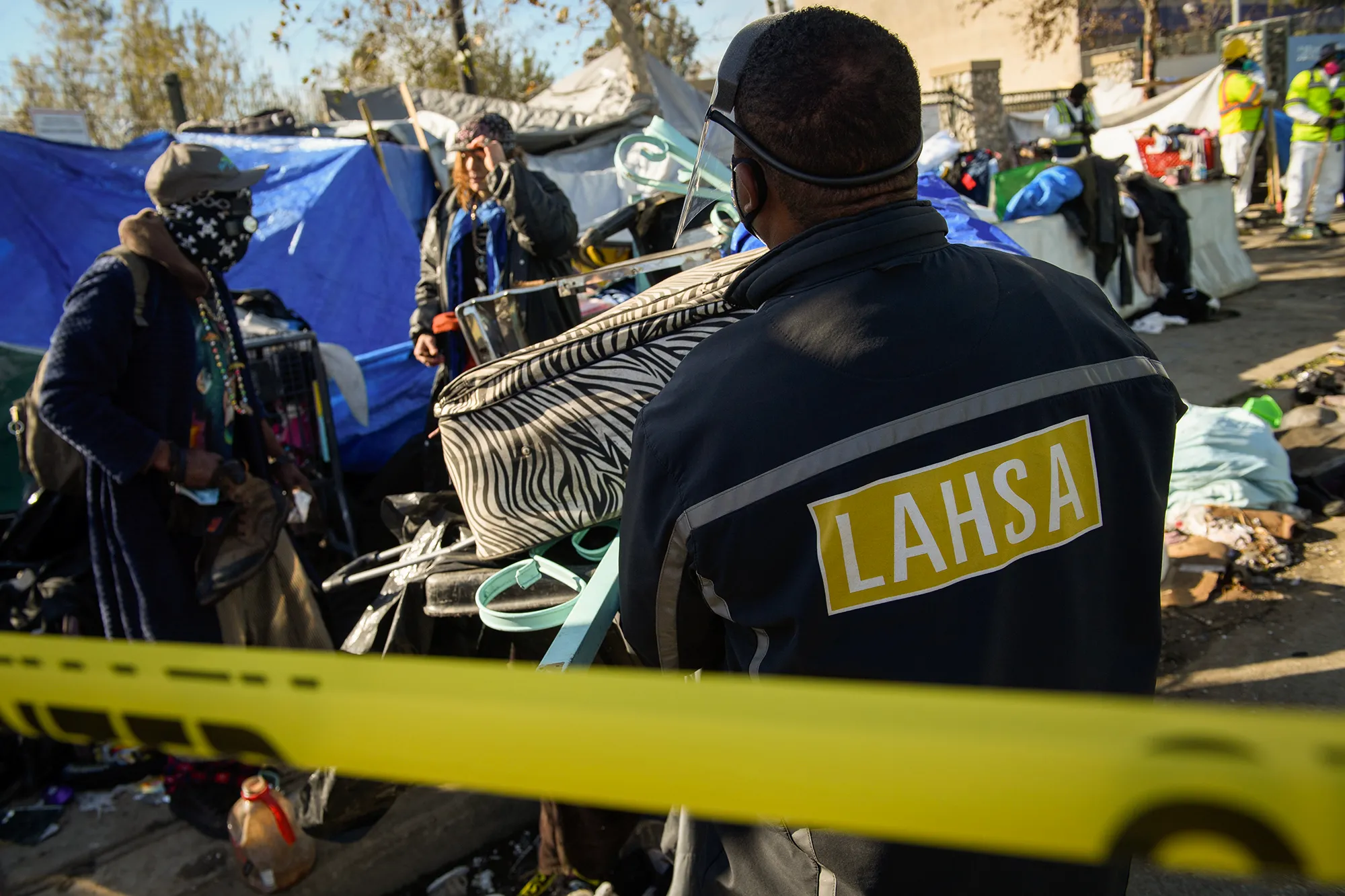
Los Angeles is facing a potential overhaul of how it runs homelessness programs as city leaders consider pulling hundreds of millions of dollars away from the Los Angeles Homeless Services Authority, the regional agency that has coordinated homelessness services for decades. The discussion comes amid mounting pressure on the agency after audits raised questions about oversight and LAHSA acknowledged it had fallen tens of millions of dollars behind on payments to nonprofit service providers. At the same time, the LA County Board of Supervisors has already begun moving more than $300 million in homelessness funding out of LAHSA and into a new county department, raising the possibility that the joint city-county structure that has governed homelessness services since the 1990s could begin to unravel.
The stakes are high. The City of Los Angeles currently sends roughly $300 million a year through LAHSA to fund outreach teams, shelters and housing programs. City officials are now weighing whether to keep using the agency, bring those programs under direct city control or shift them to the county’s new homelessness department. Karen Bass has warned that pulling away from LAHSA too quickly could disrupt services for people living on the streets, while Lindsey Horvath has argued that years of audits and management problems show the system needs to be fundamentally restructured.
That broader governance fight was on display locally at the recent Westside Regional Alliance of Councils debate for Los Angeles City Council District 11, where candidates were asked how the city should respond to the county’s decision to pull out of LAHSA. The exchange between challenger Faizah Malik and Councilmember Traci Park offered a snapshot of the competing ways local leaders are interpreting the agency’s crisis.
Malik framed the issue primarily as a breakdown in coordination between the city and county. Without defending LAHSA as an institution or arguing that the agency itself should remain unchanged, she focused on preserving cooperation between the two levels of government, arguing that the region’s homelessness response depends on that partnership. In her view, the county should continue providing services like mental health care and addiction treatment while the city focuses its spending on housing and shelter. Creating a new city homelessness department, she said, would simply add another layer of bureaucracy. Rather than abandoning the regional system entirely, Malik argued that Los Angeles should work to rebuild coordination with the county while continuing to rely on experienced outreach workers already doing the work.
Park took a far more confrontational approach toward the agency itself. “I’ve wanted a divorce from LAHSA since I was elected,” she said, arguing that years of spending have produced too little accountability or measurable results. Park also criticized what she described as an overemphasis on housing construction, arguing that addiction and mental health issues must be addressed through recovery-based housing and treatment programs.
Yet when moderators pressed her on what system should replace LAHSA if the city leaves the agency, Park’s answer ultimately returned to many of the same structural assumptions Malik described. The county, she said, would still have to provide the mental health and addiction services that unhoused residents need, while the city would focus on housing and shelter programs. Even if the city breaks with LAHSA, she acknowledged, Los Angeles will still need a cooperative relationship with the county to deliver those services.
In that sense, the debate highlighted a key tension in the current LAHSA fight. While rhetoric around the agency has grown increasingly sharp, the practical structure of homelessness services still depends heavily on coordination between the city and county. The county runs the region’s public health and mental health systems, while the city controls much of the funding for housing and shelter programs.
That interdependence is precisely what makes the future of LAHSA so complicated. If Los Angeles also withdraws its funding, the regional governance model that has managed homelessness programs for more than three decades could effectively collapse, but the basic division of responsibilities between the city and county is unlikely to change. For now, the City Council is continuing to debate its options, and any decision to move away from LAHSA would likely take months or even years to implement.