
In early 2025, Blaise was working at a Venice coffee shop when he struck up a conversation with a customer named Parks about what he was working on at the shop that day. Blaise had been reading The Alchemist, Paulo Coelho’s novel about following one’s personal destiny and it inspired him to start being more curious about the interests and thoughts of those around him.
That conversation gave both Blaise and Parks an idea. What if they started a book club? Soon after, Blaise, Parks, and their friend Marli organized their first gathering. Emily, Blaise’s girlfriend, joined and became an organizer. What began as a casual conversation between strangers at a coffee shop has now grown into the Venice Book Club, a community group bringing together Angelenos of all different ages, backgrounds, and political perspectives to talk about books, ideas, and just about everything else.
But the Venice Book Club isn’t all about reading. In fact, its motto is “It’s not about the book.”
“We’ve been trying to find rooms in LA where people can meet and interact over ideas,” Parks told Mar Vista Voice. “And I never found a room like that in LA, and so we decided to build one instead.”
Los Angeles has a reputation for being a tough place to make friends. Its sprawling geography, car-dependent neighborhoods, and transient population make it hard to foster meaningful connections outside of work or existing social circles. Emily, who grew up in LA, has a slightly different perspective. She doesn’t personally experience the city as isolating, but she recognizes that finding genuine connection as an adult can be hard anywhere you go.
“We all want to feel like we belong,” she explained. “Everybody deserves a place to go, where people know you, where you’re allowed to disagree.”
People might initially attend Venice Book Club events because they enjoy reading, but they keep coming back because they’ve found a place where they can be themselves and share their opinions. It’s a forum for exploring ideas without worrying about saying exactly the right thing.
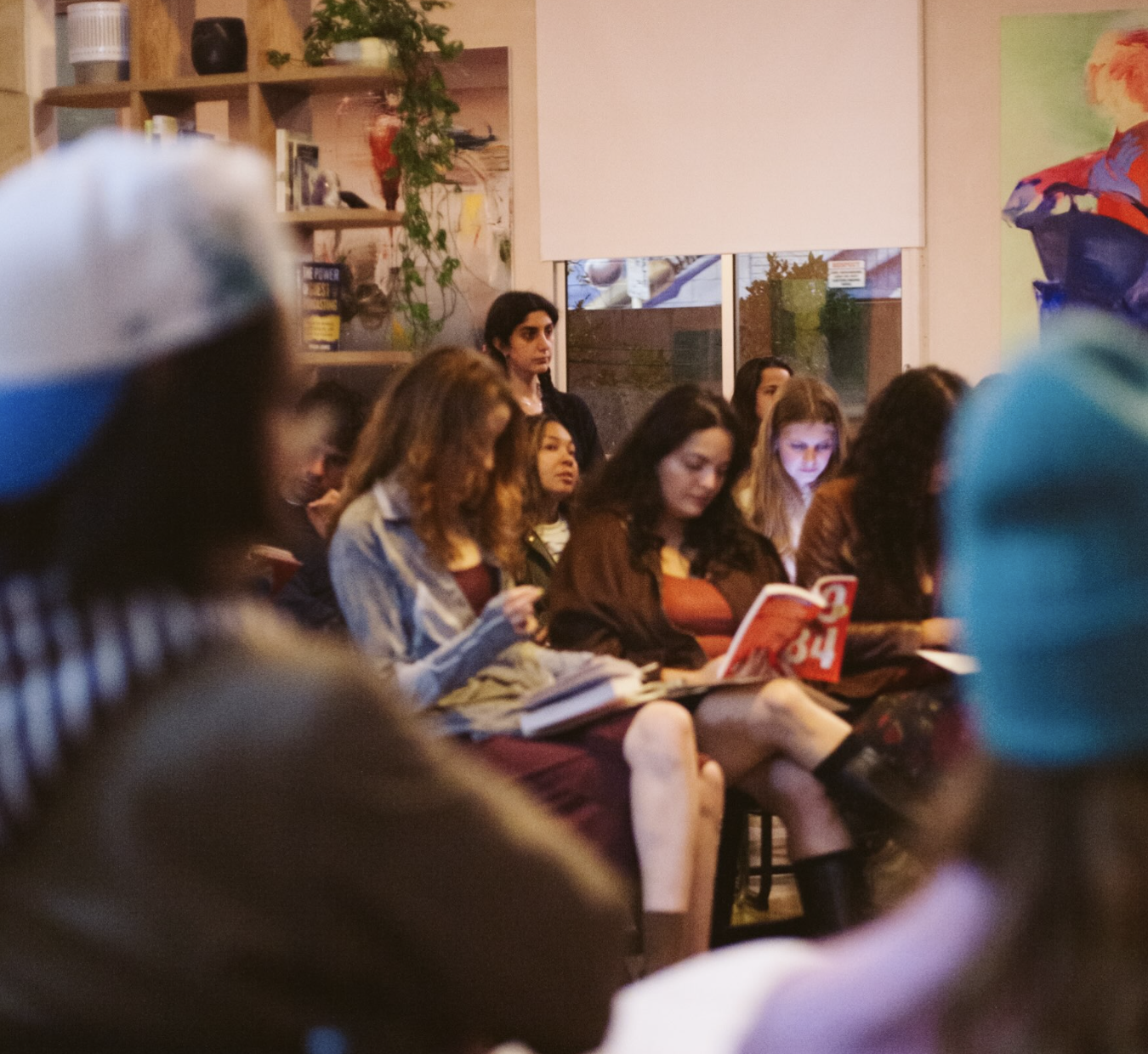
The club attracts an unusually broad mix of people. College students sit alongside retirees, and lifelong Angelenos meet recent transplants. Socialists and libertarians might even find themselves discussing the same passages of a novel. And you don’t even have to necessarily be a reader. Parks recalled speaking with a woman who wanted to attend a meeting, but admitted she didn’t really read the book being discussed. He encouraged her to come anyway. The point wasn’t to demonstrate literary sophistication, but just to participate and bring her unique perspective.
The club’s flagship event is the Circle, a facilitated group discussion centered on a book that participants read over three or four meetings. The group is currently reading George Orwell’s 1984, a dystopian novel that explores how authoritarian governments use surveillance, propaganda, and the manipulation of language to maintain power.
The conversations aren’t always comfortable, and that’s okay. The organizers want people to disagree and question one another’s assumptions. The expectation is simply that everyone treats one another with respect.
That approach stands in sharp contrast to the way much of our public discourse now takes place. On social media, people are rewarded for having the hottest take or the quickest comeback. Algorithms sort us into increasingly narrow information environments, while disagreement devolves into ridicule instead of curiosity.
Venice Book Club is trying to create the opposite experience. It’s okay to be wrong or to change your mind, and you can express a half-formed thought and work through it with other people.
The organizers describe their gatherings as a kind of modern salon or public square, drawing inspiration from the ancient tradition of people coming together in public spaces to exchange ideas.
And books are just one way to make that happen. Although the Circle remains the heart of Venice Book Club, the organizers have been experimenting with other ways to bring people together. There are Pop-Up Circles, where participants discuss a short story or essay rather than committing to an entire book. There are also After Hours gatherings at Saba Surf, where people can read quietly or socialize without an agenda.
They’re not alone in reimagining what a night out can look like. In September, a Tokyo nightclub went viral for hosting a “book rave,” where people gathered to read on the dance floor while DJs played ambient music. These events reflect a collectiving longing for social gatherings that don’t revolve around drinking or loud music.
Venice Book Club also organizes book exchanges and writing workshops, as well as Meet & Read gatherings where members help select the next book.
One of its more unusual experiments was a Voting Boot Camp, which VBC developed in partnership with LA Forward. The idea came from a member who suggested applying the club’s discussion-based approach to civic education, to help people study ballot measures in a nonpartisan, fact-based setting. The organizers wanted to give participants space to ask questions and arrive at their own conclusions instead of just telling people how to vote.
Emily calls the club itself an “experiment.” The organizers regularly try new formats, drawing inspiration from their members and ideas they encounter online. Some events stick, while others come and go.
Behind the scenes, the leadership team is building a sustained organizing effort, with meetings every Wednesday for roughly two and a half hours at SoCal Vibes to plan events and coordinate outreach.
Venice has always attracted artists, free thinkers, and people willing to challenge the status quo. The organizers see Venice Book Club as a continuation of that history, and also believe the Westside needs more accessible creative gathering spaces. There’s a tendency to associate LA’s creative communities with neighborhoods like Silver Lake and Echo Park, but the organizers reject the idea that the Westside lacks people who want to engage with art and big ideas. The organizers know those people are already here. They just need places to find one another.
Venice Book Club welcomes people with a range of political perspectives, and the organizers aren’t afraid of disagreement. In fact, they encourage it and want people to challenge each other’s assumptions and try to understand why someone might see the world differently.
One of the organizers’ favorite observations is that some members have been attending events for months without knowing what their new friends do for a living. Instead of the familiar LA introduction, “What do you do?”conversations go straight into questions about politics or personal beliefs. Members might know someone’s position on socialism before they know their job title.
The organizers have noticed a pattern at nearly every Circle. Newcomers arrive a little nervous, unsure of what to expect or whether they’ll have anything worthwhile to contribute. But as the conversation unfolds, people relax, start speaking more freely and realize they don’t have to impress anyone.
The organizers have no interest in turning the club into a networking opportunity or selling its members anything. Their goal is simply to create a space for people to engage with one another, without any expectation of what those encounters might produce.
There’s something rare about that, particularly in this city where so much of social life is organized around work, consumption, or self-promotion. Venice Book Club offers a place where conversation is an end in itself.
Emily laughs as she recalls how sometimes people will ask how her “little book club” is going, because maybe it looks like that is all it is on the outside, but she knows that to the members, its something much more significant. Its a place where people have found genuine friendships and a sense of belonging; both integral aspects of human life that we seem to be craving now more than ever.
Follow The Venice Book Club on Instagram, find them on TikTok and Substack at @thevenicebookclub, or email thevenicebookclub@gmail.com to learn about upcoming gatherings.