
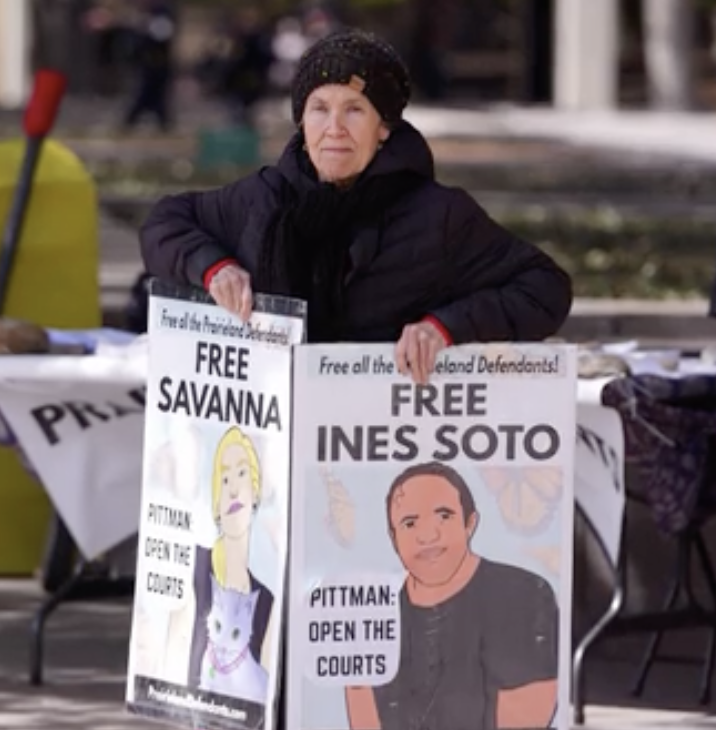
The federal government is increasingly treating protest itself as a form of terrorism. A series of recent cases show how Trump’s Department of Justice is pursuing aggressive charges against people protesting immigration enforcement, in some instances seeking terrorism enhancements typically reserved for acts of mass violence. At the center of this shift is a sweeping attempt to reframe dissent, particularly anti-ICE protests, as a national security threat.
One of the clearest examples is emerging from what has been called the Prairieland cases, where protesters accused of confronting or interfering with federal agents are being prosecuted under legal theories that go far beyond traditional protest-related charges. In these cases, prosecutors have argued that actions like blocking vehicles, clashing with agents, or organizing resistance to deportation operations can amount to “domestic terrorism,” a framing that carries enormous consequences, including longer sentences, harsher detention conditions, and a lasting stigma that reshapes how courts and the public understand political protest.
As broader reporting has documented, federal agents are often the ones initiating confrontations at protests, only for prosecutors to charge the people on the receiving end with crimes like assault on a federal officer. When those same incidents are then recast through the lens of terrorism, the stakes increase dramatically, turning what might once have been treated as a protest-related misdemeanor or low-level felony into something far more serious. The Prairieland prosecutions also reveal how elastic this terrorism label has become, with prosecutors pointing not just to conduct but to protest activity, ideological alignment, and in some cases loose associations with movements like “antifa” to justify enhanced charges. In some instances, even appearance has been folded into that logic, with black clothing or masks, common at demonstrations for anonymity and safety, cited as supposed evidence of coordinated extremism.
Civil liberties advocates warn that this approach collapses the line between protest and conspiracy, allowing the government to treat a group of people showing up to resist deportations as if they were an organized threat to national security, even when the underlying conduct resembles long-protected First Amendment activity. Labeling protest as terrorism expands the government’s toolkit, opening the door to broader surveillance, more aggressive pretrial detention, harsher sentencing, and a powerful narrative that delegitimizes protestors’ political claims.
This strategy builds on a long history. The criminalization of protest in the United States has repeatedly followed moments of mass mobilization, from civil rights to anti-war organizing to more recent uprisings. What feels different now is the scale and normalization of the terrorism frame, especially when applied to everyday acts like documenting enforcement activity, providing legal observation, or standing in solidarity with targeted communities.
And once that frame takes hold, it does not stay contained. You can already see the local version of this logic playing out in Los Angeles. Protests against immigration raids and broader federal policy have been met with heavy police response, widespread use of so-called less-lethal weapons, and ongoing fights over basic limits and accountability. City leaders have declined to impose stronger restrictions on tools like 40mm rounds and tear gas, the Los Angeles Police Department has missed reporting deadlines on its use of force, and the department has moved to weaken court-ordered protections for journalists ahead of major demonstrations. At the same time, student walkouts and community protests have been met with visible police escalation, raising questions about why dissent, especially from young people, is treated as a threat requiring force.
These dynamics operate in the same direction as federal terrorism prosecutions. When protest is met with overwhelming force, documentation is restricted, and accountability is weakened, it builds the foundation for a broader narrative that dissent is dangerous, disorderly, and in need of control. Federal prosecutors are now codifying this narrative into law through cases like Prairieland, and LA is already part of that shift.