
Flock & The Algorithmic Ecology
Most surveillance and policing technology is evaluated through a cost-benefit analysis – determining whether the privacy concerns outweigh the safety benefits. That is exactly the debate happening now around Flock and other automated license plate reader (ALPR) technology. We are grappling with how much information we are willing to allow the government to collect about our daily lives in exchange for the promise of keeping us “safe.”
Los Angeles recently let its partnership with Flock lapse in July amid growing concerns that the privacy risks were not worth the benefits. This is happening with many cities across the country as they cancel contracts after public pushback. While this can – and should – be seen as a win against expanding surveillance, the conversation cannot end there. If cities are willing to invest in this technology in the first place, we should be asking a more fundamental question: Why was our local government so eager to invest in this surveillance infrastructure to begin with?
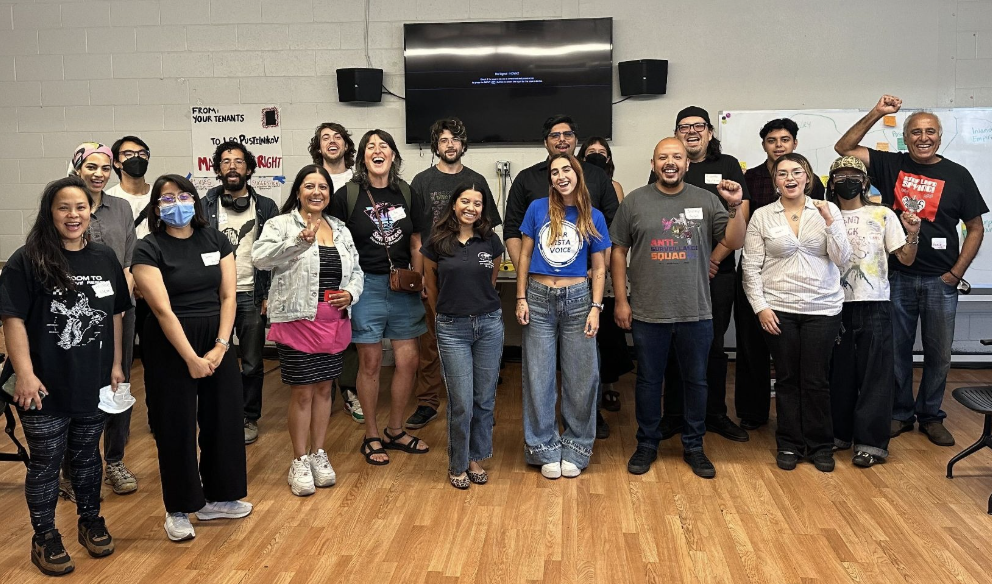
This question came into sharper focus for me after attending a recent convening on surveillance in Los Angeles hosted by the Stop LAPD Spying Coalition and MediaJustice. The convening brought together organizers, researchers, and community members to examine how surveillance operates beyond any single piece of technology. What stuck with me was the insistence that the fight against surveillance is not just about one camera, database, or contract. It is about understanding the systems of power that make surveillance seem necessary in the first place. Presenters coined this network, the algorithmic ecology.
It reminded me of theory I’ve read by Michel Foucault, who wrote extensively about the relationship between surveillance and power. Foucault’s concept of the Panopticon describes a system in which people can never be certain whether they are being watched, creating the possibility that they begin to regulate their own behavior simply because they know they could be observed. Surveillance, in this sense, is not only about catching people doing something wrong. It is a mechanism for shaping behavior – deciding what is considered normal, what is considered suspicious, and ultimately who is worthy of scrutiny.
Flock is not a literal Panopticon, but the framework is useful for understanding what makes this technology different from simply having more cameras on the street. An ALPR system can quietly collect information about where people go without requiring anyone to first be suspected of a crime. That information can then be stored, searched, shared, and interpreted later. The power comes not only from watching people, but from creating an infrastructure that makes it increasingly easy to watch, categorize, and act on information about them.
The “Undesirables”
American society has long been organized around distinctions between people who are seen as deserving of protection and people who are seen as threats. Some communities experience government primarily as a source of services and protection. Others experience it through policing, monitoring, punishment, and control. At this convening, Stop LAPD Spying organizer, Hamid Khan, emphasized this idea of the “undesirables” in society – those the State believes are dangerous and as a result must limit their access to freedom and resources in society.
This is part of what makes surveillance so powerful. The technology itself does not have to decide that someone is an “undesirable”. It simply creates the capacity to monitor everyone, while institutions decide whose information matters. And those categories can change.
The person who is considered a threat today may be different from the person considered a threat tomorrow. An immigrant. A protester. A sex worker. A person seeking reproductive healthcare. A young person in a heavily policed neighborhood. A political organizer. Someone experiencing homelessness. Someone who simply happens to be in the wrong place at the wrong time.
These possibilities are not merely hypothetical. The Trump administration has designated antifa a “domestic terrorist organization,” identified “anti-capitalism” as one of the ideologies it associates with political violence, and pursued visa revocations and deportations connected to pro-Palestinian campus activism. These examples demonstrate how quickly political beliefs and lawful advocacy can be recast as threats and used to justify surveillance and political repression.
And this is where the abolitionist framework becomes important. If surveillance is not simply a flawed technology, but part of a larger system that continually decides who is dangerous, who is deserving of protection, and who should be monitored and controlled, then the solution cannot be limited to reforming the technology itself. Better rules for surveillance may limit some of its harms, but they do not change the underlying logic that produces the “undesirable” in the first place.
Presenters at the convening repeatedly returned to abolition because it asks us to think beyond making these systems more equitable or less harmful. Abolition challenges us to question why we have built systems of surveillance and punishment as our primary response to social problems at all – and what it would look like to build safety through community care, resources, accountability, and collective power instead.
This does not mean these systems will disappear overnight. In fact, it is unlikely they will ever be fully replaced within our lifetimes. But that does not mean the work of building something different should not begin today.
Why Here, And Why Now?
Stop LAPD Spying organizers emphasized why the convening was held in Skid Row at LACAN intentionally in order to be rooted in a community that has historically been treated as a laboratory for new forms of policing and surveillance. They described their work as an effort to make Skid Row a laboratory for developing new ways to resist those systems.
Los Angeles also has something that many communities across the country facing these same technologies do not: an expansive network of community organizers, researchers, legal advocates, neighborhood groups, and mutual aid networks and neighborhood organizations like Mar Vista Voice with years of experience challenging systems of oppression, surveillance, and policing. As one MediaJustice representative emphasized, that power comes with a responsibility to lead this fight – to take on Big Tech at ground zero.
Flock will not be the last technology marketed as a solution to public safety. AI, facial recognition, predictive analytics, biometric databases, and other tools will continue to enter our communities. We must respond by continuing to ask ourselves who is benefiting, who is most at risk, and what institutions are contributing to the threat.
Throughout the event, organizers repeatedly described this fight as “not a moment in time, but a continuation of history.” It is tempting to think of surveillance technology as a uniquely modern problem. Yet the underlying impulse to monitor, categorize, predict, and control people is nothing new, especially in America. Recognizing that history also gives us reason for hope. We are not fighting for one solution to one technology. We are part of a much longer struggle – and we have the knowledge, relationships, and power to continue it.
Big Tech has organized money. Government has organized institutions. Our job is to organize people.