
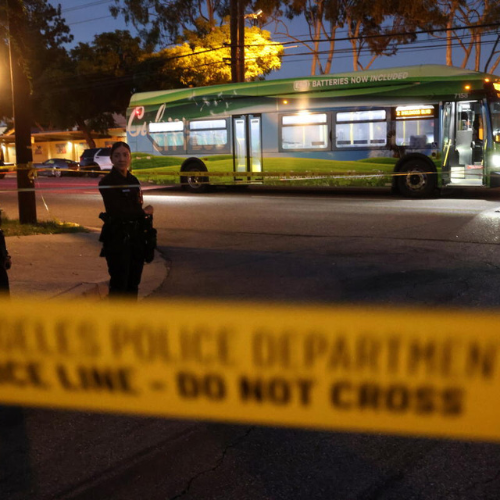
A Culver CityBus operator was shot and killed by a passenger Thursday evening near the intersection of Centinela and Mitchell avenues in Mar Vista, according to the Los Angeles Police Department.
The shooting occurred shortly after 5 p.m. during a dispute between the driver and a passenger aboard the bus. The driver, a man in his 40s, was taken to a hospital, where he died. Police had not released his name as of late Thursday.
Police said the suspect got off the bus, removed his bicycle from the rack at the front of the vehicle, and fled before officers arrived. He was last seen wearing a white shirt. One person was detained, but police said it was unclear whether that person was involved. Witnesses told the Santa Monica Daily Press they heard gunshots and saw passengers running from the bus as firefighters treated the driver.
Police have not said what prompted the confrontation, and the investigation is ongoing.
Culver City Mayor Freddy Puza announced that Culver CityBus service would be suspended through the weekend so the city could honor the operator. “Behind every city service are people who care deeply about this community,” Puza said in a statement, adding that the loss would be felt across the city organization.
The suspension, announced within hours of the shooting, applies to every Culver CityBus route, including the downtown circulator that operates entirely within Culver City. It is unclear whether Puza consulted the union representing the operators before announcing the shutdown, and the city has not said whether operators will be paid for canceled shifts or what alternatives are available to riders.
Culver CityBus, founded in 1928, is the second oldest municipal bus line in California and carries about 11,000 riders on an average weekday.
Assaults on bus operators have risen sharply in recent years. A 2024 report to the LA City Council, citing Federal Transit Administration data, found that major assaults on bus drivers nationwide more than doubled between 2008 and 2022, from 136 to 318 a year. Reported physical assaults on LADOT buses nearly tripled from 2022 to 2023, with drivers the target in more than half. An NBC4 review of three years of internal Metro reports found that operators were assaulted an average of 11 times a month.
The city report attributed many of these incidents to housing insecurity, substance use, mental health crises, and disputes over fare payment. Nationally, fare disputes are the most common cause of assaults on bus operators. A Federal Transit Administration analysis of national transit safety data found fare disputes behind 44 percent of operator assaults, followed by disputes over other rules at 18 percent and escalating arguments at 12 percent. A national transit research synthesis likewise identified fare enforcement as a leading factor. Metro has found the same pattern locally. Its own 2017 crime statistics report stated that most assaults on its bus operators were fare related. Police have not said whether fare played a role in Thursday’s shooting.
Transit worker advocates have cited these findings in pushing to remove fare collection from drivers’ duties. The union representing Metro bus operators has called for fare payment to be made cashless and taken out of operators’ hands. When New York’s MTA ran fare-free service on five bus lines in 2023 and 2024, operator assaults on those routes fell 38.9 percent.
Los Angeles agencies have largely responded to operator assaults by expanding law enforcement on transit. Operators have also called for enclosed barriers and more security staff riding buses. After the 2024 report, LADOT moved to add supervisors on its highest-risk DASH routes.
The suspect remains at large. Anyone with information is asked to contact the Los Angeles Police Department. Culver CityBus riders should plan to use Big Blue Bus or Metro service until the system resumes operation.