
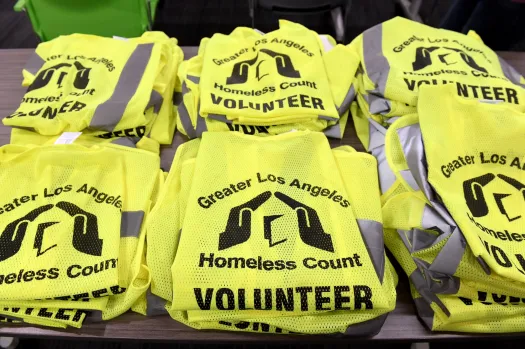
The 2026 Greater Los Angeles Homeless Count is underway this week, with thousands of volunteers deployed across the city and county over three nights to tally people living outdoors, in vehicles, and in shelters. Conducted by LAHSA and required by the federal government, the annual Point-in-Time count is presented as the authoritative snapshot of homelessness in the region and is used to guide major funding and policy decisions.
But as the count unfolds, confidence in the numbers is undercut by the fact that enforcement and displacement continue. The PIT count is already a fragile instrument. It attempts to measure a highly mobile and often hidden population during a narrow window in January. Even under ideal conditions, researchers and advocates have long warned that it undercounts people experiencing homelessness. When sweeps, vehicle enforcement, and police-led clearances continue during or immediately before the count, the results become even less reliable.
Federal guidance acknowledges this risk. In its Point-in-Time methodology materials, the U.S. Department of Housing and Urban Development warns that law enforcement involvement can scare people away and distort results if it is not strictly limited to volunteer safety and logistical support. HUD instructs Continuums of Care to make clear that officers involved in the count are not there to take enforcement actions. While this guidance is framed around the night of the count itself, the logic is clear. If visible enforcement deters participation during the count, then enforcement activity in the days leading up to it does the same by displacing people from their usual locations or pushing them further out of sight.
Despite that guidance and repeated warnings from advocates, enforcement activity continues during the count period in Los Angeles.
This problem is especially pronounced in council districts that lead with enforcement, like Traci Park’s Council District 11. In CD11, homelessness policy has increasingly centered on police-led enforcement, encampment clearances, vehicle restrictions, and the steady expansion of exclusion zones aimed at reducing visible homelessness. These tactics do not resolve homelessness. They displace people, pushing them into less visible areas or out of the district altogether. When enforcement is the dominant strategy, the Point-in-Time count is not measuring the true scale of homelessness so much as the effectiveness of making it harder to see.
Independent research suggests just how much this matters. A recent longitudinal study by RAND, which tracked unsheltered homelessness through repeated, professional enumerations in areas including Venice, found that LA’s official count has been missing roughly a third of people experiencing homelessness. While LAHSA’s volunteer counts aligned more closely with RAND’s findings in earlier years, the gap widened dramatically by 2024 and 2025, with the official count underestimating unsheltered homelessness by more than 30 percent. RAND researchers linked this divergence to changes in how homelessness appears on the street, with fewer large encampments and more people sleeping in less visible conditions, a pattern consistent with intensified enforcement and displacement.
That distinction matters because the PIT count does not just describe homelessness. It shapes how resources are distributed. Federal funding, state allocations, and local dollars tied to homelessness response rely on these numbers. When enforcement suppresses visibility rather than need, neighborhoods can appear to have made progress on paper while the underlying crisis remains unchanged. An undercount can translate directly into fewer resources for outreach, healthcare, shelter, and housing, even as people continue to cycle through displacement.
LAHSA has emphasized improvements in volunteer training and data collection this year, and those changes may improve consistency at the margins. But no amount of methodological refinement can fully compensate for policies that actively interfere with who is present to be counted. A snapshot taken while people are being pushed out of sight is not a neutral measurement of homelessness – it’s just a reflection of enforcement priorities.