
What does it mean when a City Councilmember bypasses the graffiti abatement process by spray painting over political speech under pressure from locals? That’s what just happened in Brentwood, when a patch of graffiti about the Gaza genocide triggered a very specific kind of political panic.
Earlier this month, residents contacted KTLA to complain about what they described as “hate speech” painted on their neighborhood street. But the stencil was not random vandalism. It was political speech. The message referenced the killing of Hind Rajab, a young Palestinian girl killed in Gaza, alongside condemnations of Zionism and Israel’s assault on Palestinians. The text was confrontational and morally charged, forcing anyone who passed by to reckon with a real child’s death.
According to KTLA, neighbors said they had repeatedly contacted Councilmember Traci Park’s office demanding the graffiti be removed. One resident told the station they were frustrated the city “had done nothing,” adding that the message made them feel unsafe. Another emphasized that Park had been alerted days earlier and that no city crew had shown up.
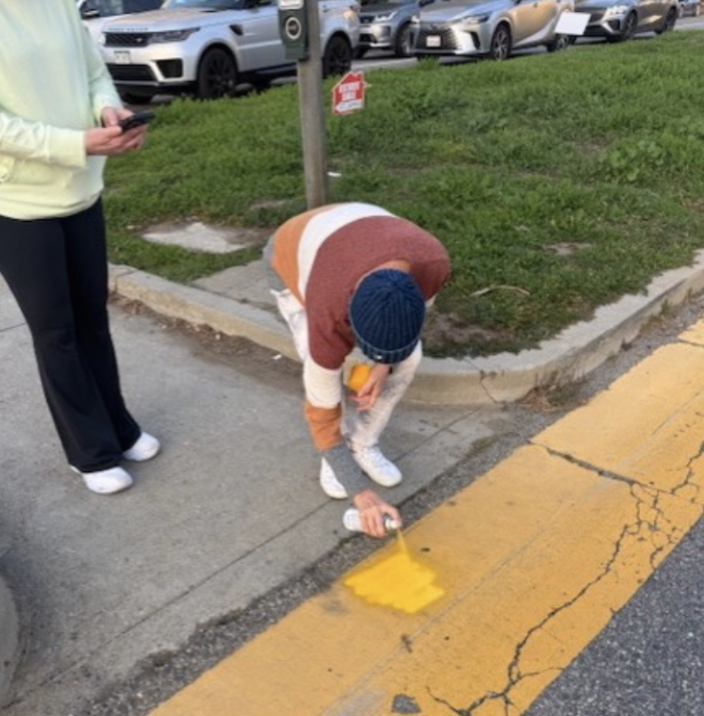
Then Traci Park arrived herself with a can of spray paint.
KTLA reported that Park personally painted over the stencil, noting that she “wasn’t waiting for street maintenance to get there.” In a statement to the station, Park framed her action as responding directly to constituents’ concerns, saying she wanted the message gone immediately.
That decision raises more than procedural questions. It raises a First Amendment problem.
Los Angeles has a formal process for graffiti removal. Requests go through MyLA311 and are handled by Street Services or the Office of Community Beautification. The system is designed to be content neutral: graffiti is removed because it is unauthorized, not because of what it says. That neutrality matters in a city that processes hundreds of thousands of graffiti removal requests each year, often more than 25,000 to 30,000 in a single month. The city relies on standardized, content-blind enforcement precisely so political pressure does not determine what gets erased first.
This was not graffiti threatening a specific household or containing obscenity. It was political speech in a public place, condemning state violence and naming a dead child. The urgency to remove it flowed directly from discomfort with the message itself.
What connects this moment to Park’s broader approach is not safety, but political convenience.
Would this have happened if the message aligned with Park’s politics? Across LA, residents routinely engage in vigilante actions against unhoused people – they blare loud music all night, spread manure where people sleep, and install boulders, planters, and other forms of hostile architecture to push people out of public space. These actions almost always remain untouched. Park does not personally intervene to remove hostile architecture or stop harassment of unhoused residents, even though those acts impose real, physical harm.
Those choices are not accidental. In one case, visible poverty is treated as politically inconvenient, and vigilante behavior that removes it from sight is tolerated for the comfort of housed constituents. In the other, political speech is treated as politically inconvenient, and a councilmember steps outside neutral city processes to erase it herself.
In both cases, the outcome is the same. What makes powerful supporters uncomfortable is removed from public view, whether that discomfort comes from seeing poverty or from confronting political speech that challenges their worldview.
Under the First Amendment, the government cannot selectively suppress political speech in public space based on viewpoint. Cities may regulate graffiti as vandalism, but only if enforcement is applied uniformly and without regard to content. That is why graffiti abatement is supposed to operate through standardized systems, not personal intervention by elected officials responding to political pressure. If the stencil qualified for removal, it should have gone through 311 like every other request in a city handling tens of thousands each month. If it did not, then a political message was erased anyway. Either way, the safeguards meant to prevent viewpoint discrimination were bypassed.
The graffiti Park erased referenced the killing of a child named Hind Rajab. The discomfort it caused was not incidental, but the very substance of the speech. Painting over it did not improve safety or resolve harm, but simply removed a politically inconvenient message from view in one of the city’s wealthiest neighborhoods.
When elected officials erase dissenting speech while allowing vigilante acts that punish visible poverty to persist, it stops being about cleanup. It becomes a question of whose discomfort matters, whose voices are tolerated, and whose presence in public space is deemed unacceptable.
If you want to learn more about the child whose name appeared in the graffiti, Hind Rajab, her story is being told in The Voice of Hind Rajab, a film documenting her life and the circumstances of her death in Gaza. The film is currently showing at the Laemmle Theatre.