
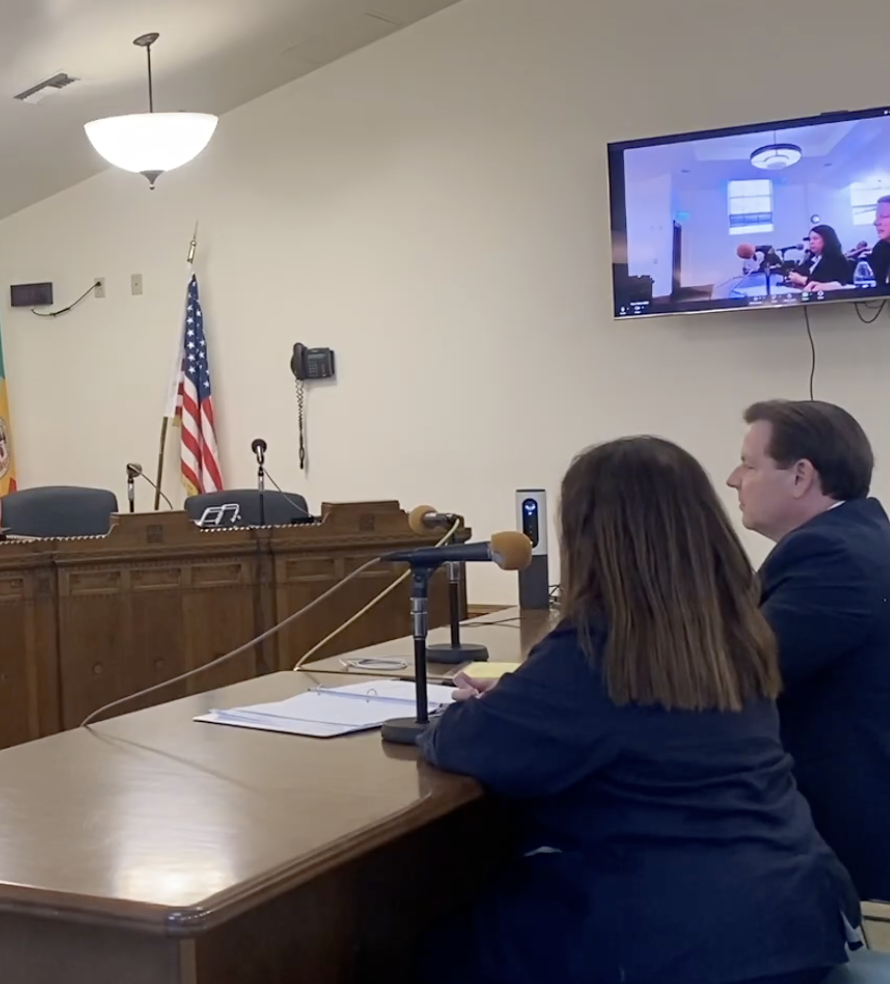
At Thursday’s Charter Reform Commission meeting, commissioners pressed City Attorney Hydee Feldstein Soto about the politicization of her office, citing her controversial role in the Venice Dell affordable housing project, a case that has already drawn lawsuits and public backlash for stalling construction in one of the Westside’s wealthiest neighborhoods.
Nonprofit developers sued the City last year after Feldstein Soto’s office refused to finalize key agreements, effectively blocking the long-approved 140-unit project despite City Council and Mayoral approval. The suit alleged the City Attorney had subverted the democratic process by treating a political dispute as a legal one, keeping affordable housing from moving forward in an exclusionary neighborhood.
That background set the stage for Thursday’s questioning. One commissioner noted the growing perception that the City Attorney’s Office is overstepping its role, playing a policy-shaping role rather than strictly serving as legal counsel. Feldstein Soto called the accusation “utterly false,” but her response quickly turned into a defense of her actions on Venice Dell and an attack on the project itself.
“There are currently, I think, five litigation matters pending on that project,” she said. “So the truth will come out.”
The phrasing implied that something hidden or improper might emerge from the lawsuits, even though her own office represents the City in those cases. Coming from Los Angeles’s top lawyer, the comment sounded less like a statement of caution and more like a suggestion of wrongdoing.
She then went further, declaring, “There isn’t the Venice Dell project. It was rejected by the Department of Transportation, and at this point it would cost something like $135 million, about $1.4 million per unit for a 400-square-foot studio.”
In reality, the Department of Transportation never rejected the project; it issued routine traffic comments. The project remains fully entitled and legally approved. Her characterization was not just inaccurate but politically charged, reinforcing the same narrative used by neighborhood groups who claim affordable housing doesn’t belong in high-cost coastal areas.
What made her remarks even more striking was how sharply they contradicted the principles she had laid out minutes earlier in the same meeting. Feldstein Soto spent much of her prepared testimony explaining that the City Attorney’s sole client is “the City of Los Angeles,” not any individual department or elected official. She praised her staff as “hard-working public servants” whose loyalty is to the municipal corporation itself and invoked what she called the “rule of eight” — the idea that whatever eight City Council members and the Mayor decide becomes the City’s position, and therefore the legal directive her office must uphold.
Feldstein Soto told commissioners that “the ultimate client for the City of Los Angeles is anything that eight members of the City Council plus the Mayor can agree upon,” adding that she tries “to stay in the lane of city attorney” and “not become a sixteenth member of City Council.”
Yet moments later she openly disputed the Council and Mayor’s approved policy, the Venice Dell project, describing it as a fiscal mistake and implying it should not be built. In doing so, she directly undermined her own stated commitment to represent the collective will of the City. By invoking secrecy (“I have to be cautious”) and hinting that “the truth will come out,” Feldstein Soto reinforced an image of herself as an insider exposing hidden wrongs but without offering evidence. The effect was to cast suspicion on a public housing project meant to serve seniors, unhoused residents, and low-income workers in Venice, one of the most exclusionary neighborhoods in Los Angeles.
That framing does tangible harm. It undermines public confidence in the City’s housing programs and bolsters the arguments of organized homeowner groups that have fought the project for years. It also raises deeper ethical questions about how the City Attorney can suggest wrongdoing in a case her office is litigating while claiming to merely follow the “rule of eight.”