
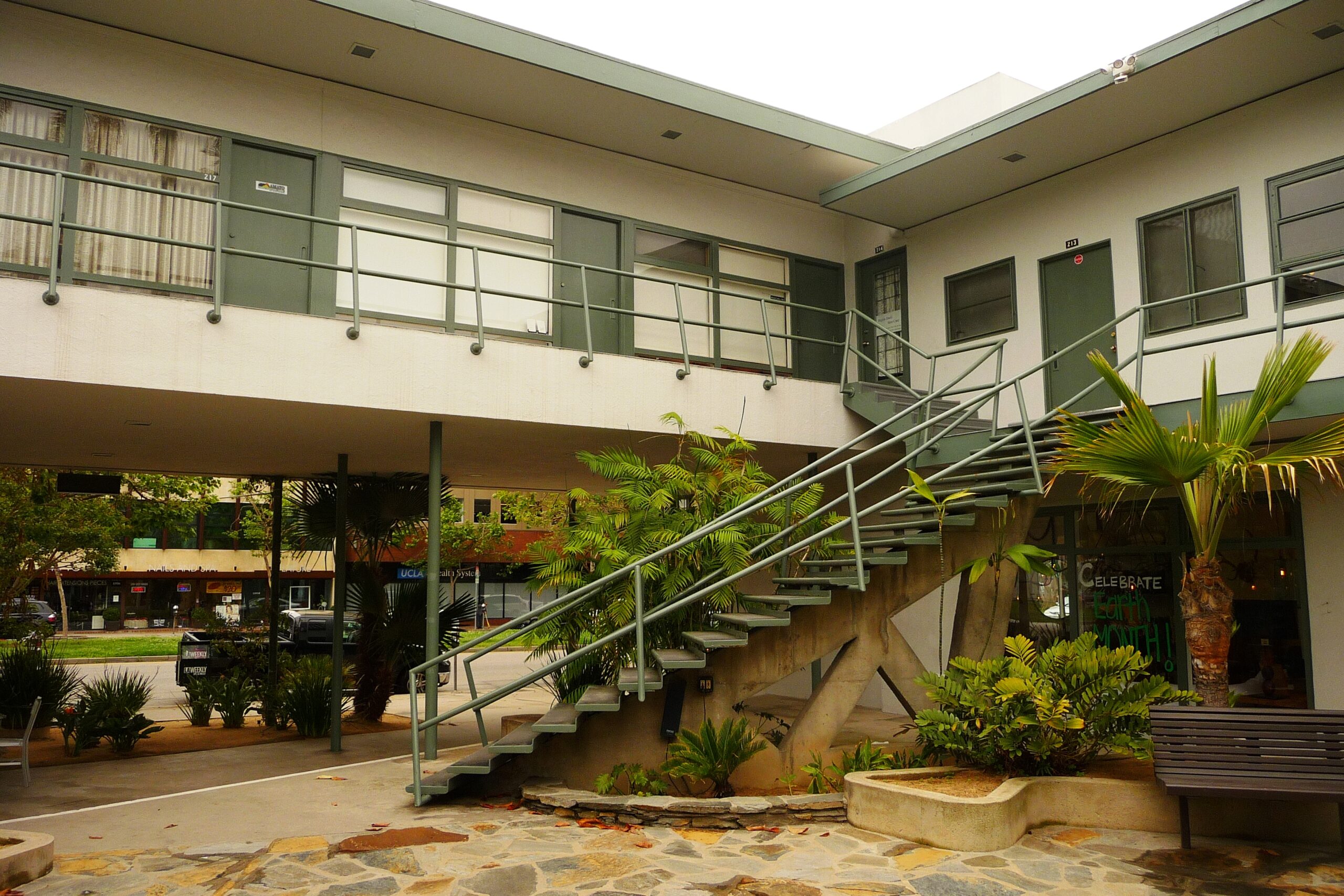
On Tuesday, the Planning and Land Use Management Committee voted to deny a community appeal of the proposed demolition of the Barry Building, a Brentwood historic landmark. City Council has until April 22nd to act. If they uphold the PLUM denial, this will be the first time in its history that LA will demolish a designated landmark to make way for nothing.
The Barry Building at 11973-11975 West San Vicente Boulevard is a 1951 mid-century modern commercial building designed by architect Milton Caughey, designated Historic-Cultural Monument No. 887 in 2007. For 24 years it was home to Dutton’s Brentwood Bookstore, where Kurt Vonnegut, Isabel Allende, Alice Walker, and Margaret Atwood held readings. The building has been vacant, fenced, and unmaintained since 2016.
The owner is 11973 San Vicente LLC, controlled by William Harold Borthwick, the stepson of the late Charlie Munger of Berkshire Hathaway. It just so happens that Borthwick also controls two adjacent parcels, both of which are already cleared and sitting empty. With three contiguous parcels sitting on one of the most valuable commercial corridors on the Westside, the only thing standing between Borthwick and a development-ready block is the Barry Building.
On the demolition permit application, the owner stated under penalty of perjury that there were no plans for a larger development project. Advocates argue this is simply a mechanism to sidestep the environmental review, public hearings, and community input that a replacement development would have required. Framed as a standalone demolition, the project could be routed through the Board of Building and Safety Commissioners rather than the standard planning process.
At the November 2025 hearing where demolition was first approved, the family’s attorney Ed Casey dropped the pretense, telling the BBSC that the Munger family simply wants to tear down the building and sell the property. The city accepted the sworn statement anyway, without requiring any analysis of what the fully assembled and cleared site would sell for on the open market. The city then contradicted itself, citing future housing benefits as a public justification for the demolition.
According to the LA Conservancy, only about a half dozen of the city’s more than 1,300 designated landmarks have ever been demolished, and every one of those was to make way for a new development. The Barry Building would be the first demolished with no project and no public review of what comes next. The Los Angeles Cultural Heritage Commission voted unanimously against demolition, but the Department of Building and Safety overrode that recommendation, and the BBSC voted 3-0 to approve the permit on November 18, 2025 (Brentwood News LA).
The case for demolition rests on the building’s condition, with the owner arguing that the property is too far gone, too expensive to fix, and a hazard to the neighborhood. Preservation advocates say the owner is creating that condition on purpose, a strategy called demolition by neglect. The logic of demolition by neglect is straightforward. A landmark designation blocks demolition, but it cannot force an owner to maintain a building. Let it deteriorate long enough and neighbors start demanding the bulldozers.
In 2016, the city cited the building under the Soft Story Retrofit Ordinance for seismic compliance, and the owner responded by clearing out the remaining tenants and allowing the building to fall into disrepair. The building was left alone and windows went unsecured through years of heavy rain, letting water rot the interior. The facade peeled and break-ins piled up, along with police and fire calls that the owner’s consultants would later cite as evidence the building was a public hazard. At the November BBSC hearing, several Brentwood residents spoke in favor of demolition, describing the building as a blight and a fire risk. The city, faced with a blighted property and a hardship claim, becomes the instrument of removal.
The Barry building demolition is further complicated by the land’s history. The site is located on Kuruvungna, a Gabrieleno sacred village that predates the City of Los Angeles by thousands of years. Under California’s Assembly Bill 52, the city was required to conduct meaningful consultation with the Gabrieleno Band of Mission Indians, Kizh Nation, before certifying the review. Instead, in 2022 the city told the tribe it was closing consultation and concluded no tribal cultural resources had been found on the site. The tribe wrote back saying it could not close consultation and asked the city to explain its findings, but the city never responded. Records show no further communication after August 2022, and internal consultation records were withheld under attorney-client privilege.
The appeal itself had a troubled path through City Hall. On February 24, with committee member Nazarian already absent from the dais, Blumenfield and Raman were caught on citizen video in a private conversation while an Indigenous advocate testified about the AB 52 violations, leaving the committee without a legal quorum. On March 4, the full council voted to deny the appeal on the consent calendar with no debate, then reversed itself hours later when Council President Marqueece Harris-Dawson and Traci Park moved to reconsider, apparently recognizing that a vote based on an illegal, quorum-less hearing would not survive a court challenge.
On March 6, Blumenfield referred the matter back to PLUM on advice from the city attorney. That same day, the statutory deadline for the council to act expired. The property owner did not consent to extend the council’s deadline until April 13, the day before the PLUM hearing. Angelenos for Historic Preservation, which filed the appeal, argues the retroactive extension was not legally valid, that City Council lost jurisdiction on March 6, and that the April 14 PLUM hearing had no legal foundation. The group says it is heading to court.
Assuming PLUM’s Tuesday decision to deny the appeal was in fact valid, City Council must act by April 22. Public comment on Council File 25-1518 can be submitted here.