
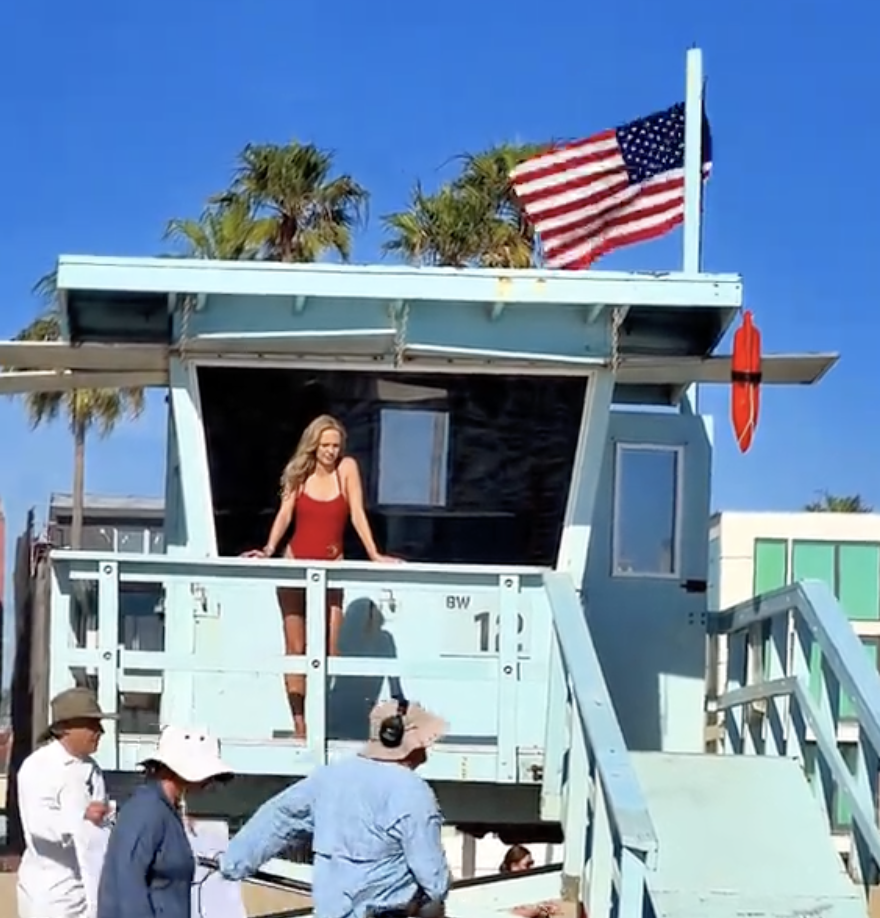
The Baywatch reboot is struggling to film in Venice. After three days of beach shooting, the production was told it was not welcome back at its primary location and has been regrouping while the crew scouts alternatives. Film industry workers have responded with accounts describing city obstruction, and at least one mayoral candidate has used the situation to pitch a deregulation platform. But a review of the permit that authorized the production raises harder questions than those accounts acknowledge, and some of them do not have clean answers yet.
The Permit and Its Conditions
Baywatch’s use of Venice Beach and its surrounding parking lots was governed by Coastal Development Permit No. 5-26-0015, approved by the California Coastal Commission on February 6, 2026. The permit was the result of a public process that included written opposition, input from the Sierra Club and the Surfrider Foundation, and two rounds of addenda issued February 4 and February 5, just one and two days before the final hearing. Commission staff inserted conditions more restrictive than what the applicant proposed. The production’s agent, McCabe and Company, participated throughout. Under Standard Condition 1 of the CDP, Baywatch, Inc. was required to sign and return an acknowledgment of the permit’s terms before development could commence.
Under the permit, Baywatch was authorized to occupy all 177 spaces in LADOT Lot 731 on beach filming days between 4:00 a.m. and 8:00 p.m. on weekdays only, across approximately 30 filming days between March 2 and July 16. The production could also use 21 public parking spaces and six red-curbed spaces in the Venice Beach Parking Lot during those same windows. Beyond those locations, the permit is unambiguous: “No other exclusive use of public parking is authorized in the coastal zone.”
The Commission also required that Lot 701, the overflow lot at 2150 Dell Avenue, remain open to the public during the same hours Lot 731 was in use, with directional signage posted on North and South Venice Boulevard. The production was required to submit evidence to the Commission’s Executive Director within 24 hours after each filming day demonstrating that Lot 701 was open.
Production Began Before Coastal Permit Was Approved
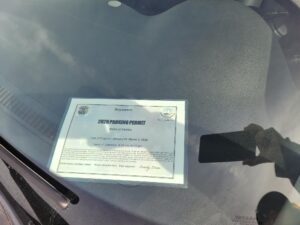
Here is where the timeline gets complicated. A Beaches and Harbors parking permit photographed in a production vehicle at the Venice Beach lot shows a program start date of January 19, 2026, but the CDP was not approved until February 6. That means the production was operating at the beach lot for approximately two and a half weeks before the Coastal Commission had finalized the conditions governing that use, including the addenda that added the Lot 701 requirement, disability parking protections, and precise operating hours.
The most specific and protective conditions, the ones that would have most constrained the production’s footprint, were added in those final addenda. If the production’s location team was working from an earlier draft of the permit conditions, they may not have known the full scope of what was eventually required. That does not excuse operating before the permit was final, but it may help explain why the production appeared unprepared for the rules that applied once it was. It is also worth noting that the CDP’s final conditions were negotiated right up to the day before the hearing. Getting more specific conditions in the final days before a CDP hearing is standard process at the Commission. Whether the production’s location department was keeping pace with those changes is another question.
There is also the question of who told them they could start in January. If the City or County provided access before the CDP was final, that is a separate accountability problem, and one that points back toward political figures like Traci Park who were publicly championing the production’s arrival.
Beach Restrictions Were Extensive and Known in Advance
The permit placed strict limits on what the production could actually do on the beach, and those limits make crew accounts of surprise obstruction hard to credit.
The active filming footprint on the sand was capped at 300 square feet at any given time, roughly the size of a one-car garage. All vehicles were prohibited from driving on or below the high tide and wrack line. A 500-foot buffer around the Venice Beach Least Tern nesting site prohibited all filming activities in that zone. Night lighting was restricted during approximately eight days per month between March and August. Beach grooming was prohibited outside the county’s regular maintenance schedule.
Crew accounts described Beach and Harbors arriving with new restrictions just before filming began, framing it as a last-minute surprise. The vehicle prohibition, the Least Tern buffer, and the 300-square-foot filming zone were all in the CDP Baywatch, Inc. accepted in February. Whether those conditions were communicated clearly within the production’s chain of command is an open question. What is not open is that they were public, final, and binding.
Two Agencies with Two Jurisdictions and Two Separate Enforcement Questions
Most coverage has conflated two separate enforcement situations involving two separate agencies with two separate authorities.
The County Department of Beaches and Harbors manages the sand and lifeguard operations and required separate approvals before filming. If Beach and Harbors enforced the permit’s beach restrictions on the ground, that is not obstruction, but enforcement. There is also a documented incident from March 18 in which production security personnel approached a member of the public in the beach lot well outside the production’s approved area. Special Condition 7 of the CDP explicitly prohibits security personnel from deterring public access or questioning members of the public who are not violating any law. That condition exists because the Commission anticipated exactly this kind of overreach.
Lot 731 is a different matter. It is LADOT-owned property in the Coastal Commission’s dual permit jurisdiction, and the conditions governing it were written by the Commission. Violations there are a CCC enforcement issue, not a county one. Conflating the two, as most coverage has done, obscures both.
On-the-Ground Documentation Raises Compliance Questions
Photographs taken on the morning of March 19 document conditions at Lot 731 and the surrounding streets during what appears to have been a beach filming day. The images show Lot 731 fully occupied by production base camp: blue catering tents, production trailers, talent Airstreams, and crew vehicles.
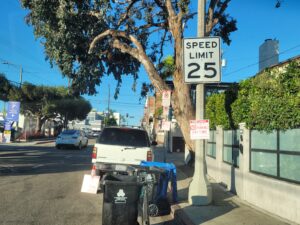
Also visible are temporary “Tow-Away / No Parking Anytime” signs and orange traffic cones on street parking along North Venice Boulevard, South Venice Boulevard at Pacific, and adjacent residential side streets, all outside the CDP-authorized footprint, all prohibited by the permit. The 21 parking spaces the CDP authorized in the beach lot are a specific, mapped allocation. The documentation suggests the production was using considerably more than that.
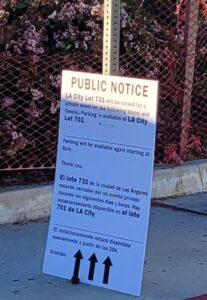
A Public Notice sign at the Lot 731 entrance directed the public to Lot 701. The photographs were taken before 8:30 a.m. A check of Lot 701 at approximately 9:30 a.m. found it closed. That is a potential violation of Special Condition 2.a, the condition inserted specifically because a public commenter warned that displaced parkers needed a guaranteed alternative.
Key Questions Remain Unanswered
It is worth being precise about what this documentation shows and what it does not. The production was told it was not welcome back on the beach after a few days of shooting. Whether that constitutes a formal enforcement action, a permit suspension, or simply a practical standoff between the production and Beach and Harbors is not yet clear. The CDP has not, as far as we know, been revoked. Revoking a coastal development permit is not a simple process, and it is possible the production chose to relocate rather than face formal action. The crew posts say they were told they were not welcome back, but that is not the same as a revocation.
What is documented is that the production was operating at the beach lot before the CDP was final, that street parking was removed beyond the permit’s authorized footprint on at least one filming day, that security personnel appear to have operated outside their approved area, and that the overflow lot required to be open for the public appears to have been closed when checked. Those are questions the California Coastal Commission and the County Department of Beaches and Harbors are in a position to answer.
Spencer Pratt’s Account of Events Does Not Match the Record
Spencer Pratt, the reality TV personality running for Los Angeles Mayor as a right-wing candidate, published a piece this week framing the Baywatch situation as proof of the city’s broken, film-hostile permitting environment. The piece blames Beach and Harbors, FilmLA, and city bureaucracy for the production’s difficulties, and ends with a campaign promise to slash location fees and deploy LAPD units to filming hotspots.
It is a well-crafted grievance piece for a film industry audience that is genuinely suffering. It is also wrong about what happened at Venice Beach. The restrictions placed on Baywatch were not arbitrary. They were negotiated, publicly noticed, and signed off on by the applicant before filming began. The 300-square-foot filming zone, the vehicle prohibition, the Least Tern buffer, the parking limits: all of it was in the permit Baywatch, Inc. accepted on February 6, along with a $21 million state tax credit and the vocal support of Councilmember Traci Park and LA County Supervisor Lindsey Horvath.
The Lot 731 Housing Fight Provides Unavoidable Context
Lot 731 has been at the center of one of the most contentious land use fights in Venice for years. The site is the planned location of the Venice Dell affordable housing project, which would provide homes for low-income residents and formerly unhoused Angelenos. The project has secured unanimous Coastal Commission approval, assembled nearly $45 million in public funding, and entered into a binding development agreement after close to a decade of work. Traci Park has been its most consistent opponent, arguing the lot is essential for coastal access and public parking. And the city, at her behest, has spent more than a million dollars in public funds litigating against it.
Against that backdrop, the selection of Lot 731 as the production’s primary base camp raises important questions. The lot is not the only parking option in the area. It is, however, the specific site where Park has spent years blocking housing development. And it is the site she chose to walk through on Instagram while the production was staged there, delivering her “underutilized? me thinks not” line directly into the Venice Dell debate. The question of who pushed for Lot 731 specifically, and why, is one the public record does not yet answer.
What is known is that Park traveled to the Coastal Commission hearing on February 6 to personally support the production’s permit application, that her office was involved in shepherding the production to Venice, and that the production appears to have been directed toward a lot that came loaded with political significance, a contentious permitting history, and conditions complex enough that even the agencies overseeing them struggled to keep the production in compliance. Whether that combination was the result of poor planning, political convenience, or something else is a question worth asking.
The production that was supposed to validate Park’s argument about Lot 731 has instead left the lot sitting under disputed circumstances, with permit compliance questions unresolved and beach filming relocated to other cities. The housing proposal Park has blocked would restore parking alongside hundreds of homes for people who need them. Her proposed alternative, a mobility hub, remains entirely conceptual, with no secured funding and no defined design.
At the WRAC candidate forum in March, Park cited Baywatch as her answer to a question about preserving Venice’s cultural identity. Her opponent Faizah Malik said plainly that Park’s alternative plans for Lot 731 were not feasible and had seen no forward movement. The production’s difficulties, and the questions now being raised about its permit compliance, only strengthen that assessment.