
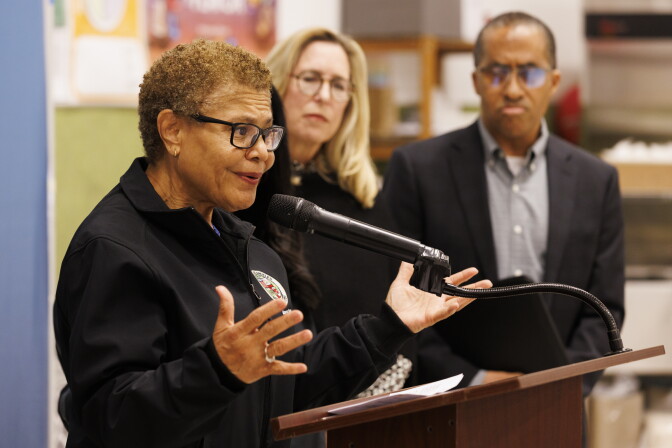
Mayor Karen Bass’s office is urging residents to reject a homelessness system transition, risking disruption to a regional funding process that brings roughly $240 million in federal support to Los Angeles. The money supports housing and services for more than 11,000 people, and LA has spent months fighting the Trump administration to protect its local funding process. Now the mayor’s office is mobilizing residents against recommendations for who should administer key parts of that system next, without explaining how its alternative would meet the court’s timetable.
On October 9, the Los Angeles Continuum of Care (CoC), the regional body that oversees that funding process, will consider recommendations to put the County in charge of functions currently administered by LAHSA. Bass’s office wants residents to reject the County’s selection for two of those roles because the City wants shared control. Blocking those recommendations, however, could delay the transition and give the Trump administration another opening to challenge local control over federal funding for housing and services.
The vote is open to the community, not just government officials or service providers. Under the CoC’s membership rules, anyone interested in collaborative efforts to address homelessness in the region is considered a member. People can register for the meeting, attend at 11 a.m. Friday, October 9, and vote on the recommendations. That open membership allows the mayor’s office to mobilize residents to influence the outcome.
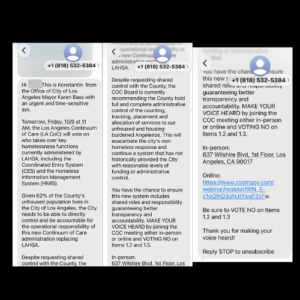 In a text message shared with Mar Vista Voice, a representative identifying himself as Konstantin from Bass’s office asks the recipient to attend and vote no on items 1.2 and 1.3. The message argues that the City needs direct operational responsibility because 62% of the County’s unhoused population lives within its boundaries. It says County administration would worsen the City’s homelessness response and perpetuate inadequate funding and administrative control. What it does not mention is that the City applied for both contested roles and scored lower than the County in the CoC’s evaluation. Nor does it identify a replacement plan if the recommendations are voted down.
The dispute grows out of the Trump administration’s attempt to remove LAHSA from the federal homelessness funding process. As we reported in August, LAHSA is not the same thing as the Continuum of Care. The CoC brings together local governments, housing and service providers, and people with lived experience of homelessness to establish priorities and rank projects seeking federal money. It covers 85 cities in Los Angeles County, excluding Long Beach, Pasadena and Glendale, which have their own CoCs. LAHSA has served as its administrator, assembling the region’s application to HUD for federal homelessness grants and operating the homelessness database, coordinated-entry system and annual homeless count.
HUD suspended LAHSA in June, after the deadline to register another agency to submit the regional application. It then proposed allowing service providers to apply directly to Washington, bypassing local evaluation and ranking. That threatened the region’s funding and would have given federal officials greater power over which local programs survived. The stakes extended beyond LAHSA’s financial and administrative failures. The Trump administration was trying to redirect homelessness policy away from permanent housing and toward compulsory treatment and institutionalization. Removing a troubled administrator became an opportunity to take funding decisions away from the local community.
Judge David Carter blocked that disruption while requiring the CoC to evaluate administrators for 2027. The Ninth Circuit subsequently refused HUD’s request to pause those protections, keeping this year’s regional application moving while Los Angeles worked out what would come next. The courts did not require the region to preserve LAHSA indefinitely. They protected the funding process while allowing an orderly transition to new administrators.
LAHSA then stepped aside rather than compete with its founding partners. On September 15, its commission voted not to apply for the 2027 roles, saying that competing against the City and County would “only fracture regional collaboration during an already complex time.” The agency committed to maintaining its current responsibilities until successors took over. Its decision made clear that protecting the regional response mattered more than retaining its own position.
To carry out the transition, the CoC invited agencies to apply for LAHSA’s administrative roles and evaluated their qualifications. Its published evaluation shows that the City applied to administer the Coordinated Entry System, which coordinates access to housing and services, and the Homeless Management Information System, the regional database. The County’s Department of Homeless Services and Housing applied for those roles as well as the federal funding application and homeless count. Independent reviewers screened for conflicts of interest scored the written applications and interviews. The County scored 90.67 out of 100 for coordinated entry, compared with the City’s 72.83, and 87.17 for the database role, compared with the City’s 82.33. Those scores do not settle every question about accountability, but they give the recommendations a documented basis that the mayor’s message leaves out.
The text from Bass’s office also blurs the distinction between administering the systems and governing them. It describes the County as receiving “full and complete administrative control” over counting, tracking, placement and service allocation. But assigning those functions to the County does not eliminate the CoC’s authority to establish regional priorities and oversee the responsibilities it delegates. The City’s large unhoused population gives it a substantial stake in how the systems operate, but it does not establish that shared administration would work better or that voting down the County’s selection would improve access to housing.
The CoC must report its evaluation of applicants to the court by October 13. A no vote does not automatically cancel Los Angeles’s grants, but a last-minute fight over control could delay the transition and give the Trump administration another pretext to argue for bypassing the CoC and taking greater control over which local housing and service programs receive federal funding. HUD has already tried to use LAHSA’s failures to justify that intervention. Creating more uncertainty now could strengthen its argument that the region cannot manage the system itself.
Bass’s office presents its campaign as a demand for accountability, but its message offers no concrete alternative or explanation of how rejection would preserve the court timetable. That leaves City residents being asked to help derail the recommendations without any indication of what comes next. Los Angeles has already had to fight Washington to protect the housing and services people depend on. Risking the transition because the City did not get the control it wanted is reckless, and the most vulnerable Angelenos could pay the price.
The October 9 meeting begins at 11 a.m. at 637 Wilshire Boulevard, first floor. Community members can also register to attend online.