
Mayor Karen Bass this week released her proposed $14.9 billion budget for 2026–27, presenting it as a steady plan that avoids layoffs after last year’s $1 billion deficit. But the budget documents tells a far more consequential story. The proposal expands policing, restructures core city functions, and shifts resources away from the populations facing the fastest-growing crises in Los Angeles.
A central throughline of the budget is the 2028 Olympics, which function less as a contained expense and more as a justification for long-term investments that will outlast the Games themselves. Critics have warned for years that mega-events can reshape city budgets in precisely this way. The coalition NOlympics LA has described the risk as Los Angeles becoming a permanent host city, what they call the “Forever Games,” where infrastructure built for a temporary event becomes a lasting expansion of policing and surveillance.
That dynamic is visible throughout the proposal. The city plans to acquire 785 new LAPD vehicles in a single year through two bond programs totaling more than $80 million in principal, with tens of millions more in interest over time. More than half of those vehicles are explicitly designated for Olympic use, yet there is no mechanism to retire or return them after 2028. Instead, they become part of the city’s permanent fleet. Additional capital investments follow a similar pattern, including a nearly $10 million helicopter replacement and a $5 million radio system upgrade described as “Phase I,” signaling further expansion to come. The budget also proposes a one-time exception to the city’s debt policies to finance patrol vehicles through long-term borrowing, a move that could set precedent well beyond the Olympics. Even organizational changes reflect this shift, with a unit originally created for Olympic planning now continued within LAPD as a standing “Major Events Group.”
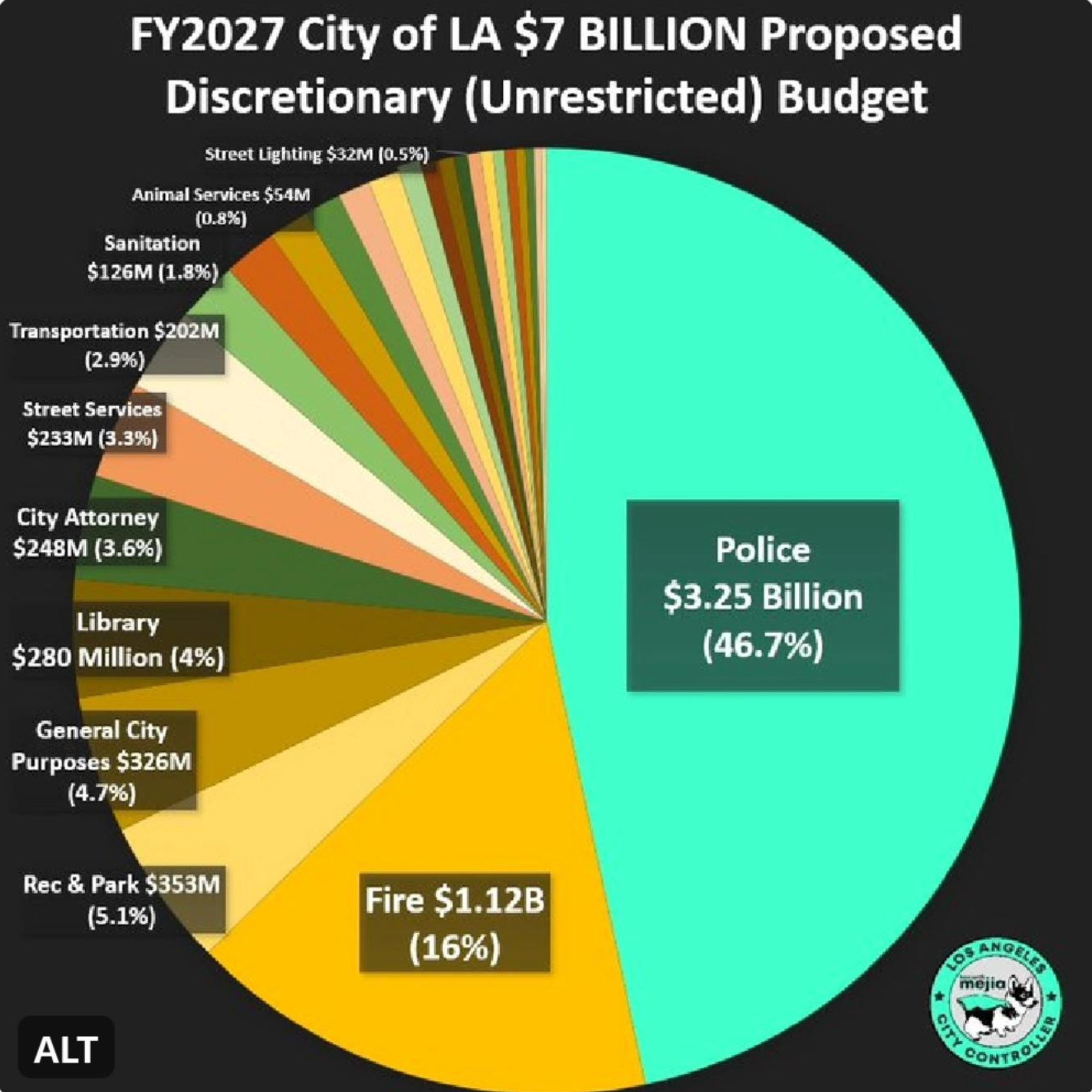
These investments contribute to a broader expansion of policing in the city’s finances. The LAPD’s operating budget rises by $124.7 million to $2.11 billion. When pensions, benefits, and other associated costs are included, the total cost of policing exceeds $3.5 billion. Police and fire together now consume nearly 63 percent of the city’s unrestricted General Fund revenue, leaving all other services to compete for what remains.
This concentration of spending stands in contrast to what many residents say they want from the city’s budget. In a recent participatory budgeting process led by People’s Budget LA, more than 1,400 Angelenos were surveyed about their priorities. Nearly 90 percent of respondents opposed any increase to LAPD funding, instead calling for investments in housing, mental health services, parks, libraries, and other community infrastructure. The gap between those priorities and the proposed budget is stark, with the city continuing to expand police funding even as service levels in other areas deteriorate.
Those tradeoffs are particularly visible in the treatment of departments serving vulnerable populations. Over the past two years, spending on aging services has fallen by 35 percent, youth development by 34 percent, and civil and human rights programs by 25 percent, trends documented by City Controller Kenneth Mejia. The current proposal completes that trajectory by eliminating several of those departments entirely.
Bass proposes dissolving the Department of Aging entirely, with its $10.8 million budget and approximately 40 positions transferred into the Community Investment Department, where its programs will continue but without independent leadership, a standalone budget, or a formal role advocating for seniors in the public budget process. This restructuring comes at a moment when older adults represent the fastest-growing segment of the unhoused population in Los Angeles. Many aging Angelenos are experiencing homelessness for the first time, pushed out by rising rents while living on fixed incomes. The crisis disproportionately affects Black older adults and is compounded by high rates of chronic illness and disability.
The budget’s approach to housing policy raises a different set of concerns, particularly in its treatment of short-term rentals. Buried in Exhibit H are two provisions that together function as a major shift in the city’s regulatory framework. One directs the creation of a new “Vacation Rental Program” allowing units that are not a host’s primary residence to be rented on a short-term basis, while the other allows companies to prepay Transient Occupancy Tax (“TOT”) ahead of the Olympics to fund city priorities.
That second provision, while written as technical budget language, introduces a highly unusual concept: allowing private companies to prepay taxes on revenue they have not yet earned. In practice, this could allow companies like Airbnb to make large upfront payments tied to anticipated Olympic demand. There is little precedent for this type of arrangement, raising questions about what the city is offering in return.
The answer appears to be embedded directly above it. The adjacent provision directs the city to expand allowable short-term rentals into second homes and investment properties, something platforms have long pushed for. Read together, the provisions suggest a coordinated policy shift pairing deregulation with upfront payments.
This comes after years of limited enforcement of the city’s existing home-sharing law, during which illegal listings have remained widespread and potential fine revenue has gone uncollected. Rather than strengthening enforcement and returning units to the long-term housing market, the budget moves toward loosening the short-term rental market itself. The structure resembles a pay-to-play system, where the city deregulates short term rentals in exchange for advance payments, while sidelining enforcement of existing rules.
The allocation of those prepaid funds adds another layer. A portion is directed toward street cleanliness and maintenance, supporting programs such as CARE and CARE+ that conduct encampment sweeps. The result is a feedback loop embedded in the budget itself: housing is removed from the market, enforcement is weakened, and revenue generated by that expansion helps fund the clearing of encampments of people displaced from housing. Embedding these directives inside the budget also allows the city to avoid the normal legislative process for major housing policy changes, burying public debate into a document few residents will ever read.
Beyond these structural changes, the budget continues to reduce or eliminate a range of programs serving vulnerable communities. The Safe Parking program, which provided legal overnight parking and basic services for people living in their vehicles, is being fully phased out by June 30. For the roughly 10,000 Angelenos living in cars or RVs, many of them employed but priced out of housing, it has been one of the few non-punitive options available. Its elimination comes as Mayor Bass is pursuing more aggressive enforcement against vehicle dwellers, an effort that was recently halted by a court. Other reductions affect youth employment programs, alternative justice initiatives, and community-based services.
At the same time, the city faces a significant funding gap in its homelessness response as one-time state grants are depleted. Roughly $148 million in funding will need to be replaced or absorbed through cuts, even as court-mandated spending tied to the Alliance settlement increases substantially. These competing pressures further constrain the city’s ability to maintain existing services.
Even areas framed as new investments reflect underlying tradeoffs. Funding for street repairs increases to more than $200 million, but much of that spending is directed toward methods like slurry sealing that avoid triggering broader accessibility and safety upgrades. Performance metrics included in the budget show worsening outcomes across basic services, including longer streetlight repair times and a reduction in crossing guards near schools.
The budget also identifies longer-term fiscal risks, including a projected $46.7 million annual loss in franchise revenue beginning in 2027-28 and economic uncertainty that could affect revenue projections. The city’s own Revenue Outlook cites an Iran war beginning February 28, 2026 and a 33 percent recession probability per an April 2026 survey. Despite these risks, the proposal assumes revenue growth above historical averages, raising questions about the sustainability of the city’s financial outlook.
The mayor has emphasized that the budget maintains reserves and avoids layoffs, and both claims are accurate. At the same time, the proposal outlines a clear set of priorities, including a continued expansion of policing tied to the Olympics, a restructuring of departments that reduces independent oversight for key city services, and an immigration response that amounts to $1 million in one-time legal aid against an escalating federal enforcement campaign. The budget now moves to the City Council’s Budget and Finance Committee for hearings and revisions, with public comment beginning this week and a final vote required before July 1.