
At the recent Westside Regional Alliance of Councils (“WRAC”) debate featuring Council District 11 candidates Faizah Malik, Jeremy Wineberg and Traci Park, the Venice Neighborhood Council posed a question that captured a concern many residents share. “Historically, Venice has been defined by its artists, street performers, small independent businesses, and unconventional cultural spaces,” the question began, noting that many residents feel parts of that identity have been “diminished or regulated out of existence.” With tourism growing and major events like the World Cup and Olympics approaching, the VNC asked candidates how they would balance economic development while “protecting Venice’s culture, artistic expression, and identity.”
In her response, CD11 candidate Faizah Malik connected that concern directly to the city’s housing crisis. “We have to create space for artists to be able to continue to make Venice beautiful,” she said, explaining that supporting artist housing is part of her housing platform and a way to ensure the people who create Venice’s culture can continue to live and work in the neighborhood.
Malik’s answer pointed to a growing challenge facing Los Angeles and many other cities, where artists have long shaped the cultural life of urban neighborhoods but rising housing costs are increasingly pushing them out. Across the city, working artists often face the same housing pressures as other renters, but with the added complication that their income is frequently irregular, arriving in bursts from projects, performances, commissions, or exhibitions rather than steady paychecks. That reality can make it difficult to qualify for traditional leases or mortgages even when artists are consistently working.
As rents continue to rise, artists find themselves competing for the same limited supply of affordable housing as other low and moderate income workers. The result is that creative workers who helped shape neighborhoods like Venice, Silver Lake, and Echo Park are increasingly being displaced to more distant parts of the region or leaving the city altogether.
Some policymakers and nonprofit developers have attempted to address the problem through housing projects aimed at artists and entertainment workers. One widely cited example is the Hollywood Arts Collective, a 151-unit affordable housing complex that opened in 2023 for people working in creative fields. But the project has also illustrated the limits of relying on developer-driven “affordable” housing to stabilize artistic communities.
Tenants at the building organized last year after management announced rent increases, arguing that they had been led to believe rents would remain stable. The property’s management company said the increases were allowed under the Low-Income Housing Tax Credit program that finances the building. Housing advocates note that this structure allows rents to rise over time, meaning units that begin as affordable may become difficult for tenants to sustain.
The dispute highlights a broader challenge with many “affordable” housing developments built through tax credit financing. They remain privately owned and operated, and rents can still increase as operating costs rise. For artists and other workers with irregular incomes, even modest increases can destabilize housing. Many housing advocates argue that preserving cultural communities requires more than relying on market-based affordable housing programs. Models that remove housing from speculative real estate markets, such as social housing, community land trusts, and nonprofit-owned housing, can provide the long-term stability artists and cultural workers need to remain in the neighborhoods they help shape.
And housing is only part of the equation. For many visual artists, studio space is essential, since painting, sculpture, ceramics, textiles, and more require room for materials, tools, and storage that cannot fit inside a small apartment. Even when artists manage to find housing they can afford, they still need an affordable place to work. In Mar Vista, the loss of the Grand View Fine Arts Studios offers a clear example of how quickly those spaces can disappear.
For more than a decade, the Grand View Fine Arts Studios on Grand View Boulevard provided affordable workspace for artists. The building contained roughly 8,000 square feet of studio space with 27 private studios tucked into a maze of rooms and hallways, housing more than twenty artists working side by side. The surrounding stretch of Grand View Boulevard had quietly become a small creative corridor in Mar Vista, where studios, workshops, and working artists contributed to the neighborhood’s cultural identity.
The studios were integrated into the surrounding community. Several times a year, the artists would open their doors to the public, inviting neighbors to wander through the building, see works in progress, and talk directly with the people creating them. At one open studios event, more than twenty artists welcomed visitors inside for a casual evening of art and conversation as people moved from studio to studio exploring the eclectic work on display.
For many people, the studios were also a gathering place for creative collaboration. Juliana Riccardi, who spent time there with friends who had studios in the building, remembers the community that formed inside its walls. “Many of my closest friends had studios there. I would spend time there with them, play music as they painted and perform at community events there. I hosted one event right before Covid and it was great with comedy, music, and poetry. Lots of memories there. My friend held art lessons there as well. We miss it.”
Another former studio tenant described the space as something closer to a second home. “It was like a second home to a lot of us artists and affordable,” the artist said. “It brought the community together and it was really heartbreaking when we all had to leave.”
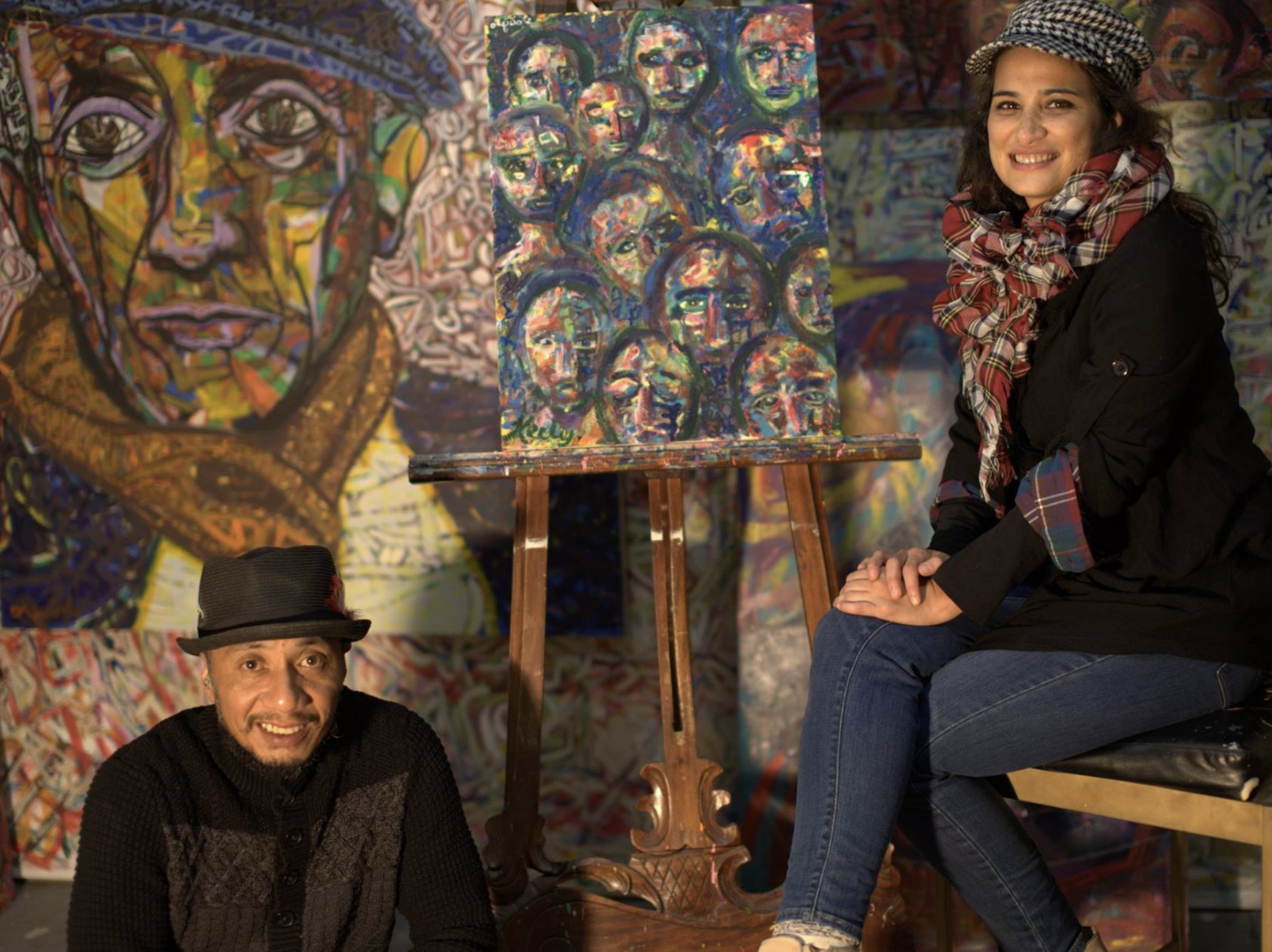
Inside the building, the work itself was just as varied. One artist created intricate collages from shredded comic books, layering strips of the material over the printed panels and adding paint and newspaper text until the entire canvas transformed into a new image. Another artist filled her studio with large acrylic paintings she sometimes created using brushes, paper, and even her feet. Other rooms contained mixed media pieces, paintings, and clothing designs produced by artists who used the space as both workshop and gallery.
Over time the studios became a small cultural anchor for the neighborhood. Artists built relationships with nearby businesses, participated in local events, and helped create the creative energy that would later feed into the Mar Vista Art Walk and other community gatherings along the Grand View corridor.
Like many artistic spaces across Los Angeles, however, the studios eventually faced the pressures of rising real estate values and redevelopment. The building changed hands, and the artists who had worked there for years were displaced. Plans presented to the Mar Vista Community Council later showed the site slated for redevelopment as a three-story self-storage facility with hundreds of storage units. The presentation acknowledged that the building previously contained artist studios alongside other small creative businesses before the proposed conversion.
For the artists who had worked there, the loss was not just about square footage but about the disappearance of a rare affordable creative community. One former studio tenant said that after leaving Grand View they struggled to find anything comparable on the Westside. “I had to move my studio to Culver City and I’m paying more than double the rent for a space that’s half the size,” the artist said. “It’s not really an artist community there because artists can’t afford rent like that.”
The project included a weak nod to the rich history of the site: a “community arts element” consisting of six small glass display boxes facing Grand View Boulevard where local artwork could be shown, along with a single 10-by-10 storage unit leased to the Mar Vista Art Walk for one dollar per month. The working studios where artists once painted, experimented, taught classes, and gathered would be gone, replaced by storage lockers with a superficial arts display.
So the question raised at the WRAC debate about how to preserve Venice’s culture is really a question facing the entire Westside. Neighborhoods like Venice and Mar Vista have long drawn people because of their artists, musicians, performers, and creative communities. But to preserve that identity, we must ensure that creators who bring that identity to life can afford to stay and have places to live and work.