
For nearly a year, Matthew, a student at LMU, spent his Sunday nights driving food from a church to unhoused residents living in encampments on the Westside. Through Sursum Corda, a campus service organization focused on food justice that partners with Grassroots Neighbors, he and a fellow volunteer built relationships with people living in some of the most hidden corners of the Westside.
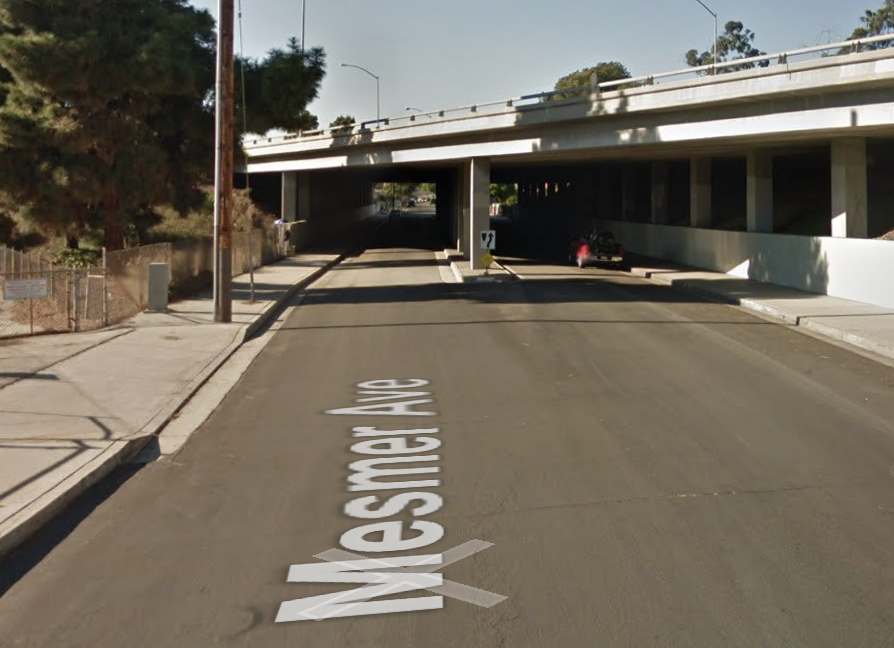
One of those encampments sat behind trees and dense brush along Mesmer Avenue near Inglewood Boulevard, tucked up a hill off a gated access road. It was so concealed that even after months of weekly visits, the LMU volunteers sometimes struggled to locate people there, calling out repeatedly into the bushes before someone responded. Over time, the encampment grew from just a handful of people into a small community of roughly 15 to 20 residents.
On April 26, the two volunteers visited as usual. People were there. Matthew says there was no posted notice warning of an upcoming cleanup or eviction. When they returned the following week on May 3, everything was gone.
The gate that normally blocked the access road stood open. The tents had disappeared. The ground itself appeared flattened and cleared. Stapled to the fence was a City of Los Angeles removal notice ordering residents to vacate the area.
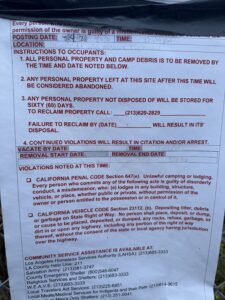
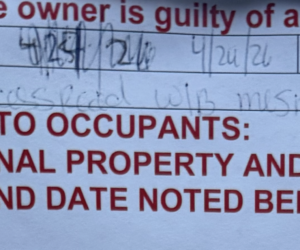
But the dates on the notice raised immediate questions. The posting date appeared altered. Up close, it looked as though “25” had originally been written before being scratched out and replaced with “24.” The notice ordered residents to vacate by April 26 at 12:04 p.m., the very same day Matthew says he visited the site without seeing any warning posted at all. If his account is accurate, that would mean residents may never have received notice before the sweep occurred.
The sweep also fits into a much larger pattern that unhoused advocates and mutual aid groups across Los Angeles have documented for years: encampments repeatedly being dismantled without meaningful pathways to housing, while residents are scattered from neighborhood to neighborhood in an endless cycle of displacement.
Matthew had already seen this cycle of displacement play out once before. Last fall, a much larger encampment near the Playa Vista Home Depot along Coral Tree Drive was swept. He estimates 70 to 80 people had been living there by the time the city cleared the area. After months of outreach, he watched that community disappear almost overnight. Some of those displaced residents eventually resurfaced at the hidden Mesmer encampment. That became the place he and Hector visited every week afterward.
The Coral Tree encampment had already become a flashpoint in broader Westside battles over homelessness enforcement. In 2024, the area drew attention after metal planters were illegally bolted into parking spaces shortly after a city sanitation sweep, apparently to prevent RV dwellers from returning. Parents at a nearby private school complained about conditions around the encampment, while unhoused advocates warned that repeated sweeps and parking restrictions were simply pushing vulnerable people from one industrial corridor to another without offering stable housing.
At the time, advocates described Council District 11’s growing strategy as one of constant displacement, with red curbs, oversized vehicle restrictions, fences, planters, bollards, and anti-camping enforcement designed to make entire areas physically inaccessible to unhoused residents. The result, they argued, was not resolution of homelessness but the gradual elimination of places where unhoused people could legally or practically exist.
Now those residents are gone too.
Over the past several years, city officials have framed sweeps as “cleanups,” “abatement,” or “public safety” operations. But critics argue the city has built an enormously expensive system focused more on moving unhoused people out of visible areas than actually resolving homelessness. Despite repeated promises from elected officials that enforcement is paired with services and housing offers, outreach workers and volunteers routinely encounter residents who report never receiving permanent housing options before displacement.
Matthew said many of the residents at Mesmer primarily spoke Spanish, and some people they had previously met at the Playa Vista encampment held jobs or advanced degrees. What struck him most about the Mesmer sweep was not just the disappearance itself, but the fact that the encampment had already been effectively invisible to the public.
“This was a sweep that was done when the people were already out of sight,” Matthew said. “They were behind trees and bushes on a gated access road. They weren’t even on the road. It was the least possible kind of disturbance.”
He described spending the last year watching people retreat further and further into hidden spaces simply to avoid harassment, complaints, and displacement, only to discover that even hiding in the brush was not enough to avoid removal.
“We knew exactly where they were and still had trouble finding them,” he said. “That’s how hidden they would be. What more do you want from people to disappear?”
That question sits at the very center of LA’s homelessness policies.
As the city expands anti-camping enforcement under laws like LAMC 41.18 and continues large-scale sanitation and encampment operations across the Westside, unhoused residents are pushed into ever more isolated areas, behind freeway embankments, in flood channels, hidden in overgrown vegetation, or deep inside industrial corridors. Outreach workers describe losing contact with vulnerable people after sweeps because communities become fragmented and harder to locate.
Matthew now plans to search nearby areas to see if he can find where residents relocated. But even he acknowledges the challenge. Mesmer itself had become the fallback location after the earlier Playa Vista sweep, and there is no obvious next destination.