
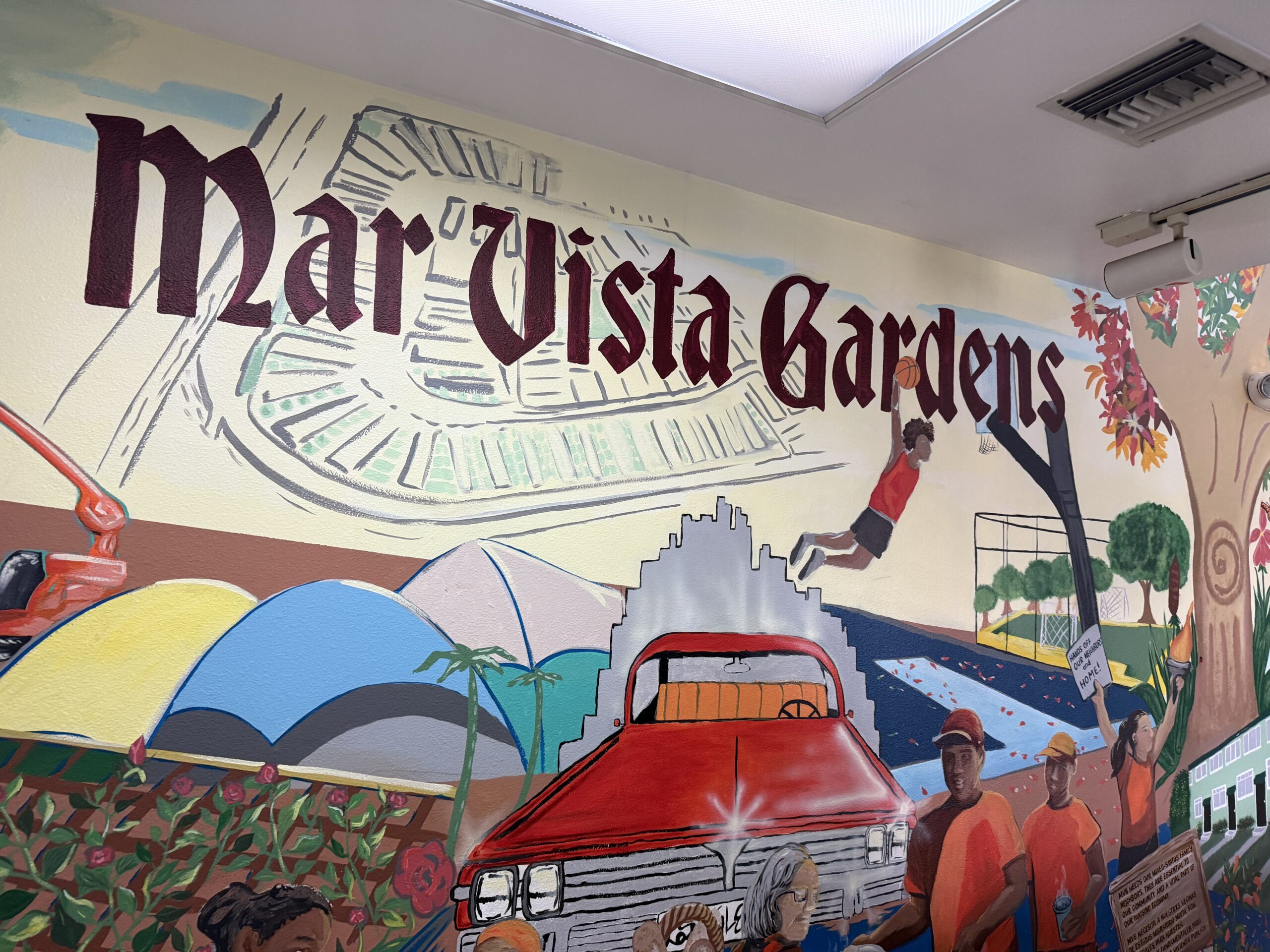
What can public housing bring to a local community? On Friday, October 23rd, I went to a community work-reveal at Mar Vista Gardens, a public housing complex on the Westside of Los Angeles, where I found myself asking that very question.
Despite volunteering to attend and write about the event for Mar Vista Voice of my own volition, I felt nervous before attending. I had only recently connected with the organization and had far less recently begun writing publicly. Further, while the courses I take as an urban planner-in-training regularly discuss affordable housing, I had little knowledge about most of the public housing that exists here in Los Angeles, the city I now call home. What I did know, however, is that I’m someone who cares deeply about community and believes that housing is a human right and the government has a responsibility to provide for its people- otherwise, what is it that we are paying taxes for? I am also someone who recognizes that a society’s physical infrastructure (i.e., the way our homes, neighborhoods, and cities are built) shapes how we live, prompting us to become interconnected communities or individuals living in isolation. Because public housing exists at the intersection of these topics, and some colleagues had discussed Mar Vista Gardens as the epitome of the former, I willingly gathered my combination of fear and excitement and headed to the complex’s community center.
The event was a celebration among the resident community of Mar Vista Gardens, in collaboration with the equity-driven urban design firm Kounkuay Design Initiative. Residents had spent months collaborating on incredible projects highlighting the people who lived among them in the form of both an art mural and a short-film documentary. In addition to those, the residents and design firm had spent several years working to get a park installed in their community. They had done rounds of community outreach, made various plan drafts, and were on a mission to create an outdoor space that would serve the people of Mar Vista Gardens. Pin-ups of the park plans were also on display, highlighting the impressive organizing efforts making tangible community change.
On this Friday evening, in a room full of folding chairs, trays of hot food, an old-timey podium next to a wall-mounted American flag, and a large projector-on-wheels showcasing a slideshow of photos, I joined the residents. This event could have become just another flier on a community bulletin board, but I watched it unfold into something much more meaningful. Interviews, conversations, artistic visuals, intimate glimpses inside residents’ homes, and the unscripted soundtrack of the audience’s live reactions- these were all micro-moments of what the documentary offered. The mural reveal was equally noteworthy- vibrant, intentional, and powerful are just some of the words best used to describe it. An homage to public housing’s historic advancements in the U.S., communal portraits, and a multilingual message about what the complex is all about were proudly showcased.
These works, all resident-featured and resident-made, were visible, physical manifestations of the care this community had for each other and for their home. Beyond these works, the event featured something else: intergenerational community, both on display and in the making in real time.
In this space, that intergenerational connection looked like: the group of 10-12-year-old boys who raised their hand during the video’s Q&A to teasingly question why they didn’t get more airtime, or them later making up silly handshakes with older residents; the young adult community leaders, Gemma, Myisha, and Nicole, who coordinated, facilitated, and empowered the people around them to create these works; the older adult women- parents and role models- being awarded certificates, with their names called individually from a microphone as they were cheered on by neighbors and friends whose lives they undoubtedly touched. Seeing these women celebrated was especially significant to me (I would love an opportunity to clap for my mom alongside an audience about something).
I entered this event with fear and a question, and I left with transformations to both. The fears had dissipated and were replaced by gratitude- how lucky was I to get to witness people taking such strong ownership of their community in this way? To the question that centers this whole article, there was now a clear answer.
The public housing facility of Mar Vista Gardens (the same one that has been under attack by the federal government, especially in recent years) gave this community the space and opportunity to grow into what it is now: an intergenerational community, filled with collaboration, investment, beauty, and opportunity. The specific impact that the community made through this housing complex was the result of their initiative. Still, the opportunities to have publicly-funded affordable housing, live among- not simply next to- our neighbors, develop a sense of collective stewardship of shared spaces, and interact with people in close proximity throughout all stages of life are things we as a society should advocate for and protect. There can be more Mar Vista Gardens-like communities if our collective dollars fund the opportunity, and if the rest of us in society recognize this as worthwhile and align our efforts accordingly.
Just one short evening with the residents of Mar Vista Gardens left me with real clarity. Community is valuable, real, and visible. Physical spaces can promote it. Public funding can, and should, enable it. Mar Vista Gardens has unquestionably cultivated it.