
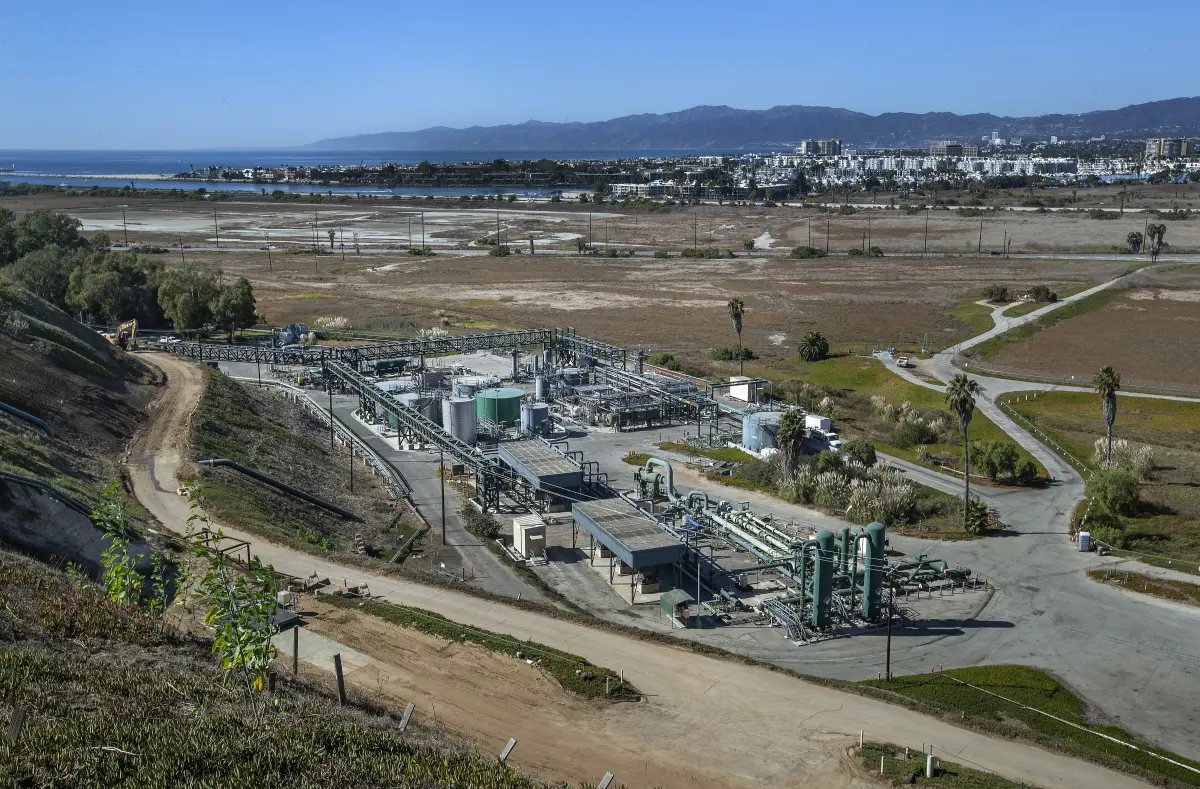
A loud roar and gas odors alarmed Playa del Rey residents Thursday evening, October 15, prompting neighbors to seek answers about a gas release at the SoCalGas storage facility near the Ballona Wetlands. In a statement posted on its community notifications page, SoCalGas said a safety valve on an aboveground pipeline activated around 7:30 p.m., releasing natural gas for approximately one minute before closing on its own. The incident raises fresh questions about a facility whose history of leaks and fires has long fueled demands for closure.
SoCalGas said the valve “functioned as designed” and that the facility was operating normally, with “no ongoing release or safety concerns at this time.” The company also said it had notified the appropriate local and state agencies. Its statement placed the release around 7:30 p.m., while residents reported the initial disturbance around 7:16 p.m. It did not explain what triggered the valve, quantify the gas released or provide air-monitoring results supporting its safety assessment.
In a neighborhood Facebook group, one resident described “a loud roaring sound seemingly coming from the middle of the wetlands that lasted for a few minutes.” Others reported gas odors near the bluffs and on 81st Street between Saran and Berger. Another resident described the view from their deck: “There was a plume of something under high pressure shooting out of a vertical pipe. Maybe steam, maybe natural gas.” Several questioned the lack of communication from the company and asked what was happening.
A separate account described a conversation with an employee at around 9:40 p.m. in which the employee said the release was due to built-up pressure. The company’s published statement did not address that explanation.
Releasing gas to reduce pressure is an established industry practice. The Environmental Protection Agency describes these “blowdowns” as a way to depressurize equipment for maintenance or emergency response, typically by venting gas into the atmosphere. They can produce substantial noise and methane emissions. A safety valve’s successful activation, however, does not explain what triggered it or establish that the underlying problem was minor.
At Playa del Rey, a previous pressure release ended in fire. The California Public Utilities Commission’s incident record states that on January 6, 2013, overpressurization caused gas to escape through a relief valve and ignite at the vent. That incident does not establish what happened Thursday, but it shows that gas discharged to relieve pressure can itself ignite.
The uncertainty neighbors faced Thursday also raises questions about the company’s notification practices. A CPUC-approved 2007 settlement concerning the facility required SoCalGas to notify subscribers within the storage reservoir’s surface footprint and a quarter-mile beyond it. Planned maintenance releases exceeding 50,000 cubic feet required as much advance warning as possible, up to 24 hours. Unplanned releases lasting more than 10 minutes or exceeding 50,000 cubic feet required notification as soon as possible within the following 24 hours. Notices were to include estimated release timing and volume, an explanation and a contact number. The approximately one-minute release described by SoCalGas would fall below the duration threshold, but the company did not disclose whether it exceeded the volume threshold. Its public statement also does not establish whether subscribers received direct alerts.
The ability to subscribe to alerts is itself unclear. SoCalGas’s 2008 community flyer provided a phone number and email address for subscribing by text, email or phone. A 2020 newsletter directed residents to an online signup page, but that address returned a “page not found” error when MVV checked Thursday night. MVV could not verify a working current online enrollment form or whether the older signup contacts remain active, raising questions about whether residents can access the promised notifications.
Stopping a release may also be only the first of the company’s obligations. Depending on the circumstances, SoCalGas may be required to notify regulators, quantify emissions, conduct testing, disclose results and document corrective measures. CPUC reporting requirements cover qualifying incidents involving significant public attention or certain pressure-limit exceedances. South Coast AQMD rules require prompt reporting and follow-up documentation for specified equipment breakdowns. The Playa del Rey settlement separately requires testing and publication of results if released liquids reach neighboring homes. Although SoCalGas says it notified local and state agencies, its statement does not identify those agencies, when notification occurred or which additional requirements applied.
A similar venting incident occurred in January 2026 at Aliso Canyon, where a safety valve on an aboveground pipeline released gas for under 20 minutes before operators stopped it. Neighbors reported loud noise and strong odors there too. The preliminary explanation was that the valve functioned as designed, and operators were inspecting the pipeline and would make any needed repairs.
Even incidents that are quickly contained deserve scrutiny, because smaller failures can reveal weaknesses that contribute to a much larger disaster. Aliso Canyon’s history illustrates that danger. An independent investigation found that SoCalGas had experienced more than 60 well-casing leaks there before the 2015 blowout without conducting detailed follow-up investigations or failure analyses. Those leaks involved different mechanisms from the brief venting reported in January 2026, but they represented missed opportunities to address serious problems.
Beginning October 23, 2015, gas escaped from a ruptured well at Aliso Canyon for approximately 111 days, releasing an estimated 109,000 metric tons of methane before the flow was stopped in February 2016. Los Angeles County Public Health received thousands of health reports and directed the temporary relocation of more than 8,000 households and two schools. Residents experienced headaches, respiratory symptoms and eye, nose and throat irritation; some reported continuing symptoms after returning home.
A major failure at Playa del Rey could put tens of thousands of nearby residents at risk. Historical estimates reported by the Los Angeles Times put approximately 45,000 residents within one mile of Playa del Rey, compared with 6,500 around Aliso Canyon.
The danger extends beyond the facility’s visible boundaries. As the Los Angeles Times reported in 2021, nearly 4,000 people lived directly above the underground storage field, compared with just 25 above Aliso Canyon. The state’s 2018 assessment also found that Playa del Rey had California’s oldest active gas-storage wells, with a median drilling date of 1935. Subsequent well closures and upgrades may have changed that inventory, but the historical findings underscore how deeply the infrastructure is embedded in surrounding neighborhoods.
The same 2018 state-commissioned scientific assessment singled out Playa del Rey for relatively higher health and safety risk, citing its history of gas escaping containment, nearby population and wildfire hazard.
Calls for closure have already won support from local governments. In April 2021, the Los Angeles City Council unanimously adopted a resolution urging the state to close the facility. Culver City approved a similar resolution, and the Los Angeles County Board of Supervisors had requested a state study of potential closure the previous year. Thursday’s incident brings renewed urgency to concerns that residents, researchers and elected officials have raised for years.
Protect Playa Now has long campaigned for a planned closure involving workers and surrounding communities. In the meantime, residents are entitled to accessible information about what is being released into their neighborhoods and accountability for the company’s safety obligations. They should not have to piece together an emergency from gas odors, a roaring sound and neighbors’ social media posts.