
You’ve probably heard about the UCLA study claiming Measure ULA is stifling housing production. Its findings have been repeated ad nauseam in news stories and used to argue that the landmark tax on high-value property sales, passed in 2022 with 58% of the vote, should not apply to newly built apartments that are sold within 15 years of construction
But there’s something crucial that coverage of this issue continues to miss: the UCLA Lewis Center report does more than estimate lost housing. The report proposes a path for City Council to exempt newly built apartments from the ULA tax without another public vote. Under ULA, councilmembers may amend the measure if the change furthers its stated purposes. Before the council adopts an amendment, the Citizens Oversight Committee, the body ULA’s voters created to watch over the measure, must review the change and may weigh in on whether it meets that requirement.
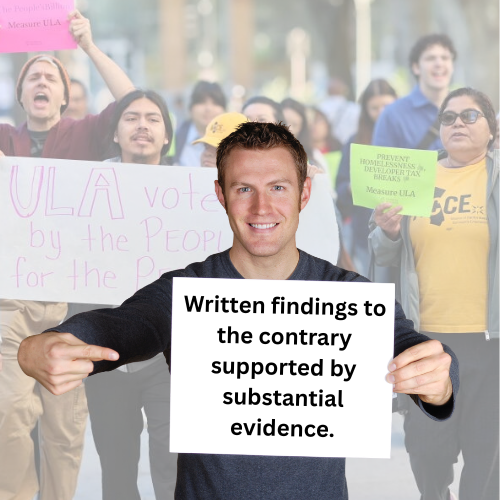
If the committee objects, City Council can still proceed, but it must make “written findings to the contrary supported by substantial evidence.” That is, councilmembers can override the oversight committee with written evidence that their proposed amendment does in fact further the law’s stated purpose. The UCLA study attempts to provide that evidence, arguing that exempting newly built apartments would create more affordable housing, one of ULA’s stated goals. Page 43 spells out the roadmap for City Council to follow.
That makes the UCLA study more than a set of numbers in a policy debate. It supplies an argument for using a provision within ULA to weaken the tax, even over the objections of the body created to oversee it. Reporters have covered the study’s housing estimates extensively, and readers could hardly be blamed for getting buried in the competing numbers, throwing up their hands and thinking, “Fine, maybe ULA needs a tweak after all.” But the report’s explicit discussion of how to turn its findings into a tax break has received far less attention. That omission does a disservice to voters, who deserve to know what changes are being proposed to the law they passed and how its safeguards would apply.
To understand why that matters, let’s go back to the vote. In November 2022, Los Angeles passed ULA with 58% of the vote. The citizen-led measure taxes high-value property sales to fund affordable housing, eviction defense and other programs that keep people housed, and has already raised $1.4 billion. The opposition began almost immediately, on three fronts: the courts, City Hall and the statewide ballot.
The Howard Jarvis Taxpayers Association (the group behind Prop 13, which still lets corporations pay property taxes based on 1970s values) and the Apartment Association of Greater Los Angeles sued the next month to overturn ULA. They argued that voters could not enact a property transfer tax the City Council could not impose on its own. The courts rejected that argument, and an appeals court upheld ULA in December 2025.
The Howard Jarvis group also backed a statewide measure that would have invalidated ULA and other existing local taxes, sharply restricted property transfer taxes, and required a two-thirds vote for future local special taxes. It was withdrawn after a deal with lawmakers. The “compromise,” Proposition 43, is punishing. Although it spares ULA and other taxes already on the books, it keeps the two-thirds hurdle for future voter-proposed special taxes. That would make new ULA-like measures, and any other citizen-led efforts to raise money for local needs like libraries, hospitals and firefighters, much harder to pass.
And at City Hall, real estate interests started pushing immediately for carveouts from ULA. In April 2025, the UCLA Lewis Center and RAND published Taxing Tomorrow. Authors Shane Phillips and Jason Ward estimated that ULA was preventing at least 1,910 multifamily units from being built each year. They recommended exempting newly built apartments from the tax for 15 years, arguing that the additional housing, including privately built affordable units, would outweigh the lost ULA revenue.
On page 43, the report moves from its estimate to the mechanics of changing the law. Under “Potential Reforms,” it names City Council action as the first route and describes how councilmembers could proceed despite an objection from the Citizens Oversight Committee. It says the research supports an exemption for mixed-income buildings and suggests that market-rate apartments and commercial and industrial properties might qualify too.
The study offers both a reason to cut the tax and a proposed way for our elected officials to defend doing it over the objection of the committee created by voters to oversee ULA. Nothing in the report indicates its authors were hired to devise that strategy, but its text clearly lays out how officials could use their work..
In January 2026, a proposal closely resembling the report’s recommendation reached City Hall. Councilmember Nithya Raman proposed a 15-year ULA exemption for newly constructed multifamily, commercial and mixed-use properties. The length of the exemption and the types of property it covered tracked the report’s recommendations. Raman proposed putting the change to voters, rather than having the council use the amendment route the report described. The council ultimately declined to put Raman’s proposal on the ballot.
The close match between the UCLA study’s proposed carveout and Raman’s proposal makes the report’s evidence especially important. If its housing estimates are used to justify a tax break, Angelenos deserve to know how well those estimates hold up under scrutiny. It turns out, not very well. A September 2025 analysis out of Occidental College questioned the Lewis Center study’s short time frame and its treatment of broader economic changes. In April 2026, Greg Bonett and Madeline Wander reexamined its data and code. They found that the study treated a drop in the average size of apartment projects as a drop in the total number of homes permitted. In fact, the number of projects permitted in its sample went up. Counting all the units, they found no meaningful monthly decline in units permitted, and also found that interest rates better explained the change in project size.
A separate BAE Urban Economics study tested the proposed fix directly, asking: would removing ULA make stalled projects profitable enough to build? In most of its scenarios, it would not. Projects that did not pencil out with the tax did not become viable without it. Projects that were viable generally did not need an exemption if their owners held them for at least eight years before selling.
The BAE study found a revealing exception: ULA made the biggest difference for developers who build a property and sell it quickly, a business model BAE calls “create and flip.” In BAE’s scenarios, the projects most likely to become viable with a ULA carveout were newly built multifamily buildings charging relatively high rents whose developers planned to sell within about eight years. That raises the question: Why should Los Angeles give up hundreds of millions of dollars in revenue for affordable housing to make quick sales more profitable? Discouraging high-rent projects built for a quick sale seems like an incentive worth keeping, so maybe we should consider this narrow impact of ULA a feature, not a bug.
The research debate is still active. The Lewis Center acknowledged a coding error in the original analysis but says its overall conclusion stands. Ward later coauthored a new RAND study that also estimates large housing losses from ULA using a different method. The critiques of Taxing Tomorrow do not automatically disprove that newer study, but they do make it harder to treat the original estimate as settled fact, much less as an unquestioned basis for surrendering ULA revenue.
There is another part of the story readers deserve to know. The Lewis Center was founded with an endowment from Ralph and Goldy Lewis. Their family built the Lewis Group of Companies, a major developer and owner of apartments and commercial property, categories the report discusses exempting. Mott Smith, a coauthor of a separate Lewis Center paper criticizing ULA, runs a real estate company and helped found a development trade group. Taxing Tomorrow says it received no external funding, and the center’s history does not establish that the Lewis company paid for or controlled it. Those ties are still relevant context when its work is offered as a reason to cut a tax on high-value property sales.
For all the attention the UCLA study has received, its proposed route around the Citizens Oversight Committee went unused. City Council did not ultimately use the report to push through a carveout over the committee’s objection. Still, coverage has focused heavily on the study’s housing estimates, even as other researchers contest them, and far less on its explicit roadmap for turning those estimates into a tax break.
The fact that the Lewis Center roadmap went unused is due in part to the strength of the Citizens Oversight Committee. ULA gives the committee an unusually robust role, providing a meaningful check on efforts to weaken the measure. The written-findings requirement the UCLA study tried to navigate is one example. Even that relatively low bar for City Council to overcome a committee objection was too much for some of ULA’s opponents. Councilmembers Imelda Padilla and Bob Blumenfield proposed removing it, stating that it would “unnecessarily complicate the City Council’s consideration of potential amendments to the Measure.” A later ballot proposal would also have loosened the qualifications for committee members and allowed the mayor to remove them without Council confirmation. The Council shelved that proposal, and the written-findings requirement remains in place.
The oversight committee has also shown that the same amendment process the UCLA study pointed to as a path to tax breaks can be used to make ULA work better. It supported technical changes to address problems faced by affordable housing providers, including rules governing which nonprofits qualify for a tax exemption. The Council has directed the City Attorney to draft those changes. This is the committee working as intended, helping remove obstacles to affordable housing while retaining its power to scrutinize proposals that could weaken the measure.
ULA has already raised $1.4 billion from high-value property sales for affordable housing and programs that keep tenants housed. That is a remarkable shift in who pays for LA’s housing crisis, and it helps explain why real estate and anti-tax interests keep trying to cut the measure down. The Council did not use the UCLA report’s roadmap this time, but future proposals may come with new studies and new claims that a tax break serves ULA’s goals. Protecting what voters won means understanding how those claims can be used to amend the law, and paying attention when officials try to weaken the safeguards around that process.