
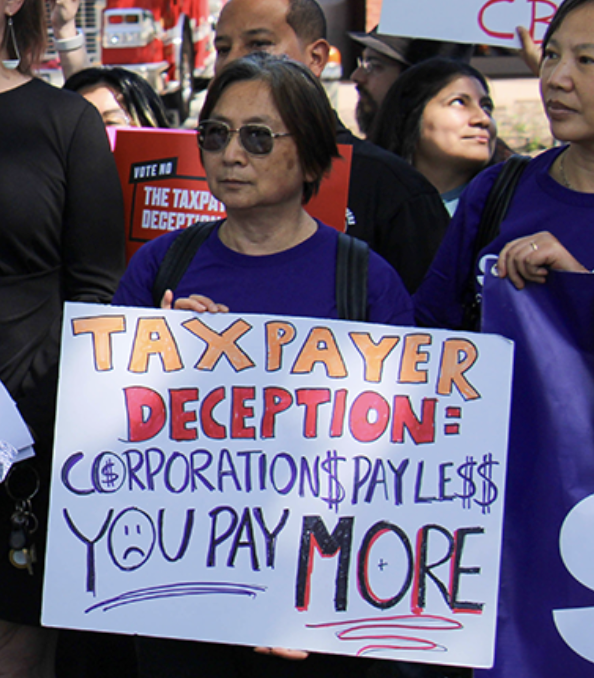
This November, California voters will confront the deceptively simple question of whether a small minority of voters be allowed to overrule nearly twice as many of their neighbors.
That is what Proposition 43 would do. The measure would amend the California Constitution to require two-thirds approval for any new, increased or extended local “special tax” placed on the ballot by voters. A special tax is simply one whose revenue must be used for a designated purpose, such as affordable housing, schools, fire protection, emergency response, hospitals or road repair.
Under current law, voter-proposed local special taxes can pass with a majority, the way democracy is supposed to work. Beginning January 1, 2027, Proposition 43 would raise the threshold to 66.7 percent.
The result would be a minority veto built for the 1 percent. When the rest of us vote to make corporations and the ultrawealthy pay their fair share for affordable housing, schools, fire protection and other basic services, those interests would not have to win a majority. They would only need to persuade a little more than one-third of voters to block what nearly two-thirds of the community wants. In practical terms, their “no” votes would carry almost twice as much power as our “yes” votes.
Even the measure’s official state title acknowledges its purpose: “Limits Voters’ Ability to Raise Revenues for Local Government Services.” The nonpartisan Legislative Analyst confirms that Proposition 43 would make it harder to pass certain local taxes and could leave local governments with less revenue than they would otherwise receive.
Supporters call Proposition 43 taxpayer protection. But it would not reduce anyone’s taxes, repeal an existing tax or create greater accountability for how public money is spent. It would change the rules of democracy so that a determined and organized minority could prevent the majority from funding services its community needs. That imbalance benefits the corporations and wealthy interests best equipped to finance opposition campaigns. They wouldn’t need to convince most voters that a proposal is harmful. They would just need to win a little more than one-third of the vote.
Measure ULA provides a clear local example of what’s at stake. Los Angeles voters approved ULA in 2022 with nearly 58 percent of the vote. The measure established a one-time tax on the city’s largest real-estate transactions, with the revenue dedicated to affordable housing, tenant protections and homelessness prevention. If Proposition 43’s threshold had applied in 2022, ULA would have failed despite receiving a decisive majority.
Proposition 43 would not repeal ULA (its haters are tabling that until next year). The measure is prospective, meaning the new threshold would apply beginning in 2027. But it would make it extraordinarily difficult for voters in other communities to adopt similar policies, or for Los Angeles voters to create new dedicated funding in response to future needs.
ULA demonstrates why the initiative process matters. It was developed by renters, labor unions, affordable-housing organizations, service providers and community groups that recognized elected officials were failing to meet the scale of the housing crisis. Voters acted directly, asking those benefiting from the city’s most expensive property transactions to contribute to keeping people housed.
That decision is already producing results. As of December 2025, ULA had raised more than $1 billion from the top 4 percent of Los Angeles real-estate sales. Its funding supports permanently affordable housing, eviction defense, emergency rental assistance, tenant outreach, protections against landlord harassment and assistance for rent-burdened seniors and people with disabilities.
The point is not that every local tax proposal is automatically good. Voters remain free to examine each measure and reject proposals they don’t support. The question is whether the majority should be allowed to make that decision.
Proposition 43 says no. It would impose gridlock at a moment when California communities need the ability to respond to overlapping crises in housing, public health, climate resilience and essential services. A city could develop a carefully targeted proposal, dedicate the revenue to a specific public purpose and persuade almost two-thirds of its voters, only to see the measure defeated.
The Mar Vista Voice Housing Justice Working Group is organizing a Westside campaign to defeat Proposition 43 and defend democratic, majority rule.
We’re hosting a community teach-in on Sunday, September 27, from 5:30 to 7:30 p.m. at Sadie’s in Westchester. Featured panelists will explain how Proposition 43 works, who benefits from it and why it threatens communities’ ability to fund local solutions. Organizations and service providers will also show how voter-approved ULA funding is already helping Angelenos remain housed. Free food from a local Westside street vendor will be provided. RSVP for the teach-in here.
We are also canvassing our neighbors in Mar Vista on September 19, October 3, October 17 and October 31. No previous canvassing experience is necessary. Volunteers will receive training, materials and support before speaking with neighbors. Sign up for a canvass here.