
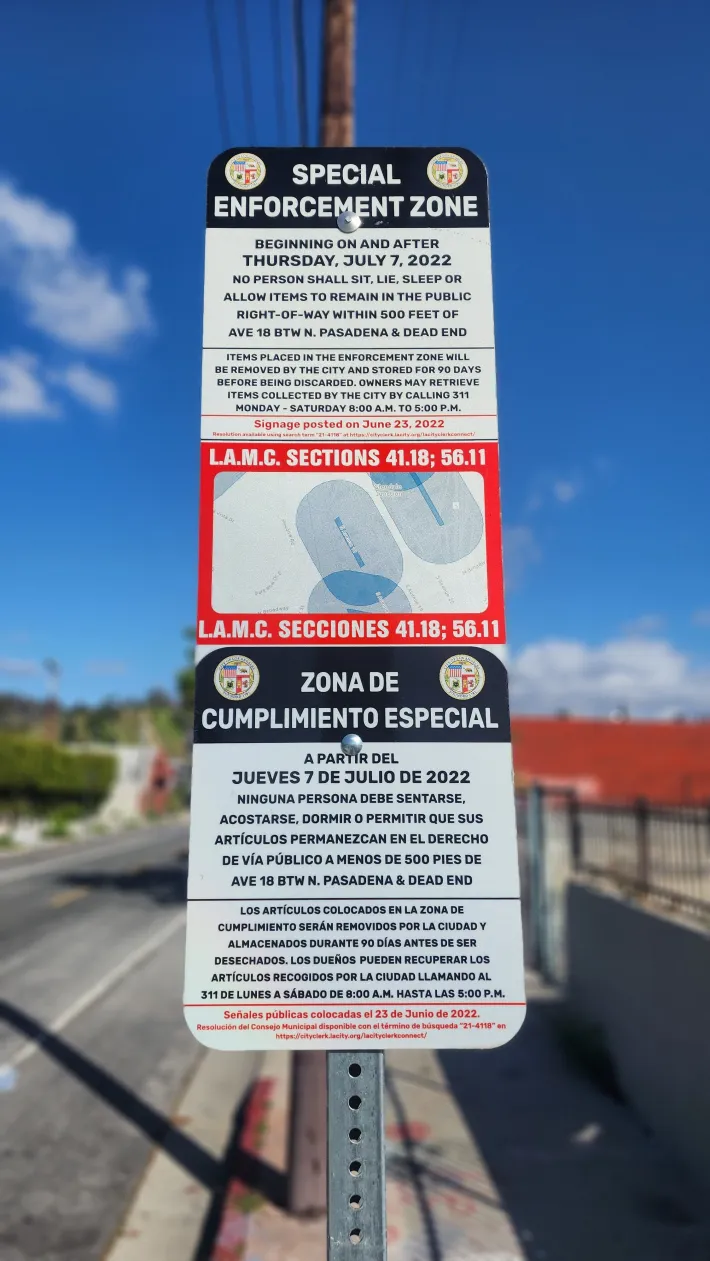
LA City Council approved seven new 41.18 enforcement zones proposed by Councilmember Traci Park on August 4, even after community members warned that the resolution lacked the required documentation and that CD11’s last-minute attempt to supply it contained claims contradicted by conditions on the ground.
The resolution passed 10–4, with Councilmembers Hugo Soto-Martínez, Eunisses Hernandez, Ysabel Jurado and Nithya Raman voting no. Curren Price was absent, and authorizes the City to prohibit sitting, lying, sleeping and storing personal property at seven locations in Council District 11: 8925 South Sepulveda Boulevard, 8651 South La Tijera Boulevard and 8921 South Sepulveda Boulevard in Westchester; 604 Rose Avenue, 204 Hampton Drive and 720 Rose Avenue in Venice; and 12054 Wilshire Boulevard in West Los Angeles.
But the controversy is not limited to those seven locations. Park’s failed effort to fix the resolution at the last minute exposes a potentially citywide problem. Los Angeles appears to have repeatedly created 41.18(c)(4) zones without placing the evidence required by its own law into the public record. Some of those designations may also have exceeded their one-year legal limit while signs or enforcement remained in place.
Park introduced the resolution on July 1. It asserted that CD11 had “submitted / posted to the File relevant documentation” showing that conditions at the seven locations posed a “particular and ongoing threat to public health or safety.” But no such documentation appeared in the public council file when the motion was introduced.
That omission matters because subsection (c)(4) is not a general license for councilmembers to criminalize homelessness wherever they choose. The text of the ordinance requires the Council to determine, in a designating resolution and “based on specific documentation,” that continued sitting, sleeping, lying, storing property or obstructing the right-of-way at a location poses a “particular and ongoing threat to public health or safety.”
The law gives examples of what could support that finding, including a death or serious injury caused by a hazardous condition, repeated serious or violent crimes, or fires that resulted in a Fire Department response. It also limits each designation to a period specified in the resolution, which can be no longer than one year.
Park’s original resolution identified no incident at any of the seven sites. It included no dates, police reports, fire records, crime statistics or other location-specific evidence. Instead, it grouped seven addresses across three different neighborhoods beneath the same generic finding. It also recited language from a different part of the ordinance. The resolution declared that sleeping or lodging “within the stated proximity” of the sites was “unhealthy, unsafe, or incompatible with safe passage.” That language appears in subsection 41.18(c)(2), which permits zones of up to 500 feet around designated overpasses, bridges, tunnels, washes, railways and similar infrastructure.
Subsection (c)(4) contains no 500-foot authorization. It permits the Council to designate a particular section of the public right-of-way only after making the required evidence-based finding about that location.
After Mar Vista Voice alerted the Council and launched a one-click email campaign, Park’s office uploaded a four-page “Findings” document on August 3, one day before the vote. The document described itself as a summary of LAPD and LAFD “statistics and data” covering May 15, 2025, through May 15, 2026. But it contains no statistics and attached no data. There were no incident dates, report numbers, agency records, response logs, counts or descriptions that would allow the Council or the public to verify its assertions.
Instead, the submission repeated almost identical paragraphs for all seven sites. It claimed that “numerous individuals” had “consistently maintained an encampment” at every address for a year, that each sidewalk was “often obstructed,” and that police and firefighters had responded to “numerous emergency incidents,” including one or several encampment fires.
It did not say when any fire occurred, what happened, whether it occurred in the designated right-of-way, or whether the conditions that allegedly caused it still existed. It did not connect any police response to an unhoused person or to the conduct subsection (c)(4) prohibits. Nor did it provide the underlying records needed to determine whether its claims were true.
The submission then repeated the same legal error as the resolution, declaring sleeping within 500 feet of each address unsafe and incompatible with safe passage. The relevant ordinance provision does not authorize CD11 to turn a street address into a 500-foot exclusion zone under subsection (c)(4).
Ordinary sidewalk obstruction is already addressed elsewhere in 41.18. Subsection 41.18(a) prohibits obstruction that impedes ADA passage and regulates property near entrances, driveways, hydrants and permitted activities. If a generic claim that a sidewalk is frequently obstructed were enough to invoke subsection (c)(4), its requirements for a particular, ongoing and specifically documented threat would mean almost nothing.
Community members who regularly visit the Venice locations and conduct outreach to unhoused neighbors also disputed some of the submission’s most basic factual claims.
At 604 Rose Avenue, outreach volunteers report that no one had maintained an encampment on the designated side of the street. People sometimes stayed across the street but packed up each morning. They said St. Joseph Center security prevented people from setting up tents on the designated side and had the sidewalk power-washed daily.
Volunteers likewise report there was no encampment at 720 Rose Avenue during Park’s stated data period. A previous encampment was located across the street, outside the Whole Foods parking lot, and was cleared in March 2024, more than a year before the period the CD11 document purported to summarize.
Recent L.A. Material reporting corroborates that timeline. Whole Foods hired the private firm Ghost Town Consultants in early 2024, and the company participated in preventing people from returning after a March 2024 City cleanup. During the reporter’s recent visit, no tents remained around the Whole Foods perimeter.
The reporting also found that people were displaced, not housed. One person who had lived outside Whole Foods was found living one block away roughly two years later.
That account is incompatible with CD11’s claim that “numerous individuals have consistently maintained an encampment at 720 Rose Ave” for the past year. It places the former encampment across the street and its removal before CD11’s May 2025 to May 2026 reporting period even began.
When claims about two of the first sites examined conflict with both firsthand observation and published reporting, the Council cannot reasonably accept the document’s remaining assertions on faith, especially when CD11 supplied none of the records it claimed to summarize. The contradictions demonstrate precisely why subsection (c)(4) requires specific documentation instead of boilerplate representations from a council office.
The timing of Park’s submission is revealing. By rushing a document labeled “41.18 Resolution Documentation” into the file after residents challenged the original resolution, CD11 effectively acknowledged that documentation must be part of the record. But even this attempted cure did not meet that standard. It offered unsupported conclusions in place of the underlying evidence and did not repair the resolution’s failure to adopt a location-specific finding for each site.
The implications extend beyond CF 26-4118-S7. A preliminary review of other council files involving subsection (c)(4) shows that the City has adopted additional 41.18 zones without supporting evidence attached. Park’s last-minute submission highlights the same mandatory requirement those earlier resolutions have ignored.
This all creates urgent practical questions. How many subsection (c)(4) zones did the Council adopt without specific documentation? Which have expired? Where do signs remain posted? Where are City workers or police still using defective or expired resolutions to displace, cite or arrest unhoused people?
The Council’s short reconsideration window has passed, but it can still rescind CF 26-4118-S7 and investigate the broader system it has created. Mar Vista Voice is asking residents to demand that the Council rescind the seven designations, order a public audit of every 41.18(c)(4) zone, and remove signs and suspend enforcement at every location that lacks the required documentation or has exceeded its legal term. The audit should identify the evidence supporting each zone, its adoption and sign-posting dates, its authorized period and expiration date, any renewal, and its enforcement history. Click here to send the follow-up email.