

The Los Angeles City Council approved a sweeping new committee structure Tuesday that removes Councilmember Nithya Raman from leadership over housing and homelessness, gives Councilmember Traci Park a decisive role over renter protections and affordable-housing programs, and places two councilmembers with serious public-corruption and ethics records on the committee responsible for government efficiency and audits.
The changes, approved with Raman casting the only opposing vote, take effect August 31. The Council’s combined Housing and Homelessness Committee will be divided into a three-member Housing Committee and a five-member Homelessness and Health Committee.
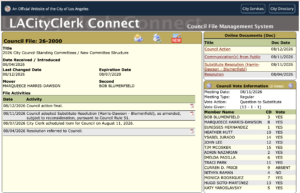
Councilmember Imelda Padilla will chair the Housing Committee, with Ysabel Jurado serving as vice chair and Park as its third member. Jurado will chair Homelessness and Health, with Tim McOsker as vice chair and Raman, Bob Blumenfield and Padilla serving as members. The new assignments were issued by Council President Marqueece Harris-Dawson.
The restructuring strips Raman of the chairmanship she used to advance renter protections, reform the city’s rent-stabilization formula and push for greater oversight of homelessness spending. It also removes her from the Housing Committee entirely, although she will remain a member of the separate homelessness panel.
Raman, who is challenging Mayor Karen Bass in the November election, called the decision political retaliation.
“I called for an audit of our homelessness programs in Los Angeles, and now I’ve been removed as Chair of the Housing and Homelessness Committee,” Raman said. “I might be getting punished for running against Mayor Bass, but Angelenos are the ones paying the price for these political games.”
Raman pointed to Bass’s continuing fight against City Controller Kenneth Mejia’s attempt to audit Inside Safe, the mayor’s signature homelessness program. She also cited her work creating a Bureau of Homelessness Oversight, although the city has still not hired anyone to lead it 16 months later, and the nearly 50 percent decline in homelessness reported in her district.
Harris-Dawson rejected Raman’s claim, telling journalist Noah Goldberg that it was “sad and pathetic frankly” and accusing her of allowing her ambition to produce “a cunningly devised falsehood.” But the timing is difficult to separate from the mayoral campaign. Raman has gone from leading the Council’s work on its most important policy crisis to holding no seat at all on the committee responsible for rent control, tenant protections, Measure ULA and affordable-housing development.
The separation of housing from homelessness is itself a telling policy choice. The city cannot meaningfully reduce homelessness without preventing evictions and producing permanent housing, yet those responsibilities will now be divided between committees with different memberships and potentially conflicting priorities.
“I oppose splitting the Housing and Homelessness Committee in two,” community member Oren Hadar wrote to the Council before the vote. “The two policy areas are inextricably linked. The word we use to describe people experiencing homelessness is literally ‘unhoused’.”
Good-government advocate Rob Quan put it succinctly: “It’s almost like they don’t want to house people.”
The decision to pair homelessness with “health” is also revealing. The new committee’s jurisdiction groups homelessness with health care, mental health, drug use and communicable diseases. Those issues can intersect with homelessness, but homelessness is not a medical diagnosis. It is principally the condition of not having housing.
The restructuring therefore makes a striking conceptual choice, separating homelessness from housing while formally associating it with illness, addiction and individual dysfunction. That framing risks encouraging more spending on forced treatment and the management of people in public space while the committee responsible for keeping tenants housed and producing affordable homes moves in a different direction. It treats homelessness as a condition located in unhoused people rather than the predictable result of unaffordable rents, eviction and an inadequate supply of deeply affordable housing.
The new composition of the Housing Committee is even more alarming. Park and Padilla together constitute a potential two-vote majority over renter protections and affordable-housing programs, leaving Jurado powerless whenever they align. As chair, Padilla will also exercise substantial control over which files receive hearings. The two would not necessarily need to cast public votes against a proposal. An item could simply remain pending without ever reaching the full Council.
This is not an abstract procedural concern. Some of the city’s most consequential renter protections reached the full Council only after passing through the Housing and Homelessness Committee.
For example, in January 2023, the committee advanced the city’s permanent post-pandemic tenant-protection package, including citywide just-cause requirements, relocation assistance for certain no-fault evictions and protections against eviction over relatively small amounts of unpaid rent. Park opposed major portions of that package when it reached the Council. Under the new structure, comparable protections could be stopped 2–1 before most Angelenos ever learn that they were proposed.
The committee also advanced the 2024 strengthening of the Tenant Anti-Harassment Ordinance, intended to address coercive tactics landlords use to push tenants from rent-controlled apartments. Park was among the small minority that opposed the measure. Future efforts to strengthen enforcement, increase penalties or close loopholes would now have to pass through a committee on which Park controls one of the two votes needed for approval.
The clearest example came during the 2025 debate over annual increases in rent-stabilized apartments. Raman’s committee advanced a stronger formula tying allowable increases to 60 percent of inflation and imposing a 3 percent ceiling, although the full Council ultimately weakened the proposal. During the floor fight, Padilla and Park voted identically on four contested amendments, while Jurado took the opposing position each time. Had the newly announced committee existed then, Padilla and Park would have had the votes to prevent the stronger proposal from leaving committee at all.
The same gatekeeping power applies to Measure ULA. Housing Committee actions have helped determine how the voter-approved tax is spent on affordable-housing construction, rental assistance, eviction defense, tenant outreach and income support for rent-burdened seniors and people with disabilities. Some spending plans also require Budget Committee approval, but Housing is an essential first stop. A Park-Padilla majority could reduce programs, attach restrictive conditions, delay contracts or prevent proposals from reaching Budget and the full Council.
The committee will also oversee the Los Angeles Housing Department and Housing Authority, affordable-housing financing, housing preservation, rent control, residential code enforcement and the Rent Escrow Account Program. That means the threat is not limited to major legislation. Project loans, legal-services contracts, enforcement programs and administrative approvals can be delayed until funding expires or projects become financially infeasible.
There are limits to the committee’s reach. Most citywide zoning changes and land-use decisions will continue to pass through the Planning and Land Use Management Committee, and major expenditures may also require Budget Committee approval. Park and Padilla will not control every decision affecting housing construction. They will, however, control the principal gateway for renter protections, Measure ULA programs and much of the city’s affordable-housing machinery.
Park’s appointment is especially difficult to defend given her record. She has voted against eviction protections, relocation assistance, stronger tenant anti-harassment rules and rent-stabilization reform. She has sought to weaken Measure ULA, opposed state and local housing reforms and repeatedly obstructed affordable and supportive housing projects in her district, including Venice Dell.
The restructuring’s other glaring contradiction is the membership of the Government Efficiency, Innovation and Audits Committee. Curren Price will chair the three-member panel, with Blumenfield as vice chair and John Lee as its third member.
The committee is charged with overseeing financial and operational audits of city departments, government liability, records retention, purchasing practices and strategies for reducing waste. Price, however, was ordered this week to stand trial on 12 felony public-corruption charges, including embezzlement of government funds, conflicts of interest and perjury. Price has pleaded not guilty and the charges have not been proven at trial. He will also remain vice chair of the Public Safety Committee, which oversees law enforcement while the District Attorney’s Public Integrity Division prosecutes him.
Lee, meanwhile, was found by the Los Angeles Ethics Commission to have committed 10 violations of city ethics laws involving undisclosed gifts, misuse of his city position and a lavish Las Vegas trip financed by businessmen seeking city business. The commission imposed a fine of more than $138,000. Lee disputes the findings and has sued the Ethics Commission. He will now help oversee the city’s audits and liability-reduction strategies.
Taken together, the changes do more than redistribute committee assignments. They separate homelessness from the housing policies necessary to prevent it, empower two councilmembers who have repeatedly resisted tenant protections to control whether those protections reach the full Council, and entrust oversight of city ethics and efficiency to officials facing some of the Council’s most serious corruption and ethics controversies. Committee structure may sound procedural, but it determines which ideas receive hearings, which programs receive funding and which proposals quietly disappear. In this case, the restructuring by the Council President shifts that power away from housing people and protecting tenants and toward the councilmembers most likely to stand in the way.