
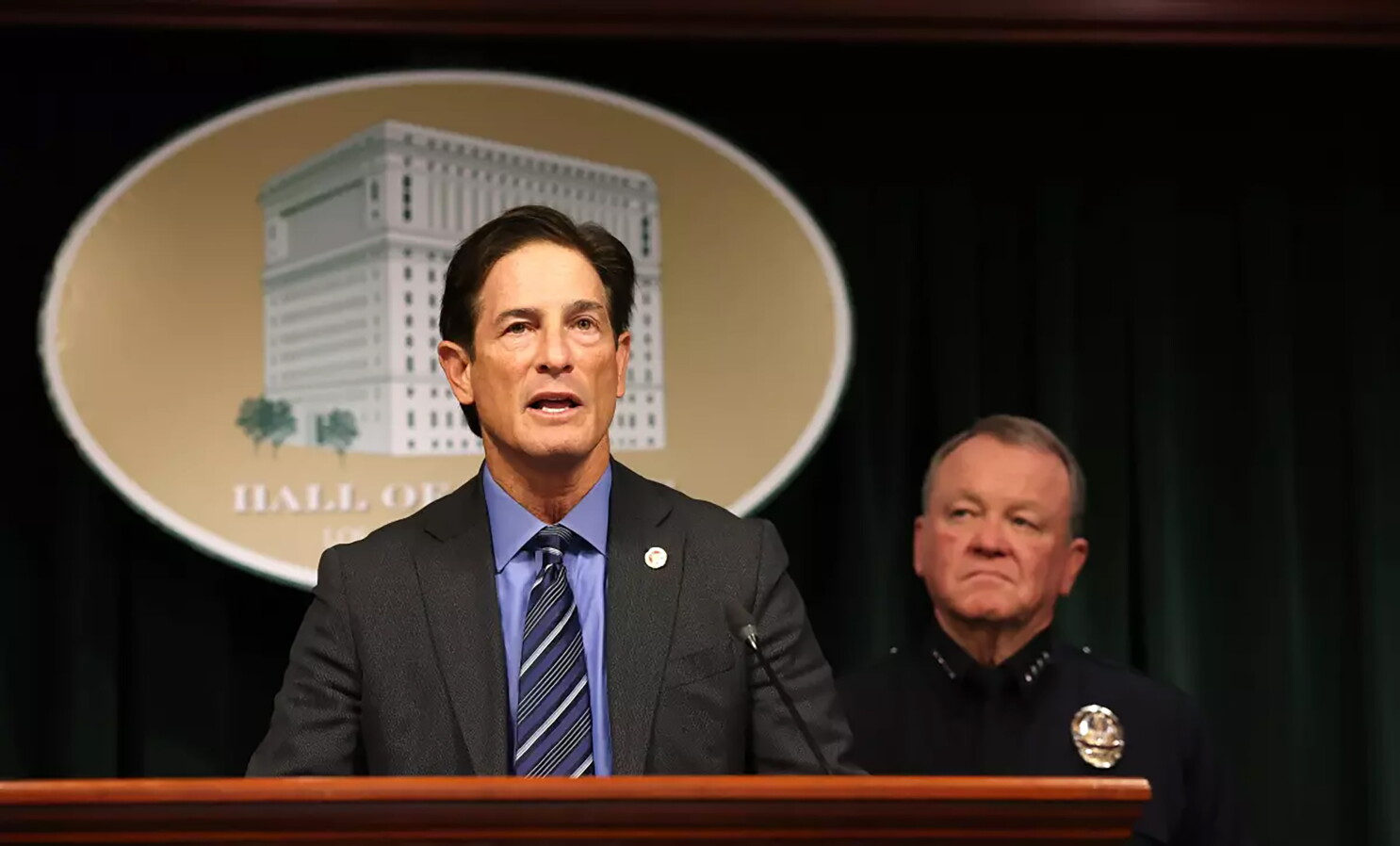
A Los Angeles Police Department officer who secretly recorded coworkers allegedly making racist, sexist and homophobic remarks has been charged with sixteen felonies, exposing him to up to thirteen years in prison. Officer Daniel Flores is scheduled to be arraigned August 10 on charges of eavesdropping on or recording confidential communications without the consent of everyone involved.
Flores made the recordings in 2024 while assigned to the LAPD’s Recruiting and Employment Division, according to the Los Angeles County District Attorney’s Office. The unit conducts background investigations and helps decide which applicants can become police officers, giving the alleged conduct significance beyond an offensive workplace conversation. Bias among the employees evaluating candidates could affect who is admitted to and excluded from the department and who is given police power over the public.
California generally prohibits recording a confidential conversation without the consent of all participants. District Attorney Nathan Hochman said that protection applies regardless of where a person works or why a recording is made, although the law excludes conversations held under circumstances in which participants could reasonably expect to be overheard or recorded. Flores’s attorneys have said they intend to argue that the workplace conversations were not legally confidential and that Flores was acting within his duties as an officer investigating misconduct.
The criminal complaint concerns sixteen alleged recordings, but Flores reportedly gave LAPD Internal Affairs approximately 90 recordings made between March and October 2024. According to a retaliation lawsuit Flores filed against the City of Los Angeles in June, his supervisors and coworkers repeatedly made derogatory comments about Black, Latino, Asian and LGBTQ people, as well as women. The recordings have not been released publicly, and the allegations in Flores’s lawsuit have not been proven in court.
Four employees assigned to the division, reportedly a lieutenant, a sergeant and two officers, were sent home without police powers after the allegations became public in February 2025. Mayor Karen Bass called the alleged remarks “outrageous and unacceptable,” while Police Chief Jim McDonnell promised a full investigation and said racism and discrimination had no place in the department.
It remains unclear whether any of those employees were ultimately disciplined or whether LAPD reviewed hiring decisions they may have influenced. California’s police personnel confidentiality laws allow the department to withhold most information about internal investigations, leaving the public unable to compare LAPD’s treatment of the alleged conduct with its response to Flores.
What is publicly known is that LAPD investigated Flores for making the recordings. That administrative investigation found he had violated department policy and recommended a 22-day unpaid suspension, according to his attorney. LAPD also investigated him for possible criminal violations and submitted the case to the District Attorney’s Office.
Hochman’s office chose to file sixteen felony counts rather than misdemeanor charges or no criminal charges. Although Hochman said the employees accused of making discriminatory remarks should be held accountable, he characterized Flores’s decision to record them as pursuing a “personal agenda” and said workplace misconduct could have been addressed through proper legal channels.
Flores did ultimately use LAPD’s formal reporting process by submitting the recordings to Internal Affairs. His case therefore raises questions about whether employees can safely document misconduct that might otherwise be denied, particularly when the evidence implicates supervisors or people with authority over their careers. LAPD policy prohibits retaliation against employees who report misconduct, but that protection does not necessarily make a secret recording lawful.
Flores’s attorney, Alan Jackson, said the prosecution tells LAPD employees that remaining silent is safer than documenting bigotry. The District Attorney’s Office argues that the case should serve as a warning to anyone considering recording a confidential conversation without permission.
The dispute comes amid broader questions about LAPD’s willingness to investigate racial bias within its own ranks. From 2016 through 2025, the department received 4,878 allegations of biased policing, according to California Department of Justice data reviewed by the Los Angeles Times. Only three were sustained, and only one officer was fired. Studies have also repeatedly found that Black and Latino Angelenos are stopped and searched by LAPD at disproportionate rates.
Those disparities make the alleged conduct inside the recruiting division a public concern rather than merely an internal personnel dispute. The employees in that office helped determine the composition of a department whose officers exercise the power to detain, search, arrest and use force. Los Angeles officials have not announced an independent review of whether bias affected the unit’s decisions about police applicants.
The prosecution also has a direct political connection to Council District 11. Councilmember Traci Park was one of Hochman’s most active elected supporters during his 2024 campaign for district attorney. The LA Times reported that Park appeared on his behalf at fundraisers, news conferences and neighborhood events, while Park told Westside voters that they were tired of crime occurring “without fear of consequence” and wanted a district attorney who would “clean up the streets” and hold people accountable. Park’s political career has also been heavily supported by the Los Angeles Police Protective League, the union that represents LAPD officers through the rank of lieutenant. LAPPL spent a total of almost $1 million on Park’s 2022 and 2026 campaigns.
Park’s alliance with Hochman and the police union is particularly striking because she spent roughly two decades as a management-side labor attorney defending cities and corporations against workers alleging discrimination, harassment and retaliation. In Harrell v. City of Anaheim, Park defended the city and a supervisor accused by a Black employee of repeatedly using the n-word in his presence, making other racist remarks and humiliating him. The employee alleged that Anaheim later fired him after he complained. Park sought to dismiss the case, arguing that “not every utterance of a racial slur in the workplace” constitutes unlawful harassment.
The Flores prosecution follows the same imbalance. Alleged racism by supervisors is treated as an internal personnel matter or a technical legal question, while the employee who documented it faces sixteen felony charges and as many as thirteen years in prison. The punitive approach Park helped Hochman sell to Westside voters is now being used in a way that shields the institution and warns other officers about the consequences of creating evidence against their colleagues.
The imbalance is also visible in what the public is allowed to know. Flores’s criminal prosecution is public and comes with a stated maximum prison sentence. Any discipline imposed on the employees he recorded is largely shielded from disclosure, meaning Los Angeles residents may learn far more about the punishment of the person who created the evidence than about the alleged conduct the evidence revealed.
Flores has not yet entered a plea and is presumed innocent. His arraignment is scheduled for August 10 at the Foltz Criminal Justice Center, while his retaliation lawsuit against the city remains pending.