
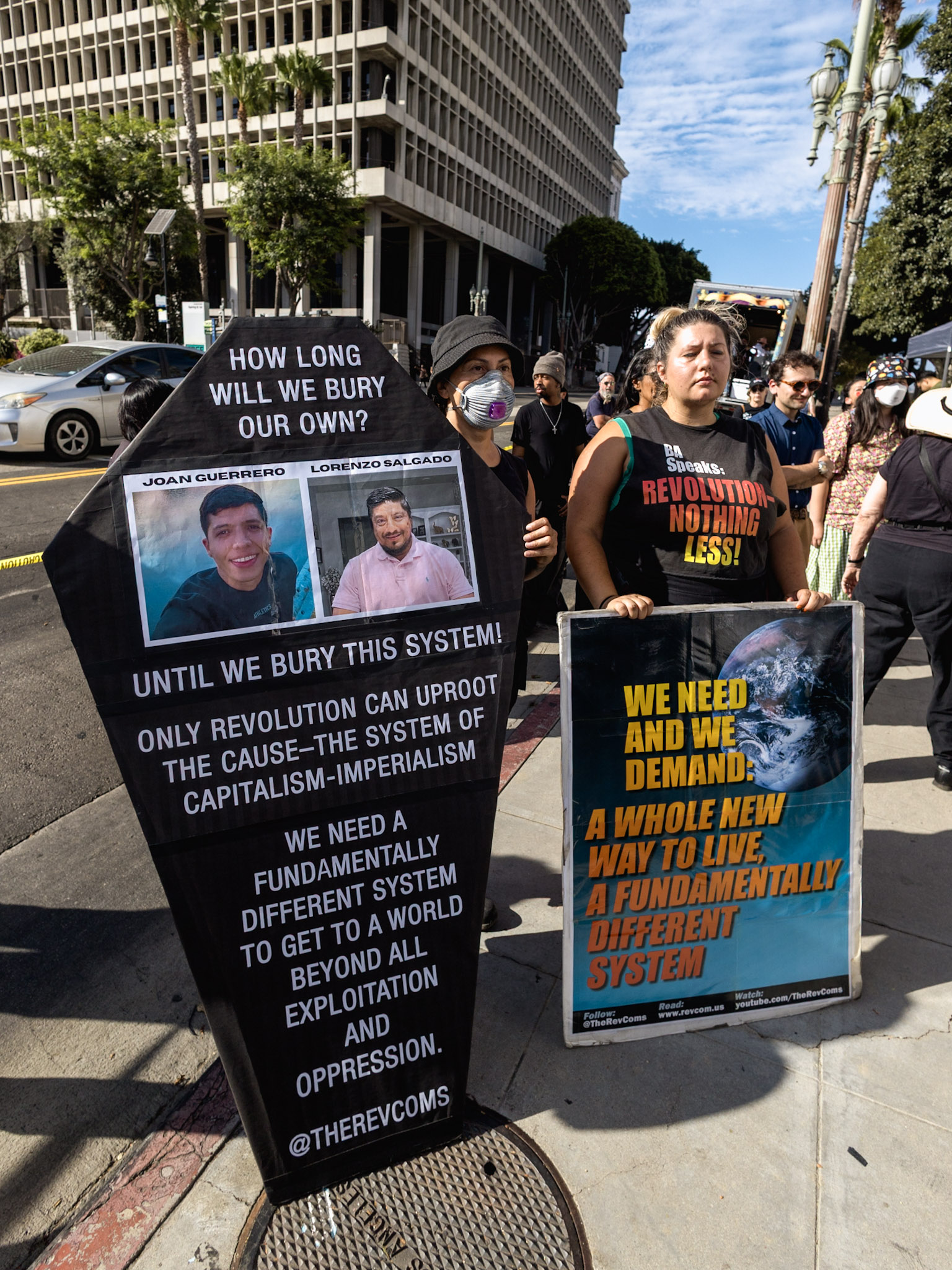
Hundreds of people marched through downtown LA on Saturday carrying 75 black coffins, one for each life organizers say has been lost to ICE detention, deportation and immigration-enforcement shootings since Donald Trump returned to office.
The funeral procession began Saturday afternoon at Los Angeles City Hall, where volunteers placed the symbolic coffins beside 75 signs bearing the names of the dead. More than 200 people gathered despite temperatures reaching 90 degrees, according to L.A. TACO.
The memorial was organized by a coalition that included Unión del Barrio, the Community Self Defense Coalition, NELA for Democracy, 50501SoCal, the Coalition for Humane Immigrant Rights of Los Angeles, Clergy and Laity United for Economic Justice, Venice Resistance and the Pilipino Workers Center.
After speeches and songs outside City Hall, volunteers lifted the coffins and carried them through downtown toward Placita Olvera. Los Jornaleros del Norte, a band formed following an immigration raid in the City of Industry in 1995, led the procession with cumbias and corridos. People cried as organizers read the names of those who died, but the procession also became a celebration of their lives and a call for communities to defend one another.
“These people that have been murdered, they have been patrollers, they have been parents,” one Unión del Barrio volunteer told L.A. TACO. “They have been folks that have also died behind bars at concentration camps.”
The organizers emphasized that these deaths are not isolated mistakes within an otherwise functioning system, but the predictable consequences of a deportation apparatus designed to imprison people, separate families and terrorize entire communities.
“We cannot reform ICE,” the volunteer said. “We cannot fix it with body cameras or accountability measures. It must be abolished.”
That machinery reached the Westside again just days after the procession. At approximately 7 a.m. on Tuesday, July 28, federal immigration agents carried out a targeted arrest near Culver Boulevard and Dawes Avenue, just south of Mar Vista. West Los Repuesta Ràpida verified that one person was detained at or near 11612 Culver Boulevard.
According to the group’s community report, at least three agents participated in the operation. They arrived in a black Dodge Challenger and black Dodge Durango and wore plain clothes, tactical vests and masks. At least one agent was armed and wearing a helmet. The agents had left the area by the time the group issued its update.
This was the second verified Westside immigration arrest in less than a week. On July 23, federal agents abducted a person outside Santa Monica City Hall, directly across from the Santa Monica Police Department.
The proximity of these operations makes the downtown funeral procession feel anything but symbolic. As Angelenos gather to mourn those already killed by this violent deportation system, masked and armed federal agents continued taking people from Westside neighborhoods and across the city.
The terror extends far beyond the person placed in custody. Every raid leaves families wondering whether a loved one will come home. Workers avoid job sites, vendors lose customers, parents reconsider taking their children to school and immigrants retreat from public life. That widespread fear is not an accidental side effect of mass deportation, but one of its main tools.
The person detained on July 28 was a gardener leaving a job site with his son when ICE agents stopped him. He is a husband and father of four, and his family has now been left without its primary wage earner. West Los is asking the community to help the family cover food, rent and other essential household expenses as they navigate his detention. Visit @westla.rrn on Instagram for the latest verified information about donating directly to the family.
Anyone who witnesses suspected immigration enforcement activity on the Westside can call the West Los Angeles Rapid Response hotline at 310-513-5539. Organizers ask community members not to intervene alone or spread unverified information, but to report the location, vehicles and activity they observe so trained responders can investigate.