
Los Angeles City Attorney Hydee Feldstein Soto announced last week that her office has filed what it describes as the first civil lawsuit under the city’s strengthened Tenant Anti-Harassment Ordinance, accusing the owner of a rent stabilized apartment building in South Los Angeles of carrying out a campaign of harassment to force longtime tenants from their homes so he could charge higher rents. It is exactly the kind of case tenant organizers spent years trying to make easier to prosecute. It’s also a reminder that stronger tenant protections are only as effective as their enforcement.
According to the complaint, landlord Femi G. Olanipekun purchased the eight-unit building in October 2025 and, within days, told tenants they had until March to leave because their rents were too low for him to make a profit. One tenant allegedly recorded the conversation on a doorbell camera. The complaint also alleges that Olanipekun later made the same admission to the LA Housing Department. After LAHD determined that his eviction notices lacked the legal basis required under the Rent Stabilization Ordinance, the City alleges he launched “an unrelenting campaign” to drive tenants out anyway.
The lawsuit accuses the landlord of repeatedly shutting off water service, removing trash bins, attempting to revoke parking rights, demanding tenants begin paying for water and trash collection, repeatedly entering a tenant’s enclosed patio without notice, attempting to ban pets, imposing unlawful late fees, and continuing to pursue illegal evictions. If proven, the allegations paint a picture not of a landlord trying to maintain a building, but of one trying to make living there so difficult that tenants would leave on their own.
What makes this case so striking is not simply the breadth of the alleged harassment, but that the complaint lays bare the economic incentive behind it. When housing is treated as a commodity, replacing longtime rent stabilized tenants with higher-paying ones can become a lucrative business strategy. Most of the time, that profit motive must be inferred from a landlord’s actions. Here, according to the City, the landlord said the quiet part out loud.
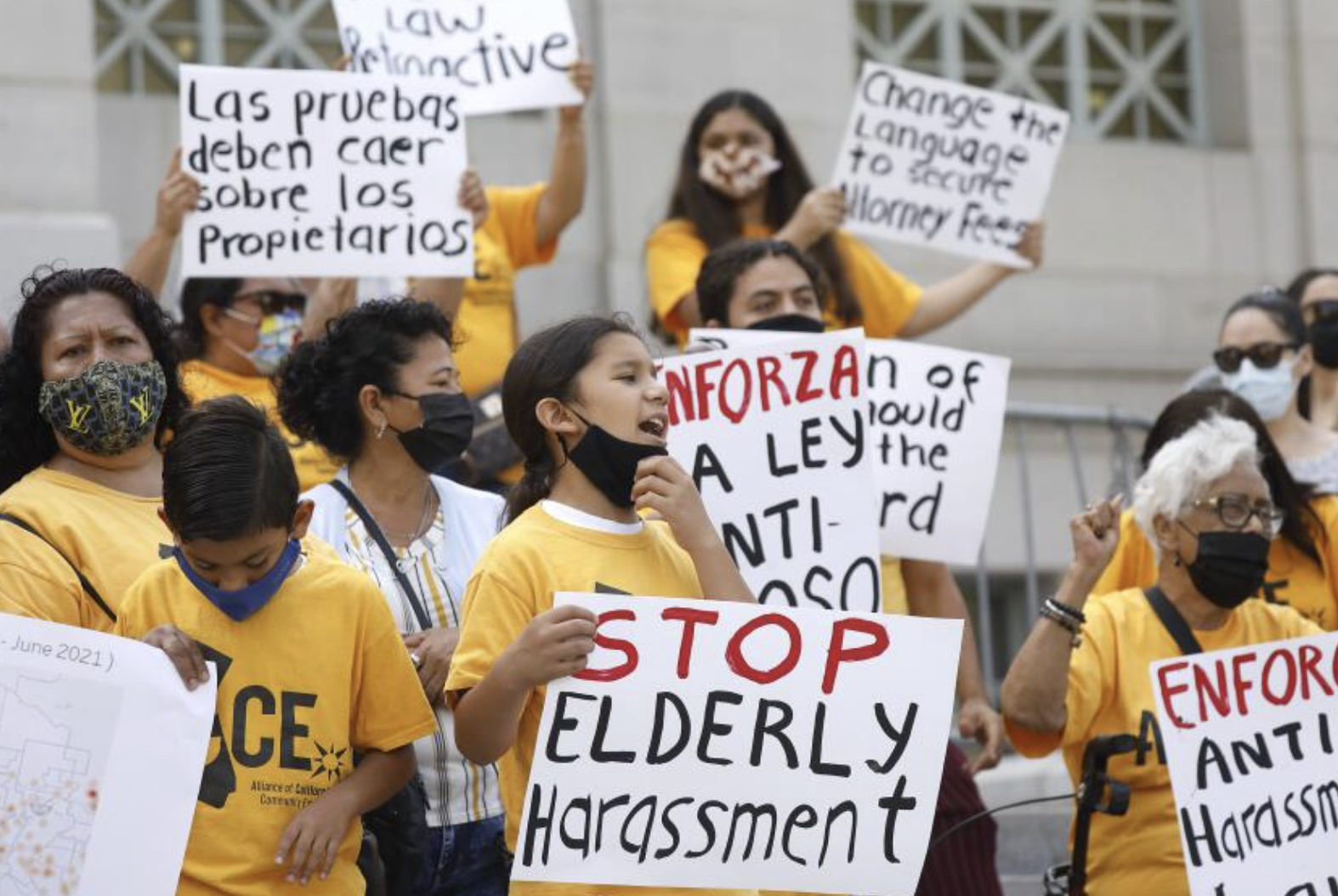
That is why the Keep LA Housed coalition first fought to pass the Tenant Anti-Harassment Ordinance in 2021 and then returned to City Hall in 2024 to strengthen it. The ordinance emerged during the height of the COVID-19 pandemic, when eviction moratoriums and rent freezes temporarily prioritized keeping people housed over maximizing returns on rental properties. Tenant organizations argued that some landlords, unable to legally evict tenants, increasingly turned to harassment, unlawful buyout pressure, utility shutoffs, illegal entries, and other tactics to pressure renters into leaving anyway. The pandemic exposed the fundamental tension in a housing system where homes are treated as financial assets as well as places to live.
The original ordinance was an important victory, but organizers concluded it remained too difficult to enforce. They returned to City Hall in 2024 and won a strengthened law that broadened the definition of harassment, strengthened legal remedies, and made it easier for both tenants and the City to bring cases.
But changing the law was only one challenge. The City also had to build the infrastructure needed to carry out the new ordinance. In a report presented this week to the Measure ULA Citizens Oversight Committee, LAHD said it spent the first several years after TAHO’s passage building that infrastructure, including hiring investigators, formalizing referral protocols, creating an internal tracking system for referrals and enforcement outcomes, and expanding the ways cases could be resolved through criminal prosecution, civil litigation, administrative enforcement, and legal services. Last week’s lawsuit is therefore significant not only because of the allegations it contains, but because it arrives as LAHD says that enforcement infrastructure is finally in place. The question now is whether that investment will translate into sustained enforcement rather than an isolated case.
By the time the infrastructure for enforcement was coming online, tenant advocates were also clashing with City Attorney Hydee Feldstein Soto over tenant protections, including months-long delays to Measure ULA-funded eviction defense contracts, investigations into tenant legal service providers that critics described as politically motivated, and other disputes over implementing ULA’s tenant protection programs.
The next challenge is determining whether this lawsuit represents the beginning of broader enforcement or an isolated case. Between 2021, when TAHO first took effect, and January 2026, tenants filed 23,326 harassment complaints with LAHD. Of those, only 30 were referred to the City Attorney for potential criminal prosecution, and the City Attorney filed just two criminal cases, both involving the same downtown landlord.
The public still has only limited visibility into what happens after a complaint is filed. LA City Controller Kenneth Mejia has helped shed light on the front end of the system through a public dashboard identifying the city’s rental properties with the most housing complaints and violations and a 2025 audit on the ordinance. Meanwhile, LAHD says it has developed an internal tracking system for TAHO referrals and enforcement outcomes and recently briefed the Measure ULA Citizens Oversight Committee on that work. But those enforcement metrics are not routinely available in a public-facing format that allows tenants and the broader public to evaluate how consistently the strengthened ordinance is being enforced over time.
While it’s important for Angelenos to know whether Los Angeles is enforcing TAHO consistently, enforcement is ultimately reactive, addressing harassment after it has already occurred. That’s why organizations like Keep LA Housed have consistently argued that stronger enforcement alone cannot solve the problem. As long as housing remains a commodity bought and sold for financial return, the incentives that produce tenant harassment and displacement will continue to exist. Laws like TAHO can deter unlawful conduct and provide meaningful remedies for tenants, but they don’t change the underlying economic forces that make replacing longtime renters with higher-paying tenants financially attractive.
That broader analysis shaped Measure ULA from the beginning. The same coalition that fought for TAHO also fought for ULA, not only to fund anti-harassment enforcement, but to invest in alternatives that begin taking housing out of the speculative market altogether. ULA funds nonprofit affordable housing, community land trusts, limited equity cooperatives, tenant acquisition of apartment buildings, eviction defense, and anti-harassment enforcement because each addresses a different part of the same problem. Some programs respond after displacement pressures emerge. Others seek to reduce the market pressures that create those incentives in the first place.