
While researching for a school project on education and literacy rates in Los Angeles, two Westside high school students, Audrey Lohara and Selvi Radia, found that LAUSD English learners were falling behind.
“Spanish-speaking emergent bilinguals failed to meet benchmarks in their grade levels in writing,” Lohara said, “more often than their native English-speaking counterparts.”
This disparity led to the creation of Second Sentence, a free writing summer camp created by Lohara and Radia to help struggling bilingual elementary and middle school students reach their potential in a fun, judgment-free environment. With funding from the Dragon Kim Foundation Fellowship and classroom space provided for free by St. Bede’s Episcopal Church, the weeklong program opened its doors in June 2026.
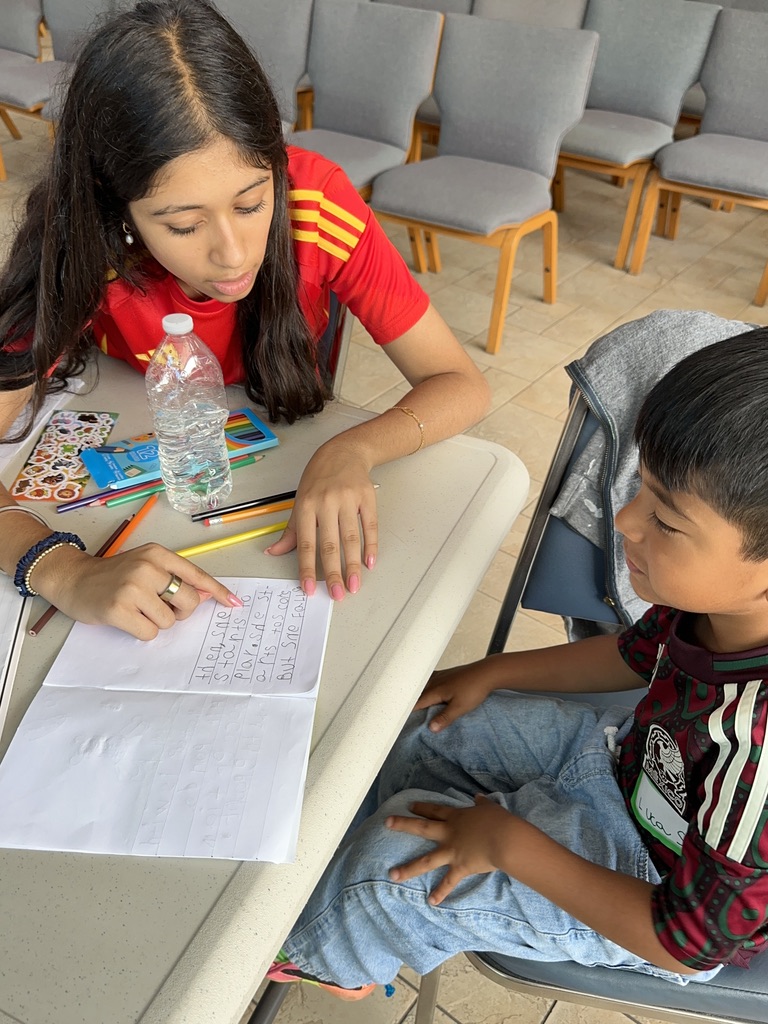
Run by trained high school volunteers and helmed by Lohara and Radia, the curriculum focuses on building writing confidence through foundational skills like grammar and descriptive writing, with the goal to help each student reach their grade-level benchmark. As a final project, each student publishes their own mini storybook that they can take home; a well-earned trophy for their achievements.
Already active community volunteers, both Lohara and Radia were primed to tackle the challenges and triumphs of their own community project before it even began.
Every few weeks, Radia and her family volunteer at SevaSphere, an organization that helps prepare and deliver meals to families on Skid Row. “The first time I volunteered there, it was incredibly eye-opening,” Radia said. She meets so many kids her age, many of whom were Hispanic, “often first-generation immigrants,” with limited access to food, education, and shelter. Using her Spanish speaking skills, she is able to build genuine connections with the people she helps. Her volunteer work directly impacted her approach to Second Sentence, teaching her both how to put her Spanish-speaking skills to good use and “the importance of connecting with people as individuals rather than simply learning about important issues through statistics.”
With Lohara’s volunteer work as a camp counselor at United in Harmony, she explained that being able “to see the impact [the camp] would have on them and the joy we bring them just by showing that we genuinely care” made a profound impact on how both teens approached their curriculum. They were also influenced heavily by their work with LAUSD emergent bilinguals specialists, who helped them shape the curriculum to make the students feel more welcome.
One of the influences was in the language and rhetoric: “I think we originally had started it as a camp for ESL [English as a Second Language] students,” Lohara said. “We learned the true importance of framing bilingualism as a strength… so that’s how we changed the language to emergent bilinguals.” This reshaping of language helped highlight the positivity of bilingualism to students who lacked confidence in their second language progression. Because seeking help can also be stigmatized, the program incorporated a hands-on approach to build students’ confidence on – and beyond – the page.
Lohara recounted one student in particular who had struggled with general participation in the camp: “At first [she] was very withdrawn from the class… didn’t want to be there.” She then spent a lot of one-on-one time with the student, guiding her through activities, making her feel supported and included. This approach worked and, by the end of camp, the student had written her story “with [Lohara] and her as the main characters.” Another student loved writing but didn’t feel comfortable sharing his work. As camp went on, his confidence grew through activities and building relationships with his peers. By the end, he shared his own mini storybook in front of everyone. When Lohara and Radia said they wanted to create an anthology with all of the stories and sell it on Amazon, his confidence grew even further: “people in India are gonna be reading my story.”
In addition to creating an anthology and planning a culminating family event in August, the teens are looking to build outside of Second Sentence. This includes a pen pal program during the school year and workshops during school breaks and occasional weekends. They have already developed a free interactive app to help students practice their writing skills through games, challenges, and activities, with feedback provided directly from Lohara and Radia.
Additionally, they have big aspirations for where Second Sentence can go, beyond its inaugural weeklong program. “[We] would love to collaborate with LAUSD to integrate Second Sentence into after-school programs or create a long-term space where the program can continue to grow,” Radia said.
What was discovered during a school research project has now blossomed into a community project, where a sentence or two can help students reach their full potential.
“Teaching writing was never just about grammar or vocabulary – it was about helping students find confidence in their own voices,” Radia said. “I hope Second Sentence continues to remind students that their stories matter and bilingualism is always a strength.”
To learn more about the program, go to secondsentencedkf.org or check out their Instagram @secondsentencedkf. To donate, head to their fundraising page and help them reach their goal.