
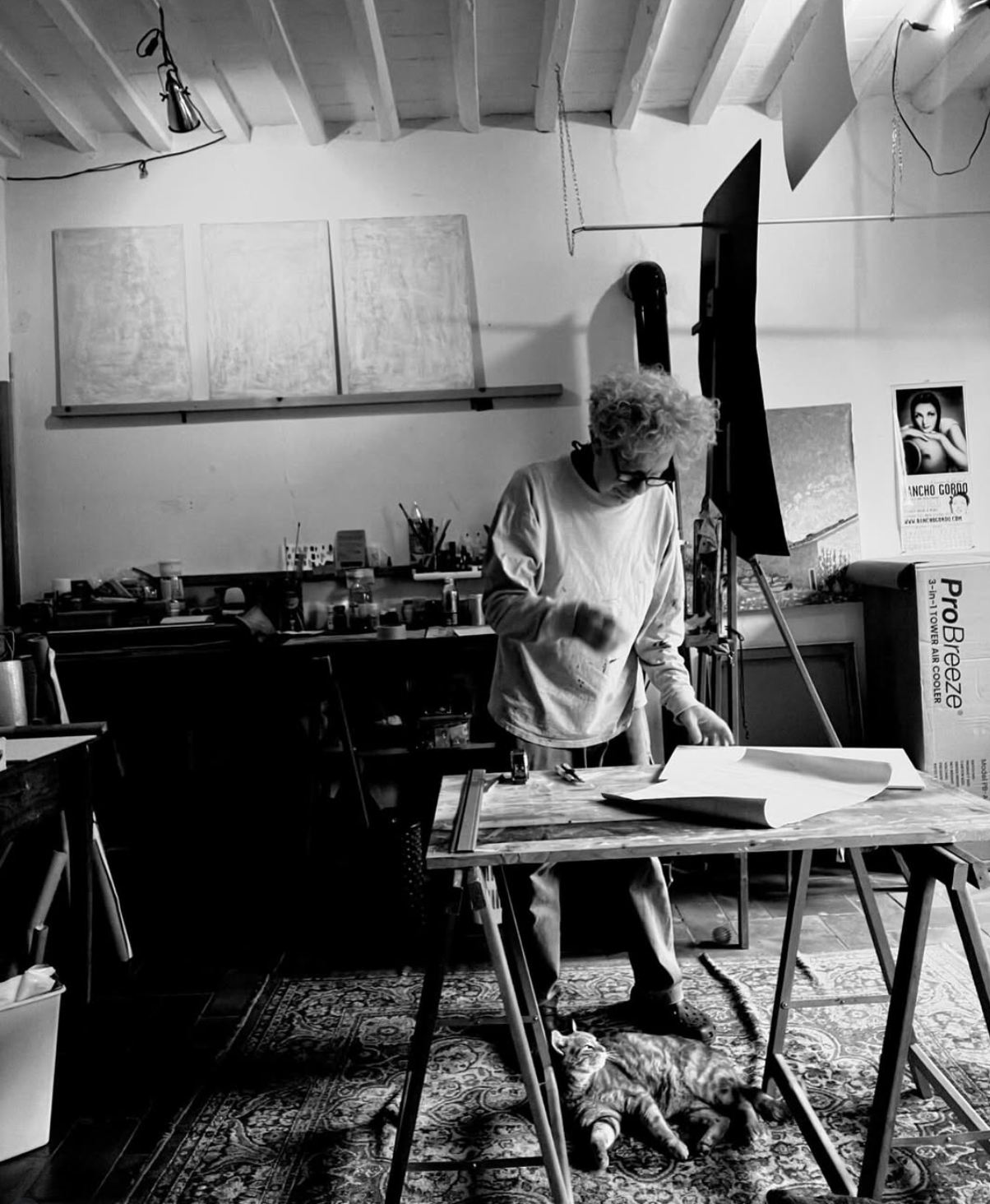
Brian Reynolds sets up his easel on a strip of sidewalk most people cross without registering. A stretch of Inglewood Boulevard at the top of the hill. The base of Grand View, looking up at the soaring palms. The chain link edge of the Ballona Creek channel, where the concrete runs flat and gray toward the ocean. Or where I found him, along Charnock Road overlooking the Sepulveda Creek Channel. He mixes color while cars pass a few feet behind him, and for an hour or two, a building or a structural detail that has been sitting there unremarked for sixty years becomes the only thing in the world worth looking at.
Reynolds has lived in Mar Vista since 2002, when he and his wife Susie moved into a small 1950s house not far from where he now keeps his studio, on Federal near Westminster. Before that, the two spent time in Austin, where they’d both gone to school and where Reynolds spent years working as a lighting and set technician on film and television productions, including a stint at Austin City Limits. The film work kept pulling them back to Los Angeles until it made sense to stick to the west coast.
Reynolds does not work from photographs. Most of his paintings begin outdoors, days spent laying in the composition on site, before he carries the canvas back to his studio to finish it. Even the studio work is still a record of something he stood and watched happen in real time, the particular slant of afternoon light that will never fall exactly that way again. A photograph freezes a moment, but Reynolds’ craft depends on duration. It asks him to notice a place slowly enough that the noticing itself becomes its own kind of labor.
“I see the soul of man in these buildings,” he said. “They’re not just buildings to me. They really speak.”
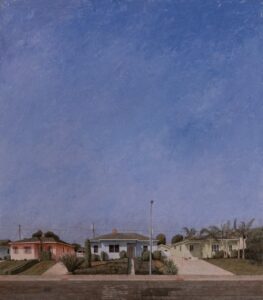
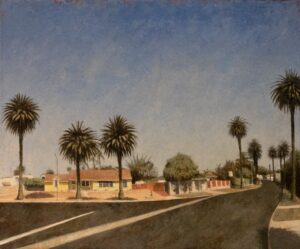
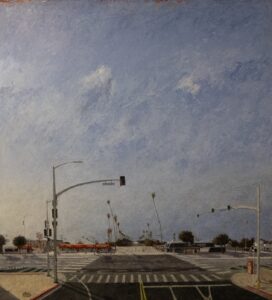
It’s a strange claim to make about postwar stucco and chain link fencing, and Reynolds knows it. His subjects are not the buildings anyone would put on a postcard. They’re the mid-century houses stacked in cheerful color on Inglewood across from the Mar Vista steps, one pink, one blue, one green, a set he latched onto so completely that he spent six months painting nothing else. They’re the sightline north from Venice at Grand View, a view he has returned to some twenty times over the years. What his paintings convey, quietly and without polemic, is that a building’s worth has less to do with its design or stature than with whether anyone passing by actually stops to notice it.
This gentle reminder in Reynolds’ scenes to notice the world around us would be purely aesthetic if the buildings he’s painting weren’t actually disappearing. Over the past two decades, Mar Vista has absorbed the same pressures reshaping the rest of the Westside. Small postwar houses, the very ones Reynolds paints, have been coming down at a steady clip, replaced by construction built to a different scale and a different market. Older apartment buildings haven’t just been remodeled. Many have been emptied out entirely through Ellis Act evictions, the state law that lets a landlord clear a rent-controlled building of tenants and pull it off the rental market for good. This pattern of displacement has hit close to home for renters across the Westside in recent years. The people who could once afford to live here on a teacher’s salary or an artist’s income increasingly cannot. Reynolds has spent twenty years painting a neighborhood that’s quietly disappearing underneath him.
Even the properties that aren’t facing redevelopment carry their own instability. At the end of his street sits an old farmhouse, a leftover from when Mar Vista was still just soybean fields, tied up for years in a family feud that has left it empty and overgrown. It happens to sit on the most valuable lot on the block. Reynolds assumes it will eventually come down too.
“The loss of some of the really spectacular small houses,” he said, “that kind of disheartens me.”
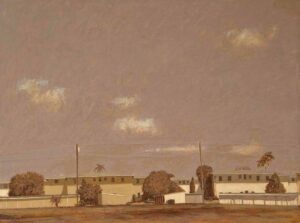 He’s been closer to that loss than the phrase suggests. For years, Reynolds painted the garden apartments at Lincoln Place in Venice, a mid-century complex designed by architect Heth Wharton designer Ralph Vaughn, one of the first Black architects to practice in Los Angeles. He painted in courtyards that emptied out after a corporation bought the property and began pushing tenants out to clear the way for redevelopment. In December 2005, sheriff’s deputies locked more than fifty households out of their apartments in a single day, the largest lockout in Los Angeles history, and by the time the fight reached its final stretch, a last dozen or so holdouts were still refusing to leave.
Reynolds kept showing up to paint the empty buildings in between, and the property manager called the police on him more than once, unsure what to make of a man painting a place that no longer breathed with inhabitants. Eventually the tenants won. The developer settled, agreeing to bring evicted residents back and restore what it had spent years trying to tear down. Reynolds’ paintings from those years are one of the only records of what those courtyards looked like while the fight was still underway.
 The same economics have started closing in on artists themselves. A set of studios that once sat near Grand View was torn down for a self-storage facility. Reynolds has watched the same slow squeeze work on the Hangar Gallery at the Santa Monica Airport, once home to roughly twenty working studios and an annual gala he would show at. He doesn’t frame any of this as a fight with a clean ending. “The battle of affordability and density versus what we have now is never going to end,” he said. And the artist isn’t only mourning the buildings that are gone. He’s mourning something quieter alongside them, the habit of actually noticing what’s still here.
“I think people miss everything,” he said. “People need to put their phones down and take a look at what’s around them.”
He draws the sharpest version of that argument from Italy, where he and Susie own a small house in a hill town, built in 1567, its stone walls nearly two feet thick. He isn’t shy about the fact that the place cost him less than a decent used car. What he loves about it is the visible depth of time and the sense that a wall that old has simply been paying attention to the world for far longer than he has. In 2016, Reynolds received a Pollock-Krasner Foundation grant, funding that sent him to Cuba just as the Obama administration was reopening travel between the two countries, and later to Italy for four months of painting.
Asked which three paintings would tell someone everything they needed to know about Mar Vista, Reynolds didn’t hesitate. The Oval, the view north from Venice Blvd at Grand View, and the row of small colorful houses on Inglewood. He’s currently finishing a series from Italy built around the beauty of decay, alongside a pencil study of the Ballona Creek culvert that he plans to keep working on, one more ordinary stretch of concrete he isn’t ready to stop looking at.
Residents can see more of his work at bhreynolds.com or on Instagram, where he posts regularly from Mar Vista, the Westside, and further afield.