
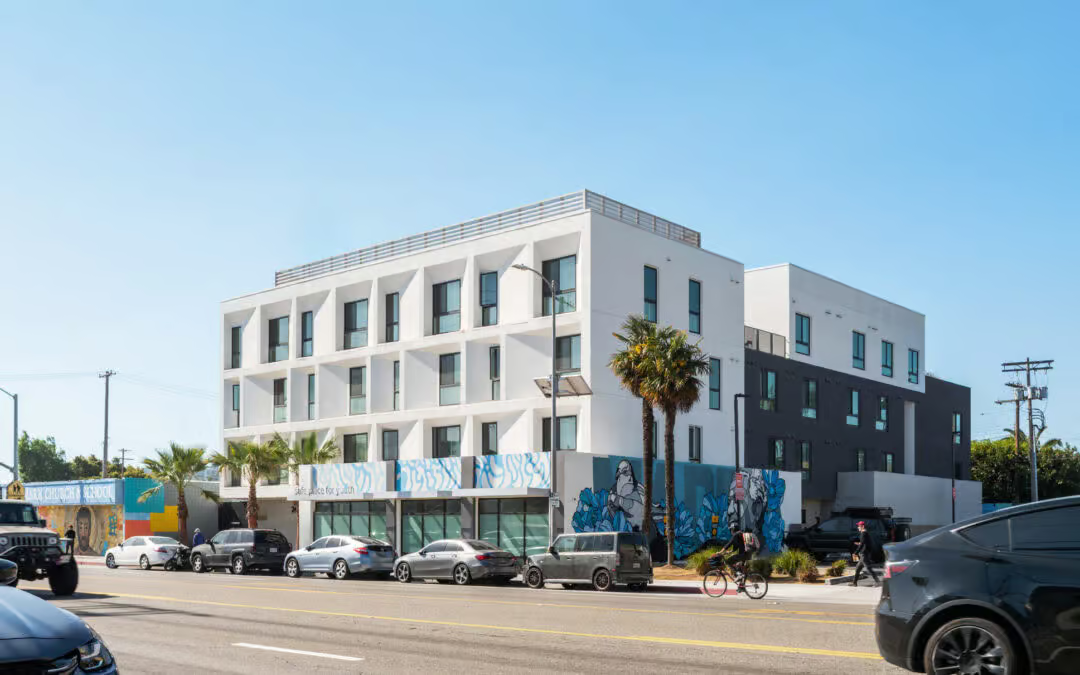
On June 29, local residents packed St. Mark Parish for what was billed as a community meeting about neighborhood concerns surrounding supportive housing. By the end of the evening, the gathering had become a public confrontation, aired by Fox 11, pitting frustrated neighbors and Councilmember Traci Park against two nonprofit housing providers.
Neighbors around The Journey, a permanent supportive housing development by Venice Community Housing, with Safe Place for Youth operating on the ground floor, described drug use, mental health crises, violence, property crime and disorder they attributed to the site, and wanted answers from the organizations operating it. Councilmember Traci Park stood alongside residents, criticizing Venice Community Housing’s handling of the property and arguing that supportive housing providers should be held responsible for neighborhood conditions and risk losing future funding if those conditions did not improve.
Interviews conducted by Mar Vista Voice, together with emails, planning documents and other records, show that a very different meeting was planned.
Planning for the June 29 “community meeting” evidently stretched back weeks and included five separate calls. Neighborhood tensions escalated this spring, and certain organizers decided a larger meeting was necessary. Sean Silva, Park’s Venice deputy, helped coordinate one of the planning calls after suggesting an additional meeting so the parties could show up with unified perspective. LAPD was invited in because residents wanted answers about public safety concerns beyond the housing developments themselves.
The June 29 meeting was also intended as a continuation of an existing process rather than a one-time event. VCH had held community meetings roughly every six months since The Journey opened in December 2024, first in the parish hall and later in The Journey’s community room. VCH Co-Executive Director Allison Riley said the meetings grew out of the organization’s commitment to maintaining an ongoing dialogue with neighbors and St. Mark Parish.
The written agenda for June 29 reflected that collaborative approach, including introductions, community agreements and small-group discussions where residents, service providers and government representatives would sit together identifying challenges and solutions. Each organization would explain its role, strengths, limitations and responsibilities before opening into a shared discussion about next steps. Father Albert van der Woerd reviewed the draft agenda beforehand and suggested more time for neighborhood input, prompting organizers to add community representative Brennan Lindner as one of the evening’s scheduled speakers.
Father van der Woerd confirmed this account, noting that VCH asked to use the parish hall and that the meeting was “their meeting and initiative.” The church provided the space and commented on the draft agenda but did not organize the event or identify speakers. The agenda, he said, was circulated beforehand to LAPD, Council District 11, the Mayor’s Office and St. Mark Parish.
Taken together, the interviews and planning documents describe a meeting built around the premise that neighborhood concerns were real, but responsibility for addressing them was shared. VCH could explain how permanent supportive housing operated and what authority it had over residents, while Safe Place for Youth could discuss the supportive services it provides on site. LAPD could respond to enforcement questions outside the residence, and Council District 11 and the Mayor’s Office could explain what city resources were available. Residents could then identify problems and collectively discuss solutions.
But most of the local residents in attendance never saw that agenda. Their understanding of the meeting was shaped elsewhere, through weeks of conversations with neighbors and growing concern about conditions around The Journey. One of the neighbors helping to organize the meeting was resident Brennan Lindner, who was tapped as community representative at the meeting after Father Albert van der Woerd requested more time for neighborhood voices. Lindner had long advocated for regular communication between providers and neighbors, including urging VCH to hold recurring community meetings before The Journey opened.
In the days leading up to June 29, Lindner created and distributed a neighborhood flyer announcing that Venice Community Housing and Safe Place for Youth would “hold a community meeting to address the increase in ‘issues’ around their property, and our schools, streets and homes,” adding his own perspective that those issues were “negatively impacting the safety and quality of life in the neighborhood.”
He also compiled an incident tracker documenting months of neighborhood disturbances that he believed illustrated the worsening conditions around The Journey. He told Mar Vista Voice he contacted a reporter he knows at Fox 11 because residents wanted broader public attention focused on the neighborhood. Together with ongoing conversations among neighbors and pre-meeting media coverage, those efforts helped shape expectations before residents ever walked through the doors of St. Mark Parish.
Lindner participated in planning meetings with VCH, SPY, Council District 11 and St. Mark Parish, and doesn’t dispute that providers envisioned a collaborative meeting. Where he differed was not over whether the meeting should happen, but over what the community needed from it. By June, he believed residents first needed an opportunity to be heard before any collaborative problem-solving could begin. By the spring, he said, neighborhood conditions had changed dramatically. Lindner keeps his own record of neighborhood disorder, a tally of sorts that opens with headings like “No SPY = No Issues” and traces overdoses, drug use, mental health crises and a nearby homicide. He believed residents first needed to tell their stories before any collaborative discussion could take place.
“I think you need to hear from us,” he recalled one resident saying as organizers began introducing the planned format. The room, he said, overwhelmingly agreed. “Everybody was on edge.”
The meeting departed from that plan almost immediately. Instead of breaking into facilitated small-group discussions, attendees demanded an open microphone. Residents spoke for nearly an hour, many carrying handmade signs demanding accountability from VCH and SPY. A resident-made video montage displayed Citizen app alerts, photographs of unhoused people and images of neighborhood incidents. VCH officials later said many of those incidents were not connected to The Journey itself but reflected homelessness and public safety concerns more broadly throughout Venice.
Erika Lee, VCH’s Co-Executive Director, said organizers felt they had prepared for a fundamentally different kind of meeting. “We did all these prep calls to show an allied response,” she explained. “We’re trying to work in the community and figure out with all the stakeholders what we can do to resolve these issues.” Instead of moving into the planned agency presentations and breakout discussions, the collaborative structure dissolved almost immediately as residents rejected the planned format in favor of an open public forum.
Looking back, Father van der Woerd agreed with that decision, saying VCH and SPY “allowed the neighbors to share their concerns,” calling it “a good choice,” and that both organizations “were responsive to the issues that were raised.”
But in that moment, the purpose of the meeting shifted. By the time Traci Park rose to speak near the end of the evening, the central question was no longer how multiple institutions could respond to a complex neighborhood problem. It had become whether supportive housing providers and the Housing First model they represented were themselves the problem. At that point, the meeting had become a public forum that closely aligned with the legislation Park had introduced just three days earlier.
On June 26, Park introduced Council File 26-0956, directing city departments to report back on new standards for permanent supportive housing. While publicly framed as an accountability and safety measure, it reaches well beyond operational questions like security staffing or property management. As Mar Vista Voice previously reported, the motion asks the city to examine requiring comprehensive screening before people are placed into permanent supportive housing, to consider alternative placements for people deemed too high-risk, and to develop new operating standards for providers citywide.
The proposal did not emerge in isolation. Throughout her time in office, Park has repeatedly championed enforcement-first responses to visible homelessness, expanded anti-camping zones, supported restrictions on vehicle dwelling, opposed or sought to delay supportive housing projects. She even described Los Angeles’ Housing First approach as a “failed social experiment.” Council File 26-0956 is the clearest legislative expression of that broader philosophy to date, urging that access to permanent supportive housing should become more contingent on behavioral screening, risk assessment and other eligibility requirements.
Ndindi Kitonga, founder of Palms Unhoused Mutual Aid, rejected that characterization. “Housing First is not a ‘failed social experiment,'” she said. “We’ve never attempted it with any level of seriousness.” Instead, she argued, Los Angeles has relied on sweeps, expanding enforcement zones and other punitive measures while failing to invest adequately in housing and care. “Sweeping people, expanding enforcement zones and stealing the only home folks have if they live in an RV is counterproductive and ridiculous,” she said.
Housing First, which has guided federal homelessness policy for nearly two decades and underpins LA’s homelessness response, rests on the premise that people should receive permanent housing first, without having to demonstrate sobriety or otherwise prove they are “housing ready.” Stable housing is the platform from which recovery becomes possible, not the reward that comes after it.
Peggy Lee Kennedy of the Venice Justice Committee said the debate often skips over what permanent supportive housing was designed to do, and what it was never intended to do. Housing First and permanent supportive housing, she said, have a well-documented record of helping people exit homelessness, but they cannot substitute for the broader continuum of behavioral health care that our city has failed to build.
People living with the most acute psychiatric needs often require residential treatment, public mental health facilities or other forms of long-term supportive care that simply do not exist at sufficient scale, she said. “The failure,” Kennedy argued, “is not Housing First or permanent supportive housing. The failure is that our systems are based on profit-based housing.” Rather than raising barriers to supportive housing, she said, the city should invest in the additional public and nonprofit care options that are currently missing.
Father Andy, who has spent six decades working with unhoused young adults, said public debates about supportive housing often begin from the wrong premise. Most of the people he works with carry profound trauma, serious mental illness or addiction. For them, stable housing isn’t something that follows recovery, it’s what makes recovery possible. “One of the biggest things, of course, about safety is housing,” he said. Without that stability, people remain consumed by survival rather than healing.
Andy was sharply critical of proposals that would make supportive housing more conditional, arguing that screening out people with the greatest behavioral challenges misunderstands the purpose of supportive housing itself. The answer, in his view, is to deepen the relationships and services that help people stabilize once housed, not raise the bar for entry. Housing First, “done correctly, is what works,” he said.
Council File 26-0956 moves in the opposite direction. Additional screening, expanded risk assessments and steering people considered too unstable into more restrictive settings would mean LA deciding who is appropriate for supportive housing before people ever receive it, rather than housing people first and building services around them.
That broader policy debate was largely absent from the June 29 meeting. Near the end, Park distributed copies of the motion while promising residents greater accountability from providers. Fox 11’s cameras captured her saying the city would “continue to fix this and hold these people responsible for providing their own security, for ensuring that the neighborhood around these facilities remain safe,” before adding, “we will start talking about pulling back their future funding.”
The timing was significant. A meeting originally planned around a coordinated response from providers, LAPD, Council District 11 and the Mayor’s Office had, by the time Park spoke, become a public argument that supportive housing providers themselves were responsible for neighborhood decline.
That shift matters because Venice Community Housing is not simply another nonprofit in the room. For years, Park has made stopping VCH’s Venice Dell project one of the defining priorities of her tenure, repeatedly seeking to block, delay or redirect the development while VCH has consistently defeated those efforts in court. Just one month before the June 29 meeting, the nonprofit secured another major legal victory, defeating yet another attempt to derail the project. By the time residents gathered at St. Mark Parish, VCH had become one of Park’s most prominent political targets. Against that backdrop, Park used a meeting that had evolved into a public critique of one of the city’s leading supportive housing providers to advance legislation that would directly affect organizations like it and, critics argue, move Los Angeles further away from the Housing First model VCH has spent decades implementing.
Mar Vista Voice also asked whether Council District 11 received the written agenda circulated before the meeting, whether the office expected the meeting to follow that format, and whether Park intended before arriving to discuss Council File 26-0956. The office did not respond.
People living around The Journey described experiences that have left many feeling less safe in their own neighborhood. Venice Community Housing acknowledged that one resident’s escalating mental health crisis became a catalyst for many of those concerns, while emphasizing that many incidents presented during the meeting involved homelessness and public safety issues extending well beyond its residents. Providers also acknowledged gaps in the broader behavioral health system and said they had hoped the meeting would clarify the respective responsibilities of housing providers, mental health agencies, LAPD and city government.
The larger question raised by June 29 is what happens when genuine neighborhood concerns collide with a preexisting political agenda. The debate now unfolding at City Hall extends far beyond one building on Lincoln Boulevard. It asks whether failures in California’s behavioral health system should prompt Los Angeles to invest more deeply in the continuum of care surrounding permanent housing, or whether those failures should instead become a reason to make permanent housing itself harder to access. Critics of Council File 26-0956 argue the latter approach mistakes the symptom for the cause, raising barriers to the very intervention that has allowed thousands of people to leave homelessness while leaving the underlying shortage of behavioral health care largely unaddressed.