
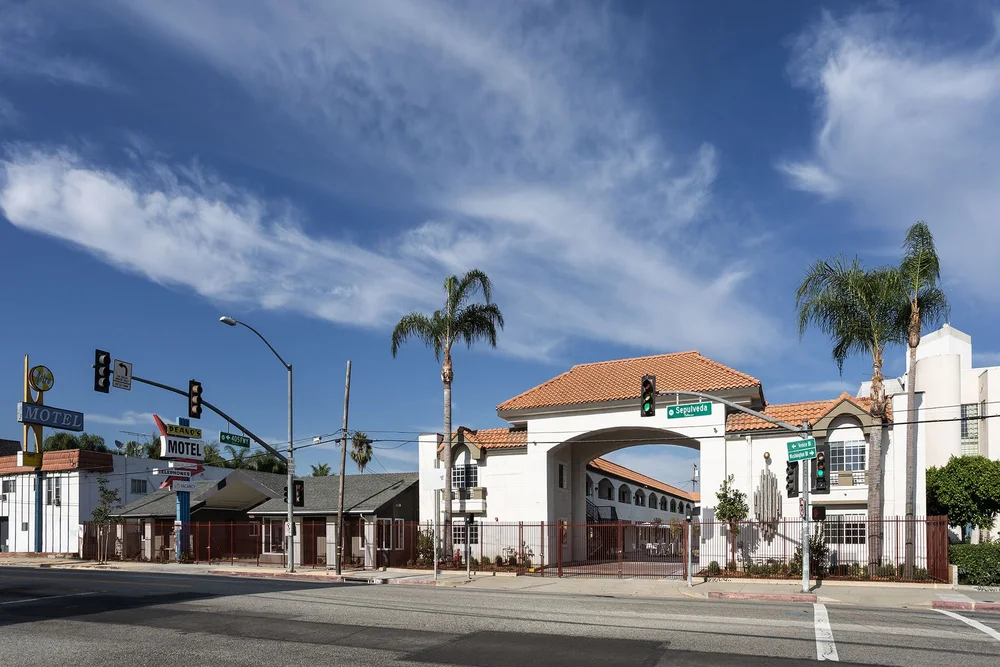
This article by Rosalind Jones originally appeared in KnockLA, and is republished here with their permission.
Several residents from the interim housing program are speaking out about alleged theft of personal property by staff, mistreatment, and harassment by service providers and guards.
Since Knock LA’s last article on medical neglect and substandard conditions at Project Homekey Culver City, additional residents have come forward to share their experiences within the program.
“It’s their way or there’s the door,” said Vince, a resident of the interim housing program at Project Homekey Culver City, during an interview with Knock LA. “They even tell you, ‘You can leave at any time.’ I tell them, ‘You’re the one that took me off the street!’ I gave away all my stuff to come here because I thought I was going to be getting better, but it’s a freaking nightmare!’”
Vince moved into the Project Homekey Culver City facility in 2024. After staff approached him while he was living on the street, Vince decided to give the program a chance. What was supposed to be a six-month stay has now stretched into more than two years. For Vince, living in the Project Homekey Culver City has been traumatic. Previously incarcerated, he claims the guards’ search procedures trigger memories of what he experienced in prison.
“Every time I come back here, it’s like I’m back in prison. I’m already getting my head ready for the fight with the guards,” he said. “[The staff] told us, ‘Go to the shelter. Within so many months, you’ll have your [housing] voucher and you’ll have your own place.’ That is literally what they told us almost word for word. That’s why everybody came here. We did not sign up for all the madness we have to go through.”
When the site opened in September 2023, Project Homekey Culver City contracted Exodus Recovery, Inc. to provide case managers, clinicians, and security personnel. Founded in 1989 by Luana Murphy, the private company initially started out managing hospital-based inpatient and outpatient programs.
Exodus Recovery is no stranger to litigation, as the company is currently facing a personal injury lawsuit for the alleged wrongful death of 26-year-old Le Wayne Anthony Wright. In November 2020, Wright was admitted to Exodus Recovery’s Urgent Care Center in East Los Angeles while experiencing a severe mental health crisis and expressing plans to end his life by jumping from the four-story window of his apartment. According to the legal complaint, Exodus Recovery staff were wholly aware of his condition and the danger he posed to himself.
Court documents revealed that the morning after his arrival at the medical facility, Exodus Recovery staff put Wright back out on the street and discontinued his care, presumably to save costs for the business. Wright immediately returned to his apartment and jumped from the window of his apartment on the fourth floor. He was pronounced dead that same day upon examination by medical professionals at Los Angeles County-USC Medical Center.
Another lawsuit, settled in 2022, named Exodus Recovery responsible for the wrongful death of a father of three who was admitted to the company’s care after expressing suicidal ideation and making two attempts in as many days to take his own life.
According to a report on the case, Exodus Recovery staff left the man without supervision for long enough that he was able to affix himself by the neck to a bathroom vent. He died that day. During the case’s litigation, discovery reports revealed that legal counsel representing Exodus Recovery altered and withheld crucial evidentiary documents. The discovery referee, Judge Joyce K. Fahey, stated, “This is the most egregious case of falsification and perjury that I have ever seen.” The case settled with $4.5 million awarded to the family of the deceased.
In July 2022, Project Homekey Culver City signed a three-year, $12 million contract with Exodus Recovery to serve as the main operator, service provider, and property management entity for the transitional housing facility. In September 2024, Culver City received the “Rehabilitation Development of the Year Award” for their work at the Home Within Reach Awards created by the Southern California Association of Non Profit Housing.
The purported experiences of residents at Project Homekey Culver City, as told to Knock LA, are far from the picture painted by the accolades and statements from public officials. In previous coverage by Knock LA, resident Veronica Cavazos claimed to have personal property taken from her room by Exodus Recovery staff.
Vince also shared that his personal items have allegedly been taken by staff. To make money, he repairs bicycles and sells them. When he signed the intake paperwork to become an official resident, his case manager told him there was no problem with repairing bikes on the premises. In contrast, Vince has had to constantly argue with staff and guards about this.
“I have to fight with them all the time about my bikes, and they’re on me about my tools,” he said. “They’re tools! They’re not harmful.”
Vince told Knock LA that two weeks ago, he was informed that guards and staff would be searching his room after noticing he kept his tools in there. Vince said he left the property during the time of the search and came back hours later. When he returned, he found his room completely ransacked and turned upside down as a result, and the tools weren’t the only thing gone after the search.
“They took everything,” he said.
Vince alleged that many of his belongings including bike parts, rims, tires, batteries, and chargers were all missing. He also firmly asserted that staff and guards removed two scooters from his room, even though staff was informed about his possession of them prior to the search and had allowed him to keep the scooters in his room with their permission. Vince claimed he never received a notice regarding the scooters being “off limits” and has yet to receive a response from management regarding where he can retrieve his property.
Vince said that every time his tools are confiscated by staff, he is forced to personally replace everything that goes missing.
“I’ve lost over $1000 on tools,” he told Knock LA. “Every couple of months I have to go buy tools, and it’s like $150 every time.”
Vince also claimed that, like Veronica, he has experienced medical neglect while in the program. He recounted to Knock LA a time that he had a heart attack on the premises. According to Vince, the director at the time told him to “stop faking it” and refused to call 911. It was only after other staff called an ambulance that he was transported to a hospital.
Due to the constant harassment and harm that Vince said he is constantly subjected to, he stated he’d rather be in jail than live in Culver City’s Project Homekey facility. This sentiment reveals a glaring gap between the perception of the program’s success and the reality for its residents.
“I don’t feel safe there anymore,” Vince said.
When asked to respond to the claims of mistreatment, theft, and carceral conditions, Culver City officials provided the following statement:
“The City of Culver City cannot comment on individual participant matters. Safety remains our top priority at Project Homekey, and the program is intended to provide a safe, structured environment where participants can stabilize and connect with supportive services. The City will continue working with Exodus Recovery to review site operations and identify ways to best serve program participants while maintaining safety for everyone at the facility.”
Another shared experience for residents is getting locked out of the facility after returning past the 10:00 PM curfew. Veronica told Knock LA in an interview that she was denied re-entry to the property after returning past curfew and was forced to sleep outside on the sidewalk. Her reason for returning late was that she had been taken to the hospital for a medical emergency. Veronica said Project Homekey guards refused to allow her entry even though she had obtained discharge paperwork.
Brian, another resident of Project Homekey Culver City, had a similar experience. He was given permission to return past curfew but was denied when he tried to re-enter.
“I had a pass, and they locked me out one night when it was raining,” he told Knock LA. “I came back at night and they said, ‘You don’t have a pass.’”
Brian, like Veronica, said he had no choice but to spend the night outside on the street. Vince stated that curfew is a major concern among residents, and that this rigid enforcement has led to him being harmed outside the facility. According to Vince, in one instance he arrived at Project Homekey Culver City’s entrance ten minutes prior to the 7:00 AM end of the curfew and was told by guards he could not enter. As he proceeded to walk away, he was then hit by an unknown vehicle.
“Everyone on [the temporary housing] side, … we all are saying pretty much the same thing,” he said. “Everybody that tries to come in after [or before] curfew gets turned away. When we try to explain why, they don’t even want to hear.”
Veronica and Vince also claim to have experienced harmful and unsettling behavior from Carly Gaspari, program manager of the Project Homekey Culver City facility. Before she was the director, Vince said that Gaspari worked with him as a therapist.
“She knows what triggers me,” he said to Knock LA. “She knows my darkest fears.”
Vince confided in Gaspari many times about how his interactions with the guards were deeply upsetting and triggering to him due to the similar methods used at the door of Project Homekey as those the guards used in prison. Despite this, Gaspari never intervened in these pat-downs or searches and continued to allow guards to put Vince in re-traumatizing situations.
“I told her every time I’m coming home, my head is already like I’m back in prison. Like I’m getting ready to go to the yard. Carly knows I don’t want to be touched by a cop anymore,” he said. “But I know as soon as I get through the gate they’re going to search me, they’re going to touch on me.”
Veronica claimed that Gaspari’s actions went beyond ignoring a person’s triggers and veered into provocation.
“When she became director, she literally sat down in front of me with this grin on her face and said ‘I’m the one that didn’t accept [your fiancé] or your daughter into the program,’” Veronica said. “They’re provoking a person [with that].”
Veronica told Knock LA that her daughter is currently unhoused and living on the streets while also being a victim of sex trafficking.
When asked to provide a comment, Exodus Recovery president and CEO Lezlie Murch echoed the statement from Culver City and said over the phone to Knock LA, “I cannot comment about individual participants and clients. Our utmost objective is to maintain a safe, secure, therapeutic, and serene environment. I will tell you that is our mission and our philosophy. I think we have done a really good job of hiring qualified and compassionate staff.”
Exodus Recovery’s contract at Project Homekey Culver City is nearing the end of its duration. In the near future, the City Council will decide whether the service provider remains at Project Homekey or is replaced with a different entity.
Rosalind Jones (she/they) is a queer, Los Angeles-based writer and community organizer. She is a contributor for the online publication Knock LA, a founding member of the social justice organization Community Solidarity Project, and authors a Substack titled ‘Another World is Inevitable’. Rosalind holds a BA in Diplomacy and World Affairs from Occidental College and a certification in Creative Writing from the UCLA Extension.