
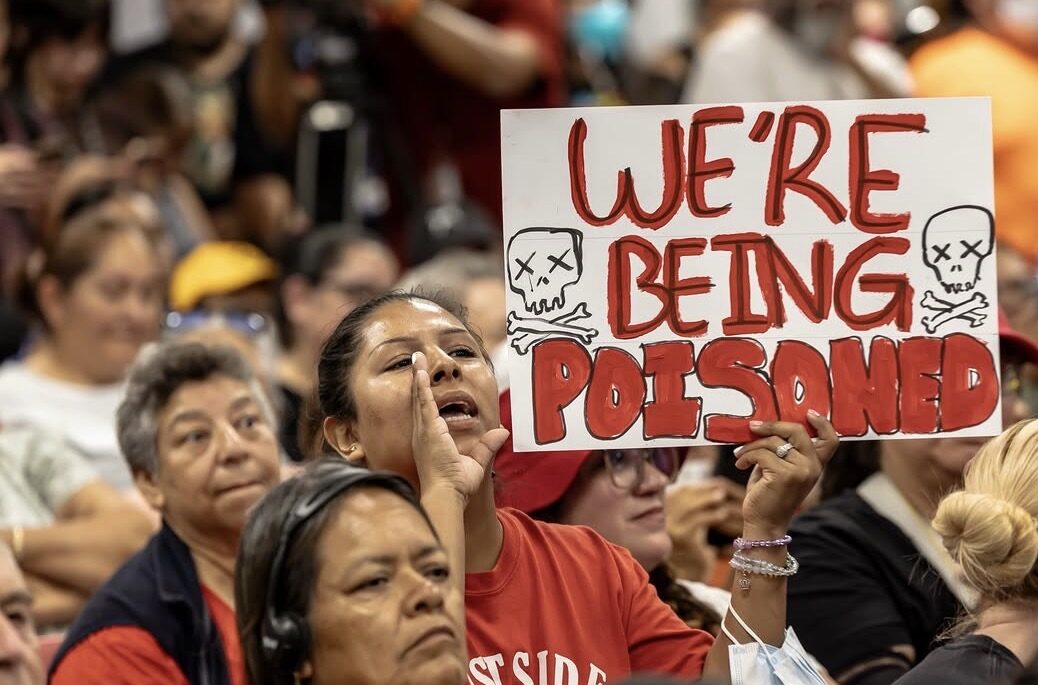
Hundreds of residents packed Stevenson Middle School Thursday night for what city officials described as a community update on the Lineage warehouse fire. It did not remain an informational meeting for long. The auditorium quickly reached capacity, and hundreds more were turned away outside. Protesters pushed into the building chanting “Lineage out!” while holding signs demanding the warehouse close permanently. Mayor Karen Bass, County Supervisor Hilda Solis, Councilmember Ysabel Jurado and Lineage executives struggled throughout much of the evening to speak over loud boos from the audience.
The fire began June 17 at Lineage’s cold-storage warehouse in Boyle Heights, destroying a facility that contained approximately 85 million pounds of refrigerated food. Although firefighters extinguished the blaze after several days, millions of pounds of food remain inside as demolition and cleanup continue. The decomposition has produced a disgusting odor and renewed concerns about air quality.
Before the meeting began, organizer Jazmine Garcia told demonstrators that the gathering was “about quality of life” and “about not being ignored anymore.” That theme echoed throughout the evening as residents described not only the conditions they have endured since the fire but what they view as an inadequate public response.
One resident challenged elected officials directly, saying, “I would like for you to come sleep where we sleep, so you can experience what we have to go through.” Others described repeated hospital visits for respiratory symptoms and criticized the county’s lack of a coordinated public health response. One speaker told officials, “You have failed us,” adding that “People are suffering, and it is a disgrace.”
When Lineage Chief Operating Officer Jeff Rivera apologized and began outlining cleanup efforts, much of the audience responded by chanting, “Liar!” Rivera said approximately 200 workers are now on site around the clock. According to the company, crews have removed roughly 1.4 million pounds of waste, structural demolition is underway, and cleanup is expected to finish within the city’s 45-day deadline. Lineage also announced additional assistance for nearby residents, including temporary housing vouchers, grocery vouchers, prepaid cash assistance and utility bill support.
Those announcements did little to change the tenor of the meeting. Much of the public testimony focused less on cleanup timelines than on trust. Residents questioned repeated assurances that air quality remained safe while describing ongoing illnesses and conditions they said contradicted official messaging.
NBC4 reported that residents described a disconnect between what they were being told and what they were experiencing, noting that neighborhood volunteers, not government agencies, were distributing masks, air purifiers, food and water while many residents continued to question official assurances about environmental conditions.
The concerns raised Thursday night extend beyond the immediate disaster. The Boyle Heights fire has drawn renewed attention to an industry that has expanded rapidly over the past decade while remaining largely outside public scrutiny.
Lineage is the world’s largest temperature-controlled warehouse operator, backed by private equity through Bay Grove Capital. A recent analysis by Americans for Financial Reform and Our Financial Security argues that the Boyle Heights disaster has exposed the environmental and public health risks associated with modern cold-storage facilities, which often rely on large ammonia refrigeration systems, combustible foam insulation and massive quantities of plastic-wrapped food.
The report also points to a similar Lineage warehouse fire in Washington state in 2024 that burned for roughly 60 days before the building was demolished. According to Lineage’s filings with the Securities and Exchange Commission, the company ultimately recorded a net insurance gain of approximately $107 million related to that fire. More than 100 nearby residents later filed lawsuits alleging the blaze caused environmental contamination and health effects. Lineage has denied wrongdoing in those cases.
That history has become part of the public conversation in Boyle Heights. Thursday’s meeting made clear that many residents are concerned not only with how quickly debris is removed but with what they may already have been exposed to and whether the full health consequences will be understood for years to come. Calls throughout the evening for the warehouse to close permanently reflected longstanding concerns about the concentration of industrial uses in Boyle Heights. Speaker after speaker argued that the fire exposed vulnerabilities that existed long before June 17 and questioned why neighborhoods like Boyle Heights continue to bear a disproportionate share of the region’s environmental risks.