
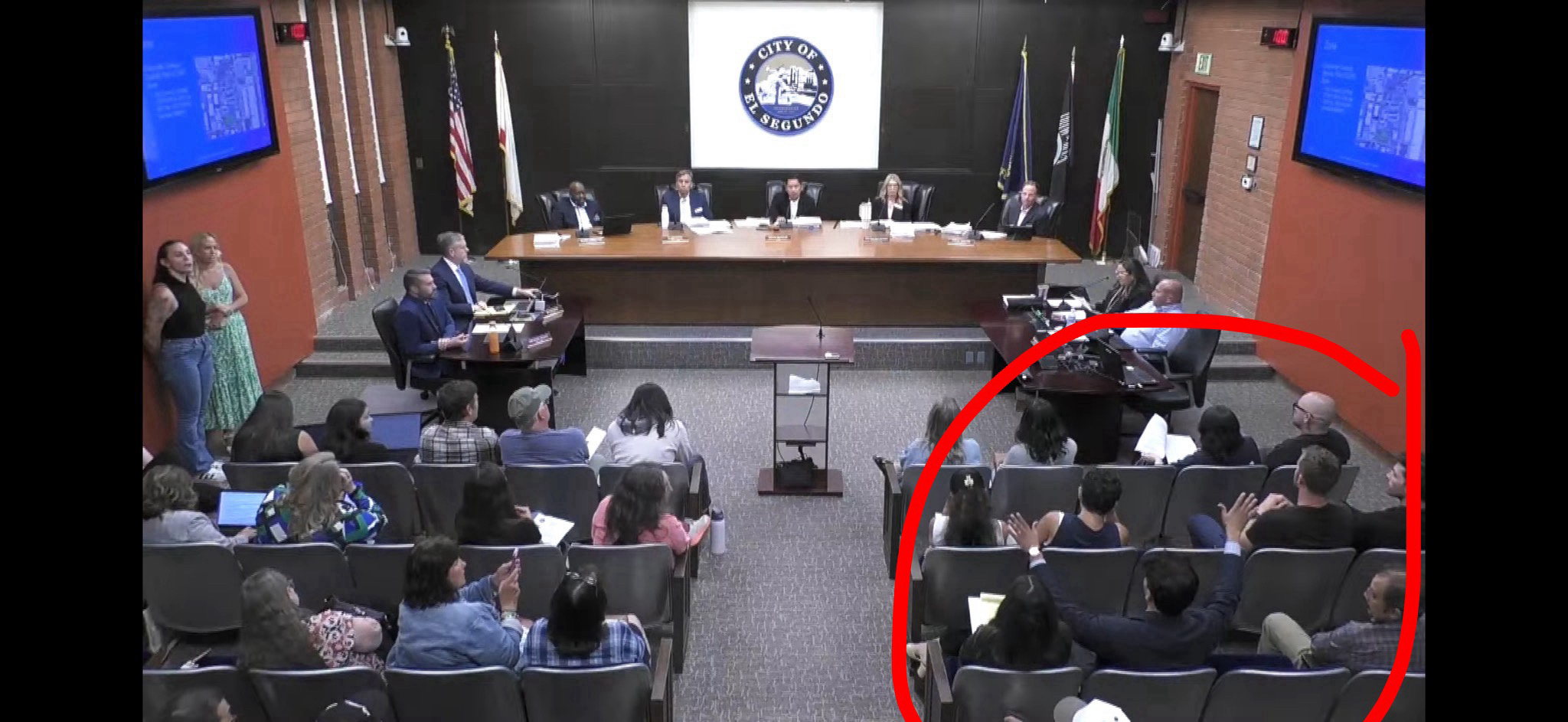
A proposal to replace the Hyatt Place hotel at 750 North Nash Street in El Segundo with a five-story artificial intelligence data center and electrical substation was withdrawn Thursday night after a massive outpouring of public opposition.
What would otherwise have been a routine land use hearing turned into a packed house, with over 54 people submitting comments to the El Segundo Planning Commission. After nearly three hours of testimony and 33 public speakers, the applicant withdrew the project before commissioners could vote. A photo taken at that moment shows the applicant, seated among the packed rows of residents, with his arms raised as he signals the withdrawal.
The proposal would have demolished the existing hotel and replaced it with roughly 230,000 square feet of server space along with a new electrical substation. One of the residents’ central arguments against the project was its reliance on an Environmental Impact Report prepared back in 2002, before California even required greenhouse gas analysis under CEQA, and well before AI transformed data centers into some of the most energy-intensive industrial facilities ever built.
The El Segundo fight arrives at a pivotal moment for Los Angeles. Artificial intelligence has set off one of the largest infrastructure buildouts in decades. Data centers already draw roughly 4.4 percent of all electricity generated in the United States, and federal researchers project that figure could climb to somewhere between 6.7 and 12 percent by 2028 as AI demand keeps accelerating. These facilities also need enormous amounts of water for cooling, plus new substations and transmission infrastructure, large battery systems, emergency generators, and acres of land that could otherwise go toward housing or other community-serving uses.
Despite those impacts, Los Angeles has not yet decided how these facilities should be regulated. LA County currently has no data-center-specific zoning regulations, although the Board of Supervisors has directed county agencies to begin studying their impacts. The City of Los Angeles is undertaking a similar effort through Council File 26-0262. Introduced by Councilmember Monica Rodriguez back in February, the motion would establish the City’s first formal definition of data centers while creating standards governing where they may be built and how they should operate. The motion also requests that LADWP prepare a standalone assessment of how data center development could affect the City’s power grid, water resources, and climate goals, but includes no deadline for that report.
Taken together, these efforts amount to an acknowledgment that the current regulatory system wasn’t built with AI-era infrastructure in mind, but incremental steps aren’t going to cut it. Development proposals keep arriving, and the industry push behind them is only going to intensify. That creates a dangerous regulatory vacuum. Without clear rules, communities are left to fight these battles project by project, often after developers have already bought the property and made significant investments into moving proposals forward. Questions about the dangers of data centers will end up as site-specific political fights instead of being settled through democratically established policy.
It also creates an opening for well-organized interests to shape the rules before the broader public is fully engaged. That’s already happening in Los Angeles. Council File 26-0262 has been sitting in the Planning and Land Use Management Committee since it was introduced in February, with no hearing scheduled and no movement since. The only public comments on file so far come from building trades organizations, including IBEW Local 11, Ironworkers Locals 416 and 433, UA Local 78, the Southern California Pipe Trades District Council 16, and others. Every letter follows the same template, warning against what they call “overly broad or restrictive policies.”
The public debate over data centers ultimately goes beyond construction employment. It comes down to who bears the environmental costs of powering the AI economy. These facilities place extraordinary demands on public infrastructure. Their electricity consumption can require new substations, transmission upgrades, and additional generating capacity. Many rely on water-intensive cooling systems, and backup diesel generators and gas-fired equipment can add to air pollution. Constant mechanical cooling equipment generates constant noise, and waste heat and industrial infrastructure reshape the neighborhoods around them. These impacts are often pushed on communities that already carry more than their share of environmental burdens. We’re seeing this play out in real time in Boyle Heights, where residents are still reeling from a recent oil spill and the disastrous Lineage fire.
Other jurisdictions have begun responding before those conflicts become routine. For example, Monterey Park adopted a temporary moratorium before voters overwhelmingly approved a permanent prohibition on new data centers. Prince William County, Virginia, saw courts invalidate approvals for one of the nation’s largest proposed data center complexes after successful community litigation. Missouri communities have rewritten zoning codes. And New York lawmakers have approved a one-year moratorium on large new data centers while the state studies their impacts.
Los Angeles seems to be heading down a different path. Rather than pause development while rules are written, both the City and County are attempting to build a regulatory framework as proposals continue to arrive. Whether that approach succeeds will depend on what happens next.
The building trades have already recognized that the ordinance now being drafted will shape billions of dollars of future investment and have organized accordingly. If the City’s first comprehensive data center ordinance is written primarily through negotiations among developers, utilities, and construction interests, many of the communities that will live alongside these facilities may have little influence over the rules governing them for decades to come. The outcome in El Segundo demonstrates that organized public participation can still alter the trajectory of an individual project, but the larger question is whether LA will continue fighting these battles one proposal at a time, or use this moment to establish a regional framework before AI infrastructure reshapes the landscape faster than public policy can respond.