
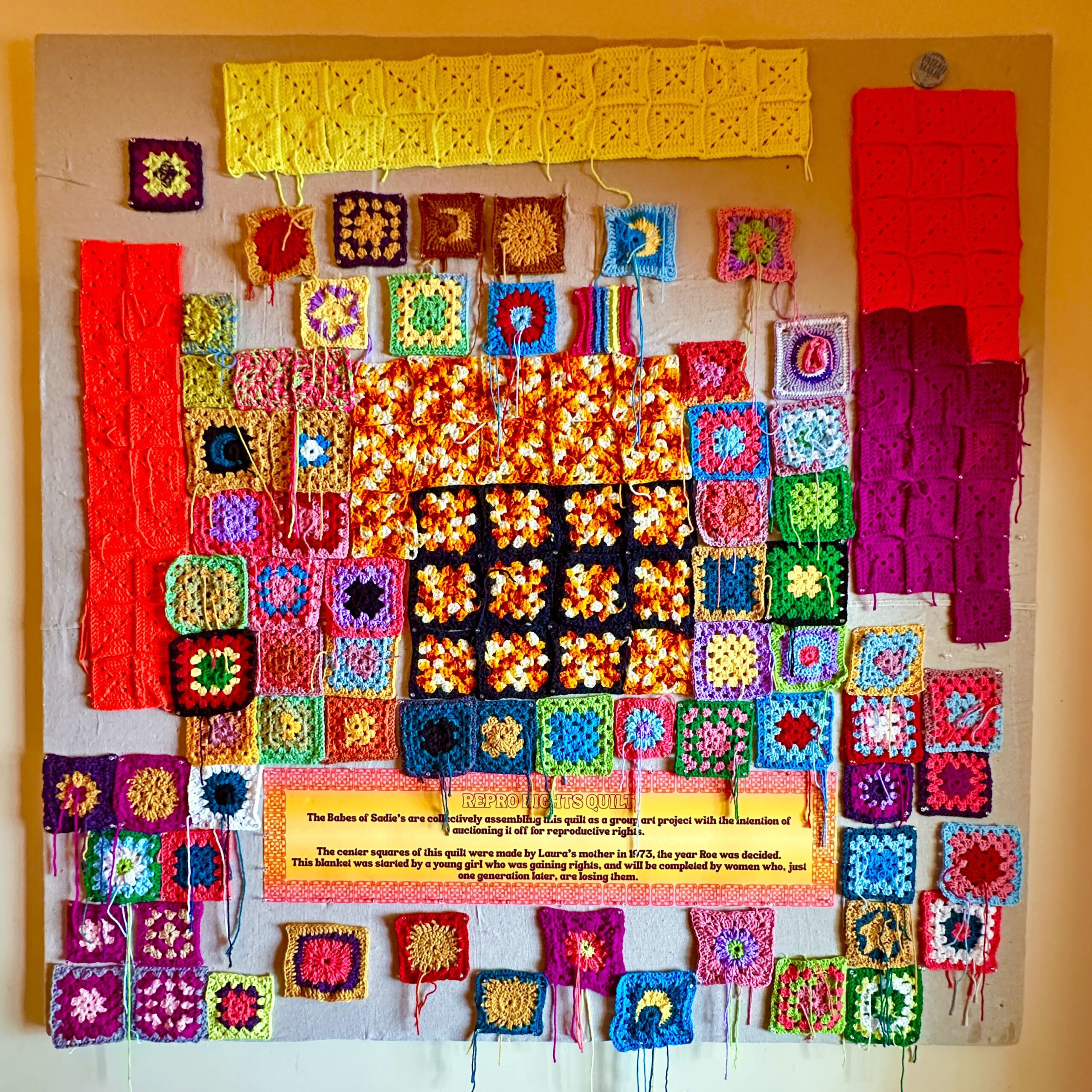
Laura Arbios never intended to make a political artwork. The first pieces of what has become a growing community abortion blanket were simply crochet squares her mother and aunt learned to make as children during a family vacation in 1973. They sat tucked away for nearly five decades, surviving countless moves before resurfacing during the COVID-19 pandemic.
Originally, the plan was modest. Laura and the women in her family would each contribute handmade squares to create a series of family blankets. But when her mother mailed those original 1973 squares, one detail immediately stood out: the year.
“It was the minute she sent it to me, and I saw the year 1973,” Laura said. “We had been following what was going to happen” with the Supreme Court and the growing threat to abortion rights. So what began as a family craft project became something else entirely.
Today, women from across the region are contributing knitted, crocheted, sewn, and quilted squares to what Laura hopes will become both a memorial to a pivotal moment in American history and a fundraising tool for abortion access. The project began before the Supreme Court’s 2022 decision in Dobbs v. Jackson Women’s Health Organization overturned nearly 50 years of federal abortion protections. At first, Laura imagined it as a way to rally people around a right she still hoped could be protected.
“Before Roe fell, I wanted to draw attention to this issue and get people energized,” she said. “Once it actually happened, I realized this was just going to be a devastating art piece.”
Rather than documenting one person’s experience, the blanket has become a collective expression of grief and anger, but also solidarity and resistance. Some contributors have shared their own abortion stories. Others simply wanted to create something in defense of bodily autonomy. One crocheted an anatomically correct 3D vulva. Laura is also collecting short written reflections from contributors and hopes the finished work will include an interactive archive where viewers can click on each square to learn the story behind it. The project was publicly unveiled earlier this year during an event at Sadie’s featuring author Becca Rae-Tucker, whose book The Abortion Companion encourages people to reject the shame and stigma surrounding abortion.
One contributor, Jasmine McLeod, said contributing a square was about more than abortion alone. “At its core, this is about bodily autonomy,” she wrote. “If society is going to require someone to carry a pregnancy to term, then society also has a responsibility to support that decision.”
The emphasis on storytelling feels fitting for a medium long associated with women’s history. For generations, quilting circles, often called “quilting bees,” were among the few socially acceptable public spaces where women could gather without male supervision. They were places to finish practical work, but also to exchange news, build friendships, debate ideas, and organize around the issues shaping their communities. In the 19th century, women used sewing circles to support the abolitionist movement, raising money through anti-slavery fairs and creating quilts embroidered with abolitionist poems and messages. Later, quilting groups became part of women’s suffrage campaigns, church organizing, labor movements, and mutual aid networks. Long before many women could vote or hold public office, quilts became one way they preserved stories and transformed domestic work into collective action.
For Laura, who owns and operates Sadie’s Pole Studio in Westchester, the blanket grew out of another kind of women’s gathering space. Many of the squares have been created by members of the studio, where classes have become a place for friendship, conversation, and mutual support as much as movement. She sees that community as a modern expression of the same tradition.
“I look at our pole dancing studio as the modern-day version of quilting groups,” she said. “It’s this place that everybody dismisses as being so silly . . . and it’s our protest, it’s our grief, and it’s our statement that we’re still going to keep fighting for this.” Like the quilting circles that came before it, the project has become less about the finished object than the relationships formed along the way.
That history stretches back even further than Roe itself. The blanket contains squares crocheted by Laura’s mother as a teenager while learning from her own grandmother, linking four generations of women through a single piece of fabric. What started as a family heirloom has become a living record of another generation confronting the possibility that rights once considered settled can disappear.
Laura hopes the finished blanket will first be displayed publicly, giving contributors a chance to see the completed work together before it is auctioned to benefit abortion funds or other reproductive justice organizations. She hopes the piece can raise enough money to turn a collective act of remembrance into tangible support for people seeking reproductive care.
“We’re still going to keep fighting for this,” she said. “Dobbs is a snapshot. We are not letting this stand until we get our rights back.”
People who would like to contribute can submit a knitted, crocheted, sewn, or quilted square along with a brief note explaining why reproductive freedom matters to them. Laura said every square has a place in the blanket because every story has a place in the movement. Squares can be mailed to Sadie’s Pole Studio, 3645 Inglewood Ave. #11, Redondo Beach, CA 90278. Interested contributors can email Laura@SadiesPole.com for mailing information.