
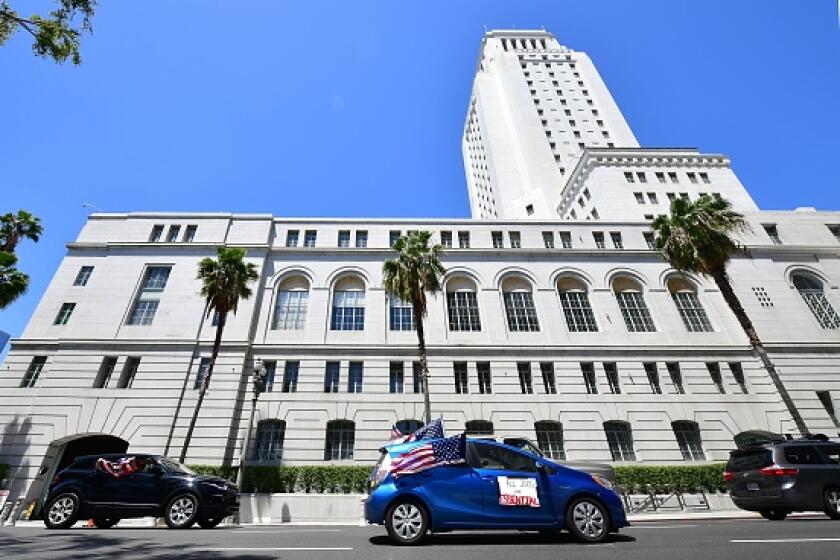
Four years after leaked City Hall recordings plunged Los Angeles into a crisis of public trust, many of the reforms intended to remake city government may never reach voters.
Late Wednesday night, the Office of the Chief Legislative Analyst (CLA) released its long-awaited recommendations on charter reform ahead of Friday’s meeting of the City Council’s Rules, Elections, and Intergovernmental Relations Committee. The report recommends advancing only nine of 59 substantive reforms to the November 2026 ballot while directing dozens of others to “further study” or “note and file,” legislative dispositions that often delay or effectively shelve proposals.
The recommendations follow more than a year of work by Los Angeles’ 13-member Charter Reform Commission, which was created in 2023 to undertake the city’s first comprehensive review of its charter in roughly a quarter century. The commission was charged with examining everything from elections and ethics to police accountability and the structure of city government itself.
The Los Angeles City Charter functions as the city’s constitution, defining the powers of elected officials and city departments. While the charter’s last major overhaul occurred in 1999, some of its basic structures date back much further. Los Angeles has maintained 15 City Council districts since 1925, when the city had approximately 600,000 residents. Today, nearly four million people live in the city.
The reform effort emerged amid growing frustration with City Hall and in the wake of the 2022 leaked Fed tapes scandal, in which several city leaders were heard making racist remarks while discussing redistricting and political power. The scandal ultimately led to resignations, criminal investigations, and renewed calls to reform how Los Angeles governs itself.
The Charter Reform Commission undertook an unusually extensive public process. Operating with a roughly $1 million budget, the commission held more than 50 meetings, heard from elected officials, city departments, and community organizations, and drew thousands of participants and public comments. Among its stated goals were strengthening democratic representation and rebuilding public trust.
Now, many of its most consequential recommendations appear to be in jeopardy. Among the reforms recommended for further study are ranked-choice voting, expanding the City Council from 15 to 25 members, and several police accountability measures.
Supporters of council expansion argue that Los Angeles is an outlier among major American cities. Each council district currently contains roughly 270,000 residents, among the largest constituent-to-representative ratios in the nation. Advocates contend that smaller districts would improve constituent access, reduce campaign costs, and diffuse political power that is currently concentrated among just 15 elected officials. Supporters also argue that smaller districts could create more opportunities for grassroots candidates and produce a City Council more reflective of Los Angeles’ diversity.
Other election reforms facing uncertainty include ranked-choice voting, which supporters say would allow voters to rank candidates by preference and reduce barriers for challengers and third candidates without fear of “spoiling” elections.
Police oversight reforms also appear particularly vulnerable. One proposal would clarify that the Los Angeles Police Department is subject to city ordinances enacted by elected officials. Another would allow the Chief of Police to remove officers with repeated histories of misconduct while preserving existing appeal rights. Additional proposals would strengthen protections for journalists and protesters. Reform advocates argue that the current charter grants LAPD an unusual degree of autonomy compared with other city departments.
Government oversight measures may also be affected. City Controller Kenneth Mejia has urged support for a charter amendment establishing an independent budget for the Controller’s Office equal to no less than 0.42 percent of the city’s General Fund. Supporters argue that because the Controller audits City Hall and oversees public spending, its budget should not be determined by the same elected officials it is tasked with monitoring.
Critics of advancing all reforms to the 2026 ballot argue that some proposals require additional analysis before being placed before voters. Councilmember Monica Rodriguez, for example, has publicly argued that reforms should not be rushed if they are not fully developed, even if that means delaying them to a future election cycle.
That future cycle may already be taking shape. City officials have discussed creating a standing charter reform process extending into 2028 to continue studying unresolved proposals. Advocates, however, worry that reforms sent for “further study” may simply disappear into an endless process.
The CLA’s recommendations are advisory rather than binding. The ultimate decision rests with the City Council, which faces a June 17 deadline to send proposed charter amendments to the City Attorney for preparation for the November 2026 ballot.