
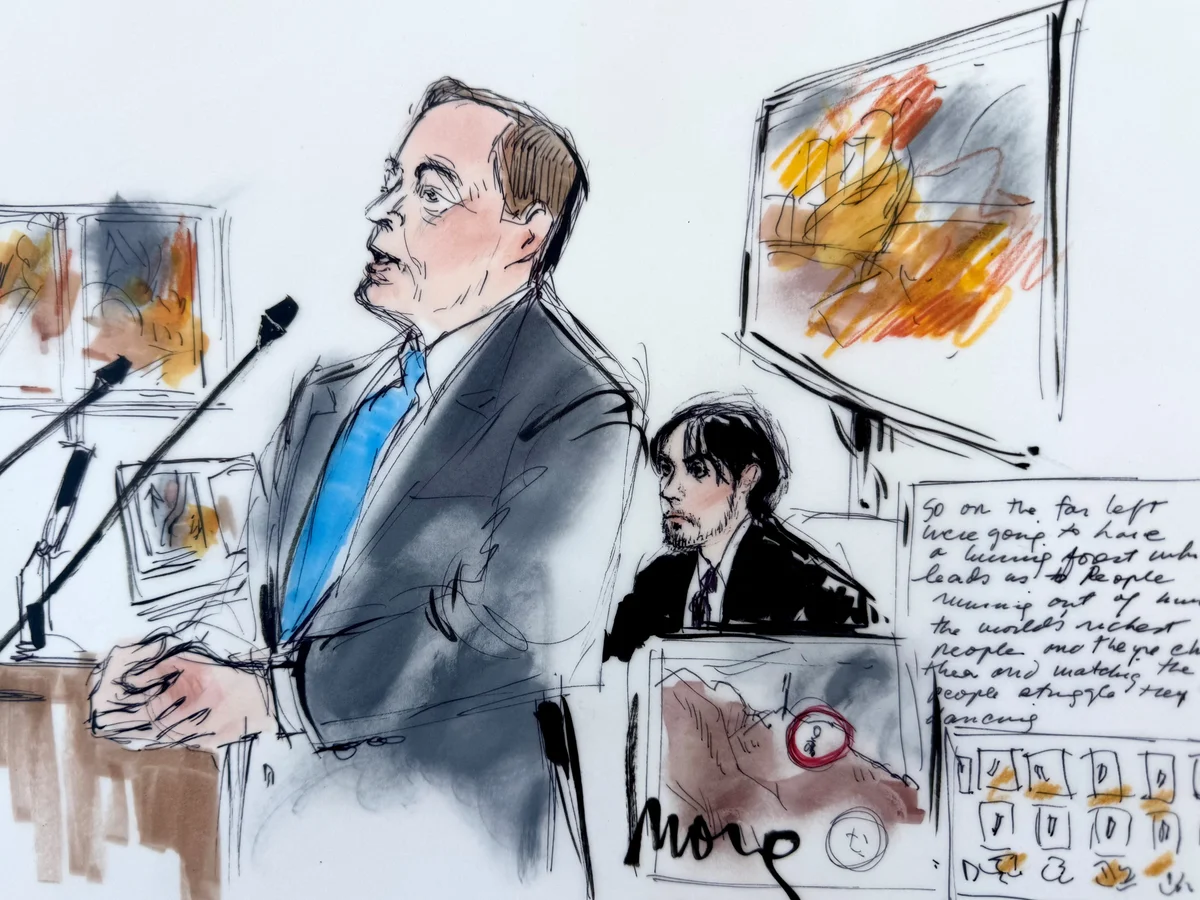
Opening statements began Wednesday in the federal trial of Jonathan Rinderknecht, the 30-year-old former Uber driver accused of setting the New Year’s Day 2025 Lachman fire, the small blaze that smoldered undetected for a week before reigniting as the Palisades fire, killing twelve people and destroying roughly 6,800 structures. Rinderknecht faces three felony counts and between five and 45 years in federal prison if convicted.
The trial, before U.S. District Judge Anne Hwang in downtown Los Angeles, will decide the narrow question of whether Rinderknecht ignited a fire near the Skull Rock trailhead shortly after midnight on January 1, 2025. It will not address the six days that followed, when Los Angeles Fire Department crews left a burn area that firefighters reported was still smoldering, or the months after the disaster, when the department’s official account of its response was revised through seven drafts to soften criticism of its leadership.
Hwang ruled before trial that the defense may not introduce evidence or argument about alleged negligence by the fire department, finding it irrelevant to the ignition question and likely to confuse the jury. The excluded material included testimony from a firefighter, a fire captain, and a state park ranger supporting the claim that the Lachman fire was visibly smoldering when LAFD crews were ordered to leave. Hwang also excluded some of the government’s evidence, including AI-generated images of fires that prosecutors allege Rinderknecht created months before the disaster.
The result is a structural gap in how the disaster is being adjudicated. For eight months, city agencies have cited the criminal case as grounds for withholding records and declining to answer questions about the department’s conduct. The city agreed last August to delay release of the LAFD’s after-action report, with Mayor Karen Bass saying the delay was meant to avoid interference with the federal investigation. The department has declined to answer questions about who altered the report’s drafts and why, citing the ongoing prosecution, and internal records related to the edits remain unreleased on the same grounds. Now that the case has reached trial, the institutional record it was invoked to protect has been ruled inadmissible. The prosecution has functioned as a reason to keep the city’s conduct out of public view, while the trial’s evidentiary rules keep that conduct away from the jury. No forum has yet examined both the ignition and the response together.
What is known about the response has emerged almost entirely through leaks and investigative reporting rather than disclosure. The Los Angeles Times reported in November that firefighters mopping up the Lachman fire warned a battalion chief that the ground was still smoldering and rocks were still hot to the touch, and were ordered to leave anyway. Their concerns were recorded in written notes and known within the department, which publicly stated for months that the fire had been fully extinguished. In December, the Times obtained seven drafts of the after-action report and found that key findings were removed or softened. An early draft said the decision not to pre-deploy firefighters ahead of the forecasted windstorm did not align with department policy, but the final version stated that pre-deployment exceeded the department’s standard procedure. A duty captain’s report that the Lachman fire had started up again was deleted from one draft, then restored in the final version.
In January, Fire Chief Jaime Moore acknowledged to the Board of Fire Commissioners that multiple drafts had been edited to reduce explicit criticism of department leadership, saying the editing occurred before his appointment. Times sources have since alleged that Bass, after reviewing an early draft, told then-interim Chief Ronnie Villanueva that the report could expose the city to legal liability and wanted key findings removed or softened before its release. Bass’s office has denied directing changes to the report and has said it was written and edited by the fire department. The Department of Justice has subpoenaed texts and communications from firefighters who responded to the Lachman fire, according to an internal LAFD memo, indicating federal investigators have examined the department’s conduct even as it remains outside the scope of the trial.
Inside the courtroom, the government’s case rests on a timeline built in part from Rinderknecht’s own repeated 911 calls in the early hours of January 1, which prosecutors say place him at the hilltop where the fire began. An ATF investigator testified that he reviewed thousands of Rinderknecht’s conversations with ChatGPT, in which the defendant complained about wealth disparity and climate change. Federal prosecutors say the determination that Rinderknecht set the fire was based on witness statements, video surveillance, cellphone data, and analysis of fire patterns at the scene. Prosecutors also told jurors that Rinderknecht, who drove Uber passengers around the Westside on New Year’s Eve, appeared agitated that night, spoke about Luigi Mangione, and later told investigators that someone might commit arson in the Palisades out of resentment of the rich.
Defense attorney Steve Haney told jurors there is no direct proof his client ignited anything, saying that when the evidence is in, proof that Rinderknecht started the fire will be missing. Haney said Rinderknecht hiked into the hills to watch fireworks, called 911 himself, and later voluntarily drove investigators back to the Palisades to help locate the fire’s origin. Haney has argued for months that his client is being used as a scapegoat for the department’s failure to fully extinguish the January 1 blaze, an argument the jury will now hear only in stripped-down form, without the firefighter testimony that supported it.
The motive evidence merits its own scrutiny. The government’s theory presents a precarious gig worker’s grievances about inequality, vented to passengers and to a chatbot, as the psychological architecture of arson. None of it is evidence of ignition, and the views attributed to Rinderknecht about wealth concentration are held by a large share of Angelenos who will never set anything on fire. Conservative outlets have already converted the motive theory into a broader argument that the fire’s cause was a leftist arsonist rather than climate conditions, a framing that elides the fact that the Lachman fire burned fewer than ten acres and destroyed nothing; it was the combination of hurricane-force winds, drought-cured fuel, an unmonitored burn area, and a depleted response that produced the catastrophe of January 7.
Among those attending opening statements was Councilmember Traci Park, who represents the Palisades. Park told reporters the trial is one of several efforts to determine accountability for the fire, saying that on January 7 every system the city needed failed, from public safety systems to the water supply available to firefighters. Which systems failed, who was warned, and who edited the record afterward are questions the trial is designed not to answer. They are also questions in which Park has a personal stake. As we reported in February, a report delivered to the U.S. Senate by Patrick Butler, a former LAFD assistant chief, concluded that the Palisades fire was a preventable event shaped by decisions made before the wind arrived, and that the failure to pre-deploy firefighters ahead of the forecasted windstorm marked a clear departure from established preparedness practices.
Park has acknowledged on the record that she was not part of pre-deployment conversations in the days before the fire, despite red flag warnings issued well in advance and despite her predecessor’s account that CD11 and other councilmembers routinely pressed the department for predeployment and other resources on red-flag days. A councilmember whose own preparedness role is under scrutiny, and who told a rally on the fire’s anniversary that the disaster was not an act of climate change, has every reason to welcome a narrative in which responsibility is shifted entirely to a single arsonist.
The strength of the location evidence means a conviction is plausible, and if Rinderknecht set the Lachman fire, the families of the twelve people killed are owed that verdict. But a verdict against one man will resolve only the question of ignition. The civil suit by fire victims remains the likeliest venue for examining the city’s conduct under oath, and the independent investigation into the Lachman mop-up that Moore promised has yet to be completed. When the criminal case ends, the city will no longer have a prosecution to point to as an excuse for withholding records.