
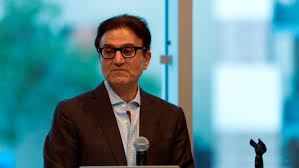
Dr. Reza Babapour believes Los Angeles County’s health inequities begin with a problem that receives far less attention than homelessness, public safety, or housing. There are not enough doctors.
The UCLA clinical faculty member has spent years arguing that the county’s shortage of primary care physicians is driving disparities in life expectancy, maternal health outcomes, and access to preventive care. Now, he is calling on elected officials to back an ambitious proposal to expand the region’s physician training pipeline through the creation of a new medical school at Harbor-UCLA Medical Center.
Alongside that effort, Babapour is also leading a campaign to expand access to menstrual products in public restrooms. While the two initiatives may appear unrelated, he sees them as expressions of the same underlying question about what society chooses to treat as a basic public necessity.
Babapour’s broader argument begins with a set of numbers. According to federal health workforce data, roughly 3.7 million Los Angeles County residents live in areas designated as having shortages of primary care physicians. The county has approximately 58 primary care doctors per 100,000 residents, though access is distributed unevenly across neighborhoods.
Babapour often contrasts that with another figure. Los Angeles County employs roughly 10,000 sworn sheriff’s deputies, or about 100 deputies per 100,000 residents.
“It doesn’t make sense,” he said. “We’re sending money to have more deputies. You see where the money is.”
A March 2026 report by Measure of America found that residents of Westwood live approximately 16 years longer than residents of Sun Village in the Antelope Valley. Black men in Los Angeles County have an average life expectancy of 69.1 years, compared with a countywide average of 80.5 years.
For Babapour, those numbers reflect more than individual behavior or personal choices. They reveal a health care system in which access to routine care remains deeply unequal.
When chronic conditions such as diabetes, hypertension, and heart disease go unmanaged, patients often seek treatment only after those conditions become medical emergencies. Los Angeles General Medical Center recorded more than 148,000 emergency department visits in 2025, making it one of the busiest emergency departments in the nation.
The county’s maternal health outcomes tell a similar story. Black women die from pregnancy-related causes at four times the rate of white women. Between 2013 and 2024, seventeen Los Angeles hospitals closed maternity wards. A Guardian investigation found that more than 23,500 expectant mothers gave birth in emergency rooms between 2019 and 2023 because no other option was available.
Babapour argues these outcomes are not inevitable. They are the result of decades of policy decisions that failed to build a physician workforce capable of serving a county of ten million people.
Los Angeles County’s first medical school was established by USC in 1888, when the county’s population was approximately 100,000. UCLA’s medical school followed in 1951, when the population had reached 4.2 million.
Today, Los Angeles County is home to roughly ten million residents. While Kaiser Permanente and Charles Drew University have opened medical schools in recent years, both remain relatively small. Babapour notes that many regions with comparable populations maintain significantly larger medical education systems.
The shortage, he argues, reproduces itself. A 2024 California Health Care Foundation report found that 78 percent of physicians practicing in California attended medical school outside the state. At the same time, new doctors increasingly graduate with hundreds of thousands of dollars in educational debt, creating strong financial incentives to pursue higher-paying specialties rather than primary care and making it difficult to establish practices in low-income communities.
“The system keeps producing the same outcome,” Babapour said. “Everybody talks about disparities, but nobody talks about the pipeline.”
His proposed solution is the creation of a new county-affiliated medical school at Harbor-UCLA Medical Center. The school would recruit students from underserved communities, train them in community hospitals and clinics, and reduce or eliminate tuition costs in exchange for service commitments in high-need areas.
“They know their own community,” Babapour said. “They speak the same language, the same culture, that is how we can uplift our own communities.”
According to Babapour, nearly 900 UCLA pre-med students have signed a petition supporting the proposal, along with roughly 2,500 additional Los Angeles County residents. Despite that support, he has yet to find a political champion willing to advance the idea.
Babapour says he has met with county supervisors and state legislators over the past several years. While some conversations have been encouraging, none have yet produced a formal proposal.
His second campaign operates on a much smaller scale but reflects the same philosophy. Through an initiative called Care You Friendly LA, Babapour is calling on Los Angeles to require publicly accessible restaurant restrooms to stock menstrual products.
“Do they believe care products are necessities or luxuries?” he said. “That is the main question. Every elected official has to publicly express themselves.”
The proposal does not necessarily require the products to be free, though Babapour hopes they eventually will be. His immediate goal is simply to make them available wherever restrooms are open to the public.
Babapour has spent several years promoting the idea through petitions, social media, and outreach to elected officials. He points to Scotland’s guarantee of free menstrual products in public facilities as evidence that governments can treat menstrual equity as a matter of public infrastructure rather than personal responsibility.
Ultimately, both campaigns return to the same question. What obligations does a city or county have to ensure that residents can meet their basic health needs?