
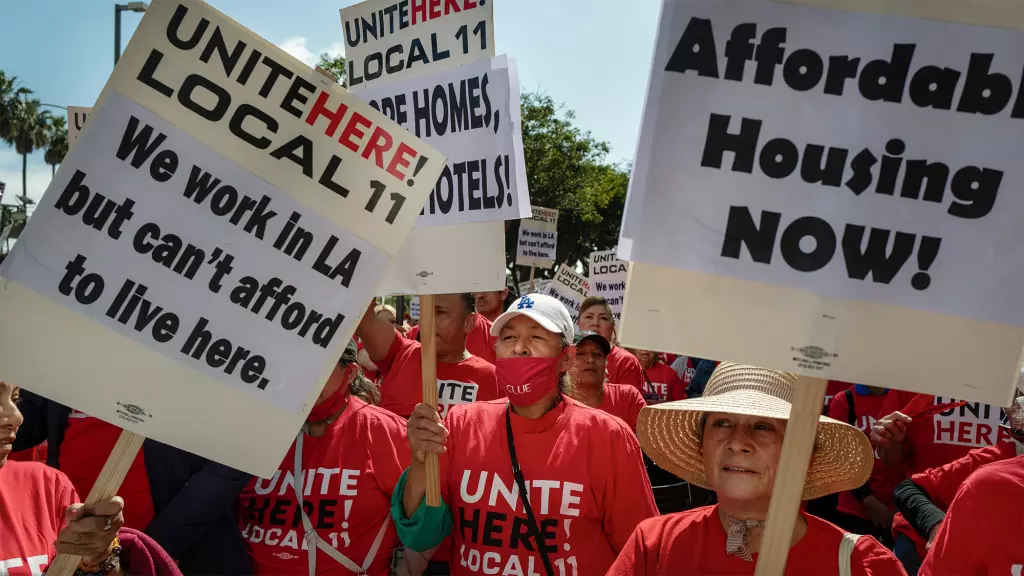
On Wednesday, the LA City Council voted 10 to 5 to instruct the city attorney to draft amendments rolling back the Olympic Wage, a minimum wage increase for airport and hotel workers that the same council passed just last year. The increase, which was supposed to bring wages to $30 an hour by 2028, will now be delayed until 2030 if the amended ordinance passes. The healthcare benefit workers were promised will be pushed back a full year. Workers who had spent three years organizing for this, who had gone on hunger strikes and marched and testified and won, came to City Hall and watched their council begin to unwind what they had built.
“I am counting on the wage increase this summer to help me provide for my daughter,” said Erick Cruz, a cook at LAX. “That increase is not extra money. It is money for rent, diapers, food, gas, and basic things a young family needs to survive.”
The reason the council is moving to delay wages it already voted for is not complicated. A coalition of business groups backed by Delta and United Airlines, hotel corporations, and the Central City Association gathered enough signatures to place a measure on the November ballot that would repeal the city’s gross receipts tax entirely, wiping out $860 million a year in General Fund revenue. The City Administrative Officer’s analysis, released May 6, describes what that would mean: austerity more severe than anything seen during the Great Recession or the COVID-19 pandemic, a structural fiscal gap with no path to recovery, the loss of nearly half the city’s police force, the gutting of homeless services, and the likely collapse of the city’s Olympic preparedness. The cumulative revenue loss over ten years would be $9.6 billion.
The message from corporate interests was direct. If City Council delays the wage and benefits increases workers already won, big business will consider withdrawing its disastrous ballot measure. “This is a huge step in that direction,” said Nella McOsker of the Central City Association. Stuart Waldman of the Valley Industry and Commerce Association was blunter, saying, “The business community has taken a page out of the union playbook to play hardball.”
Hotel worker Rosa Manriquez named it plainly. “The industry is saying that if you don’t cut wages and healthcare, they will try to destroy the budget of the city of Los Angeles.” That is not a negotiation. It is a shakedown. And yet Council President Marqueece Harris-Dawson framed his role as mediating “between two opposing forces, the people who work for us and are residents of this city and the people who have businesses.” As though the cook at LAX counting on a raise to afford diapers and the airline industry threatening fiscal apocalypse are equivalent parties deserving equal deference. They are not. One of them organized, fought, and won through a democratic process. The other lost that fight and reached for a weapon capable of destroying the city budget.
Unfortunately, this horror movie is playing on repeat. The same playbook, run by overlapping networks of real estate money and anti-tax organizers, is being used simultaneously against Measure ULA, the mansion tax LA voters passed in 2022 with 58 percent of the vote. Since taking effect in 2023, ULA has raised over one billion dollars for affordable housing construction, direct rental assistance, and legal support for tenants facing eviction, making it one of the most significant pieces of redistributive legislation this city has ever passed.
In Council District 11 alone, it has provided nearly $1 million in emergency rental assistance, supported 433 eviction defense cases, and delivered $460,000 in direct income support to households on the verge of losing their homes. And it is going directly into housing. The City’s inaugural Homes for LA notice of funding availability, drawing on ULA proceeds, just awarded $360 million to 80 projects across the city. Two of those projects are in CD11: a Venice Community Housing Corporation rehabilitation project on Slauson near Mar Vista Family Center, and a brand new 122-unit development in Del Rey by the Community Corporation of Santa Monica.
The Howard Jarvis Taxpayers Association’s response was to build a statewide weapon aimed at killing it. Their ballot proposition would sharply cap municipal transfer taxes and make it harder for voter-sponsored campaigns to raise taxes in local elections. According to the Legislative Analyst’s Office, it would cost local governments a couple of billion dollars per year, gutting not just ULA but roughly two dozen other transfer taxes in cities across California. Howard Jarvis president Jon Coupal was candid about the target: “I think ULA was not just the straw that broke the camel’s back, but the redwood tree that broke the camel’s back.”
Faced with this threat, progressive leaders began offering to do Howard Jarvis’s work for them. Mayor Bass went to Sacramento seeking legislative carveouts. Councilwoman Nithya Raman, who campaigned for ULA and ran phone banks for it, proposed exempting the first fifteen years of new multifamily construction. A group of Southern California Democrats working alongside Bass and former Assembly Speaker Bob Hertzberg launched a last-minute effort that would only take effect if Howard Jarvis removed their measure. Howard Jarvis said publicly the negotiation was over, but the concessions continued anyway.
What connects these two cases, on a fundamental level, is fear. Not the reasonable caution of leaders weighing genuine risks, but the corrosive, institutionalized fear of people who have stopped asking what is right and started asking only what is safe. Reverend Rae Huang, the only major mayoral candidate who has refused to support modifying Measure ULA, frames the problem with unusual clarity. Los Angeles, she argues, is being held back by a culture of fear manufactured by those in power to keep the rest of us from imagining something better. It is fear that leads elected officials to quickly retreat from the victories their constituents organized to win, and fear that causes City Hall to treat every threat from organized money as inevitable while treating democratic gains as something to be bargained away.
The costs of governing this way compound over time. When you signal, again and again, that threats produce results, you do not buy peace. You purchase the next threat at a premium. The business coalition that extracted wage concessions under threat of a business tax repeal has learned that this council can be moved. Howard Jarvis, watching progressive leaders offer ULA exemptions without being asked, has learned that the tax’s own architects can be pressured into weakening it. Each capitulation is not a resolution, but a cowardly payment toward the next demand.
Fear-based governance also permanently narrows what is possible. When the council’s first question about any policy is who might threaten us if we do this, the policies that survive are those that offend no organized interest sufficiently to trigger a response. That is a very small set of policies. It systematically excludes the people who need city government most, like workers who cannot threaten a ballot measure and tenants who cannot fund a statewide constitutional amendment, because their needs require exactly the kind of confrontation with organized power that fear-based governance is designed to avoid.
There is also something insulting at the core of City Council’s preemptive surrender. Essentially, our elected officials are saying that LA voters cannot be trusted to defeat a ballot measure that would financially destroy their own city. That is what the capitulation implies and the logic driving it. And beyond the insult, it undermines the very democratic processes that produced the victories now being traded away.
The CAO report is public, and the consequences of the business tax repeal are on the record. The initiative’s backers, hotel chains, airlines, and the Central City Association are not a sympathetic coalition asking voters to spare the little guy. At the May 13 hearing, Rob Cuadros of the Los Angeles County Federation of Labor told the council exactly what the polling shows. Repealing the gross receipts tax polls at 22 percent. When voters are told what it would actually do, take away fire, police, sanitation, and gut 911 response, they reject it overwhelmingly. More than 57 percent of likely voters, including a majority of Republicans, opposed the Howard Jarvis transfer tax initiative when shown its title as it would appear on the ballot. There is no reason to believe a measure that would gut city services would fare any better.
At the May 13 hearing, speaker after speaker made the same point, in Spanish and English, from the podium and from the gallery. “Corporate interest already tried to turn this law through a multi-million dollar campaign that they lost,” said one worker. “Now they’re threatening the city to get from this council what they can’t win from voters. Please stand on the side of democracy and working families.” A pastor told the council: “These workers trusted you. They took unpaid time off week after week after week, even as it cut into their budget, to speak to you and go through a democratic process. They trusted you.”
The appropriate response to a threat against democratic victories is not to preemptively dismantle what voters built. It is to trust that the same Angelenos who won those victories are capable of defending them.