On the southwest corner of Barry and Federal just south of National Boulevard, there is a new house. A 3,729 square foot home now valued at more than four million dollars stands where a more modest house once sat with a converted garage studio tucked behind it. The old home was sold by a family trust to an LLC that soon demolished it. A small palm tree and some remaining tile work were among the few traces left behind.
 For decades before that, the house belonged to Helen Gershen.
Helen died on December 27, 2019 at the age of 94. The Jewish Journal published a brief obituary noting that she was survived by her daughter, Paulette. That was nearly all the public record preserved about a woman who spent much of her life practicing one of the most meticulous and physically demanding forms of commercial art from a quiet garage studio in Mar Vista.
Helen Gershen was a professional calligrapher. Through her business, Calligraphy West, she produced handwritten Christmas cards and invitations for Hollywood studios and corporate clients, the sort of elegant correspondence that arrived in thick envelopes and felt different from everything else in the mail. She worked for Saatchi & Saatchi and was commissioned to hand-letter entire books.
The work required extraordinary precision and repetition. Neighbors who knew her later remembered seeing the evidence in her hands. One neighbor who often encountered Helen while walking the neighborhood recalled the way her fingers curved inward from decades of gripping a pen nib. The task had shaped them permanently.
 Her studio was the garage behind the house, and she sometimes sat outside on the stoop talking with people passing by. Neighbors described her as small, slightly hunched, but lively and deeply curious. Conversations with Helen could wander in many directions. She gave art supplies to neighborhood children, and not the cheap kind. “Really good art supplies,” one neighbor recalled.
She survived her husband and her mother, who had also lived in the home, and she raised her daughter there as well. Through all the changes that swept across the Westside over the decades, Helen remained rooted in the same neighborhood.
One of the people who came to know Helen over the years was longtime Mar Vista resident Thérèse Bachand. Bachand had spent decades walking the neighborhood and knew Helen in the familiar but meaningful way neighbors know one another after years of repeated encounters. They spoke on walks, ran into each other on the street, and shared small moments of life. Once, when Thérèse once confided a fear, Helen offered quiet reassurance, and Thérèse has never forgotten the sound of her voice trailing across the street after her.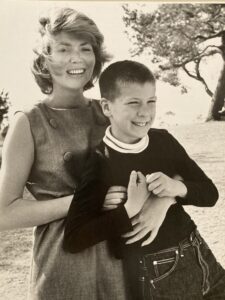
Two years later, Bachand was walking past Helen’s house when she heard piano music coming from inside, and there was a dumpster in the driveway. Workers were clearing out the property after Helen’s death. According to Bachand’s account, many of the belongings inside were simply being discarded. Open jewelry boxes sat in the studio, and the house smelled strongly after a dead cat had been discovered sealed inside a linen closet. Workers carried armfuls of possessions toward the dumpster.
With permission from the developer, Bachand went back into the house to salvage what she could. She rescued paper, books, calligraphy nibs, art materials, and accessories from the studio where Helen had worked for years. She also found a collection of striking black and white photographs apparently taken by a photographer named Joe Gottesman.
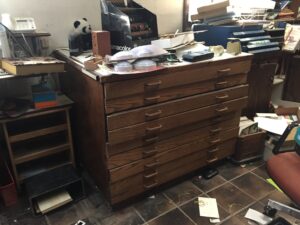
Bachand tried to save a large flat-file cabinet from the studio as well, the kind artists and architects use to store oversized work without folding or creasing it. But she couldn’t find anyone willing to take it, so it was eventually thrown away.
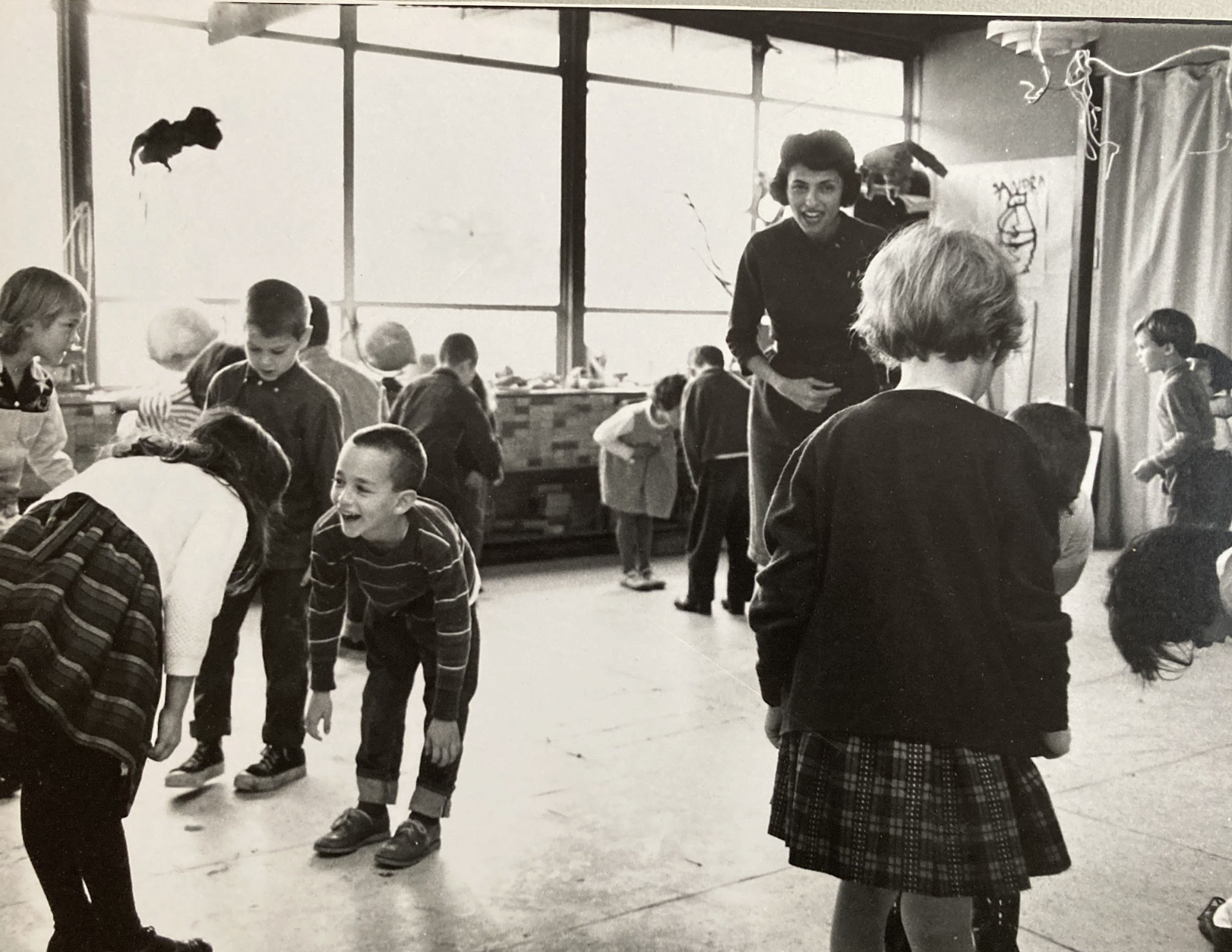
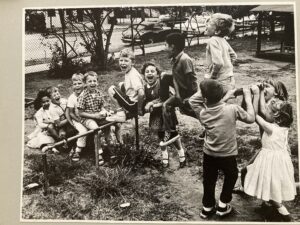
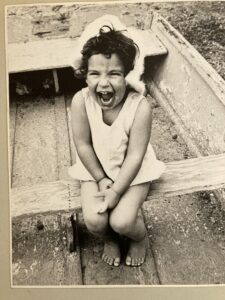 The photographs she rescued appear to document life in Mar Vista sometime in the late 1950s or early 1960s, possibly at Mar Vista Elementary School. The images are luminous and intimate. Children crowd around playground equipment laughing. A classroom scene captures a teacher at the center of a classroom filled with chaos and joy. In another photograph, a barefoot little girl sits on the edge of a sandbox. One image shows a woman at a typewriter peering over round glasses with an expression Bachand described as straight out of a 1940s film.
Gottesman’s connection to Helen remains unknown. He may have been a friend, or she may simply have recognized something valuable in the work and preserved it. The photographs were offered to institutions including the Los Angeles Public Library, the Getty, and Mar Vista Elementary, but no permanent home has yet been found for them.
There is something quietly heartbreaking in the reality that entire lives can disappear quickly in this city. Homes are demolished, longtime residents pass away, and decades of artwork, records, photographs, and memory can vanish into dumpsters within days. What remains often survives only because another ordinary person pauses long enough to recognize that a life mattered.
If you knew Helen Gershen, or know anything about Joe Gottesman’s photographs, we would love to hear from you.