
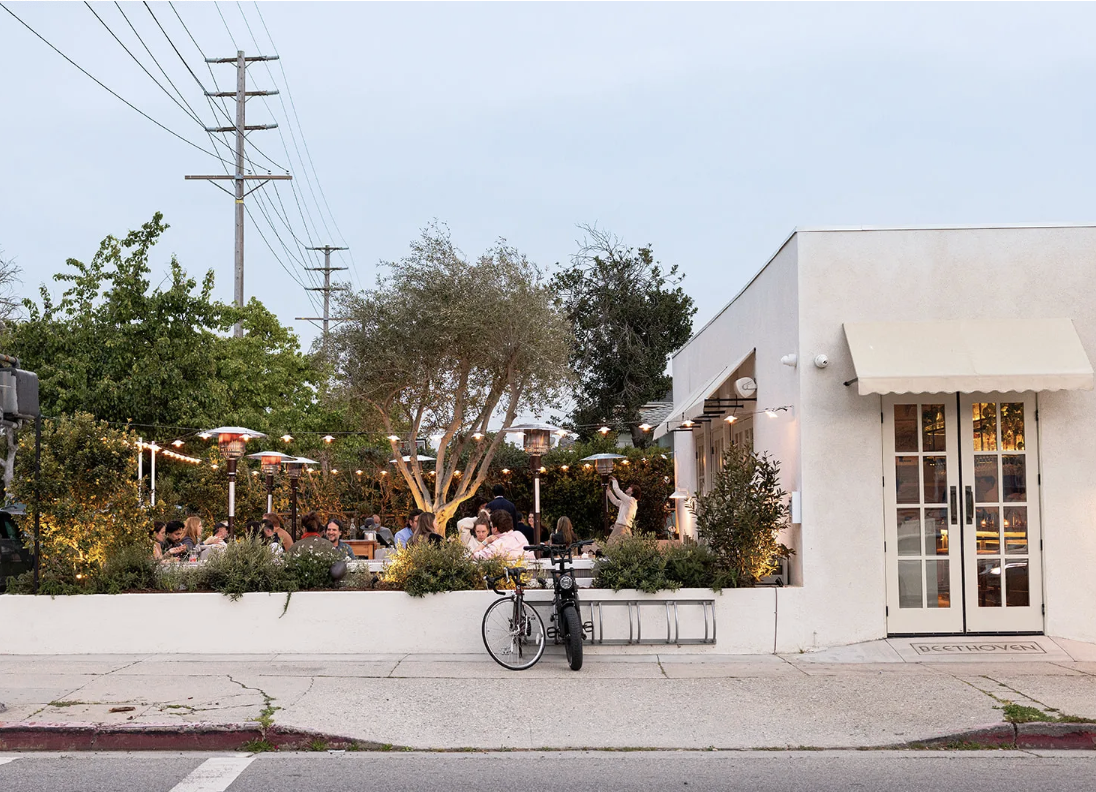
More than 250 people tuned into Thursday night’s Mar Vista Community Council Planning and Land Use Management Committee hearing on Beethoven Market, turning what is normally a relatively low attendance neighborhood land use meeting into one of the most heavily attended PLUM discussions in recent memory.
By the end of the nearly three hour hearing, the committee voted 3-1 with one abstention to support Beethoven Market’s new Conditional Use Permit application for alcohol service. According to the recorded vote, Ian Blue and Chris Curry voted in support, Steven Hedge voted no, and PLUM Chair Stephen Paddock abstained. Committee members repeatedly acknowledged the unusually overwhelming public support for the restaurant.
“I’ve been on hundreds of these meetings with neighbors, and I’ve never seen such an overwhelming support on the behalf of an applicant,” committee member Chris Curry said during deliberations.
The hearing centered on Beethoven Market’s effort to obtain a new Conditional Use Permit following the City’s December 2025 termination of the restaurant’s Restaurant Beverage Program authorization after a series of cited violations. The new application seeks permission to continue selling a full line of alcoholic beverages in conjunction with the existing restaurant operation at 12904 W. Palms Boulevard. According to City Planning documents, the request includes indoor and outdoor dining areas with limited operating hours from 7 a.m. to 11 p.m. daily.
But the hearing quickly evolved into something much larger than a technical permitting discussion. For nearly an hour and a half, residents debated what Beethoven Market represents for Mar Vista itself. Some described the restaurant as a beloved community gathering place and walkable neighborhood anchor, while others complained of an increasingly incompatible late night destination bringing traffic, parking pressure, and noise into a quiet residential area.
The restaurant’s hired land use consultant, Laurette Healey of City Land Use Inc., delivered an extensive presentation outlining the restaurant’s permit history, operational details, and proposed voluntary changes intended to address neighborhood concerns. Healey emphasized repeatedly that many of the operational modifications now being proposed were voluntary efforts to be “good neighbors,” not changes mandated by the City.
Planning filings describe the project as the “continued operation of an existing 5,564.2 sq ft neighborhood market and restaurant” with on-site alcohol service. Submitted plans show indoor dining, patio seating, and integrated market operations. The filings also note the restaurant previously received approvals associated with the City’s Restaurant Beverage Program.
Throughout the hearing, speaker after speaker described Beethoven Market as one of the few places in Mar Vista that genuinely functions as a neighborhood gathering space. Local resident and urban planner Shannon Carey told the committee that Beethoven Market had become where her family celebrates birthdays, graduations, and weekly dinners. She argued the fight reflected broader statewide changes around mixed commercial and residential neighborhoods, not simply one restaurant.
“The facts of the matter are this spot is zoned as a commercial lot,” Carey said. “This fight isn’t about a local restaurant. This fight is about statewide changes.”
Another nearby resident acknowledged occasional parking inconvenience but said the tradeoff was worth it.
“My kids can play on the street, there are people around, they have somewhere to go,” he said. “The slight inconveniences are outweighed by the overwhelming positivity that this restaurant has brought to the community.”
Others described the restaurant as a “third place” where neighbors actually meet one another in a city often criticized for social isolation. Restaurant employee Danny described the business as “career-defining” and said the restaurant had become both a workplace and a community for staff members.
“For us, it’s a second place, it’s a workplace, it’s our livelihood,” he said. “It’s somewhere where I’ve really made close connections and relationships.”
Multiple supporters also framed the debate through the lens of small business survival in Los Angeles. One speaker warned that every operational reduction carried real economic consequences.
“Losing 20 to 30 seats means losing four to five jobs,” the speaker said. “At what point do we prioritize the small business and the overwhelming majority?”
But while support for the restaurant dominated much of the hearing, opposition speakers painted a far different picture. Several nearby residents described the period when the restaurant still possessed its original alcohol authorization as deeply disruptive. Neighbor Sarah, who lives one house away from the restaurant, described noise levels that she said made it feel like “a raging party” inside her home every night.
“Trying to put my kids to bed, trying to go to bed myself, having to wake up early and go and teach all day,” she told the committee. Another resident, Kira, who said she lives across the street and a block away, described conditions before the license termination as “a total nightmare.”
“When they had the liquor license, it was like somebody else said, a raging party in my living room every single night,” she said, describing crowds, parking impacts, and late night noise.
Several opponents argued the issue was not opposition to having a restaurant in the neighborhood, but concern that the scale and popularity of the operation had outgrown what the area could reasonably absorb. Local real estate attorney Douglas Weitzman said parking and traffic had become the primary issue neighbors discussed.
“When it was a liquor store, there was never more than about three or four cars,” he said. “Now there’s maybe 100 people.”
Another speaker argued that “the amount of success that this restaurant has received over the last year supersedes what this neighborhood can handle.”
One opponent complained during public comment that supporters of the restaurant had aggressively mobilized attendance for the hearing while nearby critics and impacted residents were not similarly informed, raising questions about how representative the turnout actually was.
The hearing also exposed broader tensions increasingly shaping neighborhood politics across Los Angeles. Since the pandemic, the City has moved to permanently expand outdoor dining through programs like L.A. Al Fresco, which streamlined approvals and relaxed zoning restrictions for restaurants seeking sidewalk, patio, and street dining areas. At the same time, neighborhoods across Los Angeles (particularly in places like Venice) have seen growing conflicts between residents frustrated by noise, crowds, parking impacts, and late-night activity and supporters who argue outdoor dining has become essential to neighborhood vibrancy and small business survival. Healey emphasized during the hearing that many of the operational changes fueling neighborhood disputes stem from broader shifts toward permanent outdoor dining and evolving post-pandemic commercial regulations.
“Outdoor dining at night is unbelievable,” Healey told the committee. “California is beautiful.”
She also argued that some earlier City enforcement actions stemmed from misunderstandings about the site’s historic entitlements and grandfathered rights. The consultant outlined a series of proposed operational adjustments, including valet parking, updated reservation messaging encouraging rideshare use, noise mitigation efforts, stricter operational monitoring, and new reservation system alerts reminding staff to move patrons indoors later at night.
Attorney Ralph Saltzman, representing the restaurant on alcohol permitting issues, stressed that future City and state oversight would be extensive if the permit is approved. Saltzman told the committee the LAPD intends to recommend roughly 35 operational conditions tied to security, management, surveillance, valet operations, and neighborhood impacts.
“If the conditions are violated, it’s not difficult for the ABC to prove that and take away the ABC license,” Saltzman said.
Even committee members supportive of the project raised questions about occupancy levels, valet operations, and how increased popularity had changed the scale of the restaurant compared to earlier approvals. Committee chair Stephen Paddock noted that when the project was originally discussed years earlier, it had been framed around 97 patrons, while newer seating configurations appeared significantly larger.
Healey responded that the earlier numbers reflected the owner’s initial uncertainty about whether the restaurant would succeed.
“He was scared to death that he made a huge mistake,” she said of owner Jeremy Adler. “He didn’t think there would be enough people showing up.”
The comment prompted audible murmuring from some attendees on the Zoom call, including at least one audible expression of disbelief before the meeting quickly moved forward. Ultimately, however, the scale of public support appeared to heavily shape the committee’s direction. After the committee voted in support of the motion, members conducted an audience tally. According to the chair, roughly 141 attendees indicated support for the project while only around 10 indicated opposition.
The recommendation will now move to the full Mar Vista Community Council next Thursday, May 21st. The broader permitting process, however, is far from over. The restaurant’s Conditional Use Permit application will still move through additional City review processes involving the Department of City Planning, LAPD recommendations, the Alcoholic Beverage Control process, and City Council review.
Thursday night’s hearing made it clear that Beethoven Market has become far more than just a restaurant fight. For supporters, it represents the kind of walkable, social, community-oriented neighborhood life many Angelenos say they want more of. But for critics, it represents what happens when rapidly intensifying commercial activity collides with longstanding residential expectations in neighborhoods never designed for this level of activity.
Previous Mar Vista Voice coverage on the enforcement dispute can be found here.