
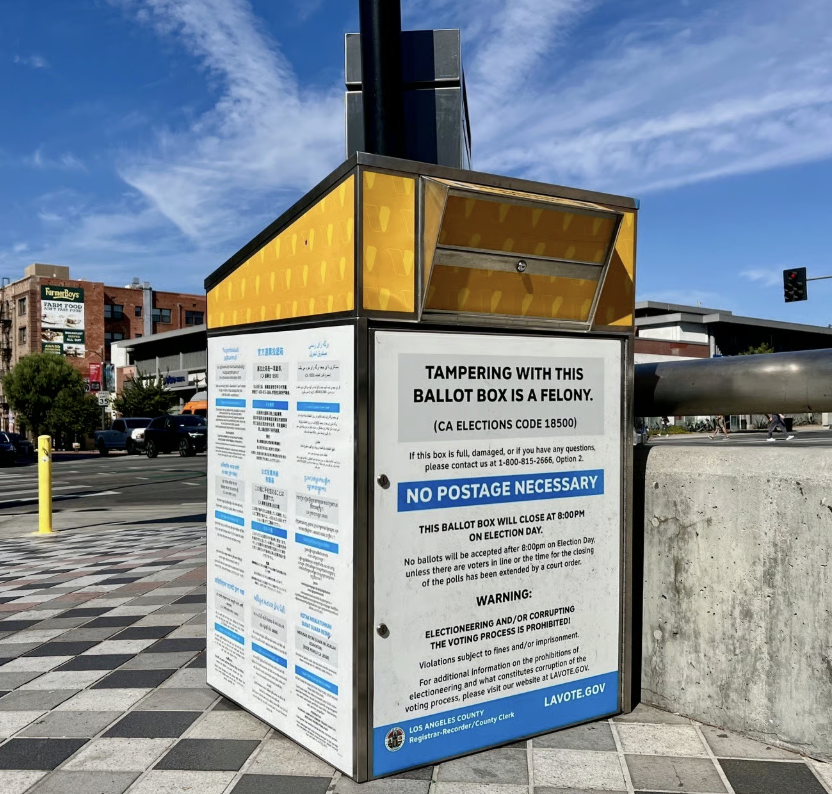
As ballots begin landing in mailboxes across LA, voters are once again being flooded with campaign mailers, attack ads, text messages, and endorsements from every imaginable political organization. In a city where many local races are decided by low turnout and where dozens of offices appear on a single ballot, figuring out how to vote can quickly feel overwhelming.
That is part of why voter guides have become such a central feature of Los Angeles politics.
But voter guides are not neutral. Every guide reflects a different coalition, strategy, and theory of political change. Some are rooted in organized labor. Others come out of tenant organizing, climate advocacy, transportation reform, abolitionist organizing, or nonprofit policy circles. Reading across multiple guides can tell you as much about the fault lines shaping Los Angeles politics as the endorsements themselves.
One of the most widely circulated guides this cycle is the LA Forward Progressive Voter Guide. LA Forward has become one of the most influential progressive political organizations in Los Angeles in recent years, particularly on housing, transportation, climate, and governance reform issues. Their guide tends to represent a more coalition-oriented and institutionally engaged version of progressive politics. The group occasionally backs more establishment-friendly candidates, most notably Councilmember Katy Yaroslavsky over tenant attorney Henry Mantel in CD5, prioritizes coalition-building and policy relationships inside City Hall over more insurgent movement candidates.
For voters looking for recommendations rooted more directly in grassroots organizing and tenant advocacy, the ACCE Action 2026 Voter Guide offers a different lens. ACCE Action comes out of statewide organizing around housing justice, utility affordability, economic inequality, and anti-displacement campaigns. Their endorsements tend to reflect organizing priorities rooted in Black and Brown working class communities, particularly around rent control, labor rights, tenant protections, and opposition to corporate influence in local politics.
Another widely used resource is the Progressive Voters Guide, which aggregates endorsements from labor unions, environmental groups, reproductive rights organizations, and progressive advocacy coalitions across California. One feature that makes the guide especially useful is its address lookup tool, which generates a customized ballot guide based on where a voter lives.
For voters who want to compare endorsements across organizations rather than follow a single slate, Blue Voter Guide functions almost like a searchable coalition map. Instead of issuing its own endorsements, the site compiles recommendations from Democratic clubs, labor unions, environmental organizations, reproductive rights groups, and progressive advocacy organizations.
For voters looking for more traditional reporting-oriented election coverage, the CalMatters 2026 California Voter Guide and Los Angeles Times election coverage provide candidate explainers, campaign finance context, ballot measure breakdowns, and election logistics without functioning primarily as endorsement slates. Meanwhile, some of the most movement-oriented guides this cycle are coming from organizations rooted in abolitionist, immigrant rights, tenant, and democratic socialist politics.
The La Defensa 2026 Primary Voter Guide evaluates races largely through the lens of incarceration, policing, criminalization, immigration enforcement, and community investment. Candidates framed elsewhere as “moderates” or “pragmatists” are often evaluated very differently through that framework. Similarly, the DSA-LA 2026 Primary Voter Guide approaches the election from an explicitly democratic socialist perspective focused on working class organizing, labor power, tenant rights, anti-capitalist politics, and long-term movement-building.
Independent media and organizer-driven guides are also playing a growing role this cycle. KNOCK LA’s Progressive Voter Guide reflects the publication’s longtime focus on policing, incarceration, housing, labor, and grassroots organizing, offering recommendations grounded in independent left local journalism. There are also increasingly popular unofficial and independently assembled voter guides circulating online through organizing networks. Olga Lexell’s voter guide is one of the best examples in this category. Faith Myhra’s voter guide looks at races through a movement-oriented lens rooted in labor, trans rights, tenant organizing, immigrant solidarity, and anti-carceral politics.
Taken together, these guides reveal a political landscape that is far more ideologically contested than Los Angeles’ overwhelmingly Democratic registration numbers might suggest. In many races, the real fight is between competing visions of what progressive politics means in this city. At a moment when national politics can feel chaotic and increasingly fascist, digging in at the local level is one of the best antidotes to despair – so take a look at these guides and cast your vote for candidates who will effect real change for regular people across the city!