
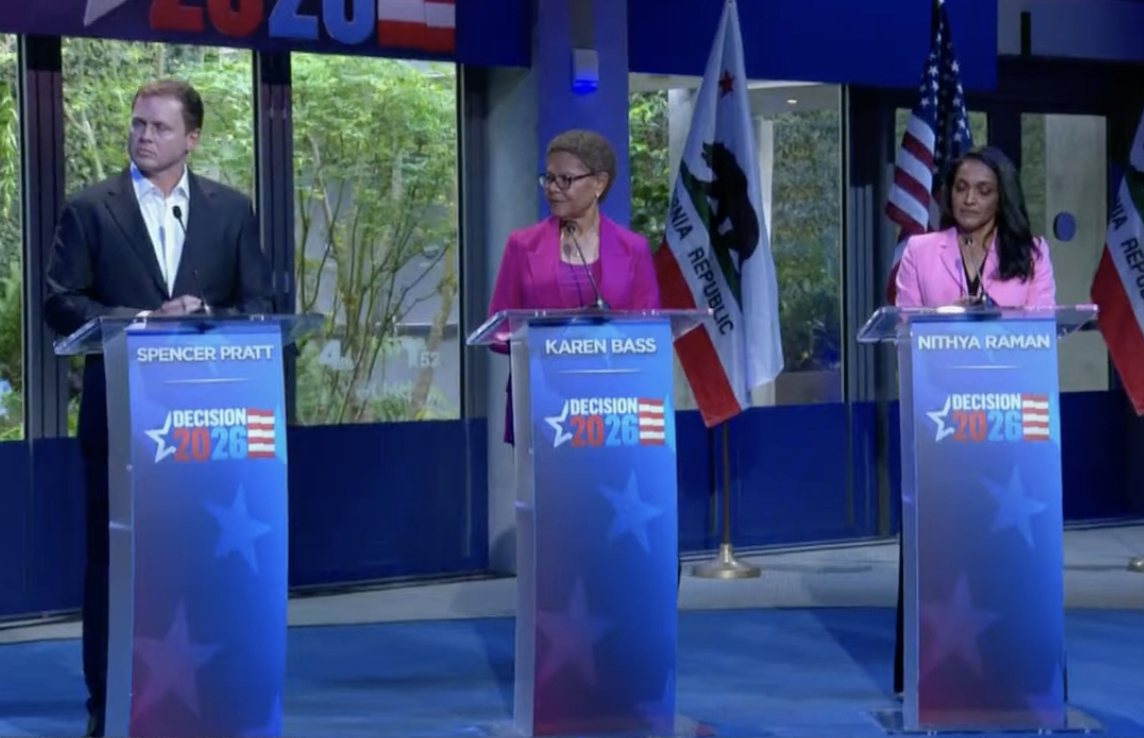
The first major Los Angeles mayoral debate of 2026 was supposed to expose sharp ideological differences between Karen Bass and Nithya Raman. Instead, it may have revealed something much more politically dangerous for both of them: despite months of positioning themselves as rivals, they often appeared far closer to each other than either seemed willing to admit. That vacuum is exactly what allowed Spencer Pratt to dominate the emotional terrain of the debate even while offering few concrete policy solutions.
For nearly two hours, Bass and Raman sparred over accountability, committee leadership, police staffing levels, homelessness spending oversight, and who deserved blame for City Hall dysfunction. But underneath the procedural fights and increasingly personal exchanges, both candidates repeatedly converged around the same core political framework, including technocratic management, incremental reforms, institutional continuity, and public order politics shaped by mounting pressure over homelessness and visible poverty.
Raman tried to frame herself as the insurgent candidate challenging the status quo. Bass repeatedly countered by reminding viewers that Raman has spent years inside City Hall, chairs the Housing and Homelessness Committee, and helped oversee many of the systems she now criticizes. That exchange became one of the defining dynamics of the debate because Bass’ argument exposed a growing contradiction in Raman’s campaign. Raman wants voters to see her simultaneously as both a reformer and an experienced governing insider. But in a city increasingly frustrated with visible dysfunction, those identities are becoming harder to reconcile.
Meanwhile, Pratt benefited enormously from the inability of either Bass or Raman to articulate a truly distinct vision for LA. Again and again, the debate returned to homelessness, policing, encampment removals, downtown disorder, and public safety. Raman defended her district’s reductions in encampments, and Bass defended Inside Safe and police hiring. Both stressed accountability and system management. Even on housing, their disagreements often sounded more like disputes over implementation timelines and permitting structures than fundamentally different visions of the city.
Pratt offered something emotionally clearer, even if politically incoherent. He was just angry, framing Los Angeles as collapsing under failed political leadership. He reduced homelessness almost entirely to addiction and disorder, and repeatedly cast Bass and Raman as interchangeable products of the same City Hall establishment. His actual proposals were often vague or reactionary, but rhetorically he benefited from being the only candidate on stage consistently projecting rupture rather than management.
That dynamic became especially clear when Raman accused Bass and Pratt of effectively working together to sideline her politically. The line was intended to frame Raman as the real threat in the race, but it came off as defensive and left Pratt occupying the role of the only candidate visibly rejecting the existing political order. That does not necessarily make Pratt’s politics coherent or popular citywide. But in a political environment shaped by frustration, fear, and distrust of institutions, clarity often matters more than specificity.
The irony is that Los Angeles does have candidates in this race offering genuinely different ideological visions from both Bass and Raman. They just were not on the NBC debate stage. That may change next week with the May 13 FOX 11 mayoral forum, where housing advocate and socialist candidate Rae Chen Huang will debate alongside Bass, Raman, and entrepreneur Adam Miller. Pratt declined the invitation, citing a scheduling conflict.
That lineup could fundamentally alter the ideological dynamics of the race. Unlike Raman, whose campaign increasingly blends progressive rhetoric with institutional governance language, Huang is running as an explicit democratic socialist candidate. Her campaign centers far more directly on class inequality, housing commodification, labor power, public ownership, and structural critiques of Los Angeles’ political economy. In a debate environment where Bass and Raman often appeared trapped defending different versions of the same governing framework, Huang may be positioned to draw sharper distinctions around the root causes of homelessness, affordability, and displacement.
That matters because one of the clearest absences in the NBC debate was any serious discussion of inequality itself. Candidates spoke extensively about homelessness, public safety, downtown decline, and permitting delays. But very little was said about the economic conditions producing those crises- skyrocketing rents, speculative real estate markets, stagnant wages, privatized social services, shrinking public capacity, and extreme concentrations of wealth. Instead, the debate largely revolved around management. Who can administer the existing system more effectively? Who can clear encampments faster? Who can make City Hall function more smoothly?
Huang’s presence could shift that conversation toward more structural questions in a way neither Bass nor Raman appeared willing to do. At the same time, Adam Miller may attempt to occupy a different lane entirely, presenting himself as the “reasonable” outsider alternative for voters uncomfortable with both Pratt’s chaos and the increasingly blurred distinctions between Bass and Raman. If Pratt represents right wing populist anger and Huang represents a more openly socialist critique of the city’s economic order, Miller is likely to position himself as a managerial business-oriented reform candidate appealing to moderates frustrated with City Hall but wary of ideological confrontation.
That means next week’s forum could reveal what the actual ideological spectrum of the 2026 mayoral race looks like once candidates outside the Bass-Raman-Pratt triangle are given equal footing.