
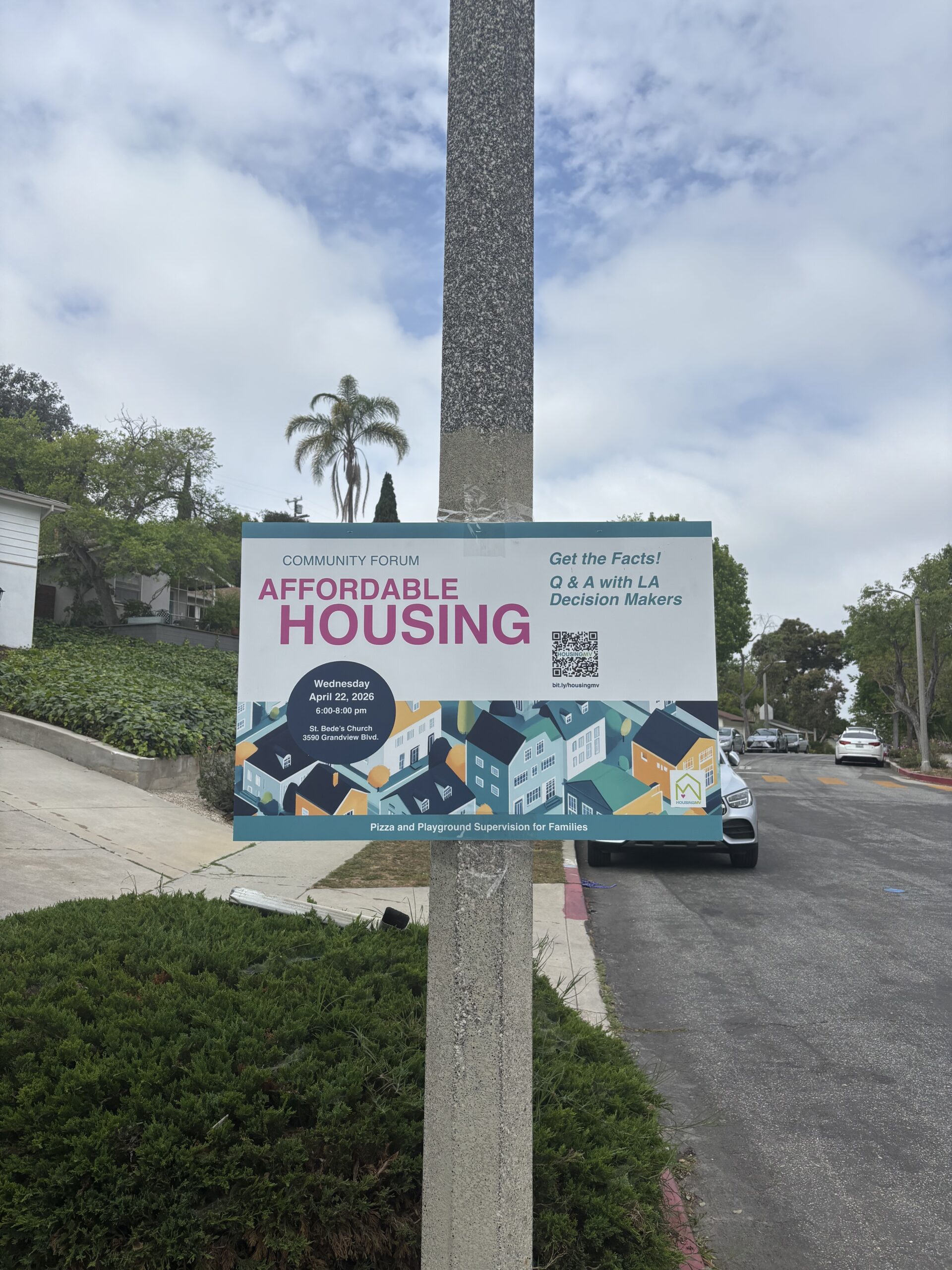
On Wednesday evening at Saint Bede’s Catholic Church in Mar Vista, Housing MV convened a community forum that brought together leading voices in affordable housing policy and service delivery to grapple with the scale and structure of Los Angeles’ housing crisis.
The panel, moderated by Rob Kadota and introduced by Susan Hirschkoff, featured Jacob Pierce of Abundant Housing LA, Amy Perkins from Supervisor Lindsey Horvath’s office, Erika Lee of Venice Community Housing, and Dr. Ryan J. Smith of St. Joseph Center. Each came from a different corner of the housing ecosystem, but over the course of the evening, a shared diagnosis emerged: the crisis is not simply a matter of supply or individual behavior, but the product of systemic contradictions embedded in how housing is produced, regulated, and valued.
Those contradictions are reflected in the numbers. Nearly half of Los Angeles households are cost-burdened, spending more than 30 percent of their income on housing, while tens of thousands of Angelenos remain unhoused, the majority of them unsheltered. The city’s housing targets under the current Regional Housing Needs Assessment call for more than 450,000 new units by 2029, yet much of that allocation is skewed toward above-moderate income housing.
Panelists returned repeatedly to what one described as the “basic math” of the crisis. Households are expected to spend no more than 30 percent of income on housing, yet many in Los Angeles are paying far more, in some cases approaching 90 percent. At the same time, the flow into homelessness continues to outpace exits, with more people losing housing each day than are able to secure it.
The reasons are structural. Large swaths of Los Angeles remain zoned exclusively for single-family housing, effectively banning apartments from roughly three quarters of residential land. Even along major corridors, years of downzoning have constrained what can be built. The result is not just higher rents, but a pattern of sprawl that drives traffic, emissions, and inequality.
At the same time, the cost of building affordable housing has surged. Panelists confirmed that per-unit costs in Los Angeles routinely reach $700,000 to over $1 million, driven by rising construction costs, lengthy permitting timelines, complex financing structures, and litigation. Projects can spend years in predevelopment phases, with delays that compound costs at every step. Even public land is not immune. One example cited involved years of waiting simply to transfer a federal deed.
These delays are not just technical, they’re political. The current approval process gives substantial leverage to nearby residents, allowing opposition to stall or reshape projects, while elected officials often retreat in the face of local backlash. High-profile developments on the Westside, including Venice Dell, have seen costs escalate significantly under the weight of legal challenges.
For those already pushed out of housing, the consequences extend far beyond shelter. Panelists described a cycle in which people who lose housing are drawn into systems of enforcement and criminalization, even as the underlying shortage remains unaddressed. The framing of homelessness as an individual failure, rather than a systemic one, continues to shape both policy and public perception.
The discussion also widened beyond construction to the broader affordability landscape. Wages, subsidies, and federal funding all play a role, and all are under strain. Panelists warned that expiring vouchers and a retreat from federal support could push more households to the brink, even as local governments struggle to fill the gap.
Tenant protections and legal resources remain critical but limited tools. While programs like Stay Housed LA and the Eviction Defense Network offer support, access to effective defense often hinges on securing legal representation, and enforcement of tenant protections can be slow.
Underlying the entire conversation was a deeper tension about what housing is, and what it is for. As one panelist put it, government policy increasingly frames housing as a human right, while the private market continues to treat it as a commodity. The crisis persists in the gap between those two frameworks. There was notable agreement on that diagnosis, but the path forward was less clear. When the conversation turned to social housing models, where housing is removed from the speculative market and owned or operated publicly, the panel’s response was more cautious. While acknowledging growing interest and recent policy movement, panelists largely framed such approaches as longer-term or politically distant, pointing instead to incremental strategies like land banking or cooperative ownership.
That hesitation stood out, particularly in a community where interest in alternatives to the current system is growing. If the existing model is producing the outcomes described throughout the evening, including scarcity, cost burdens, and displacement, then the question of what comes next is not so abstract.