
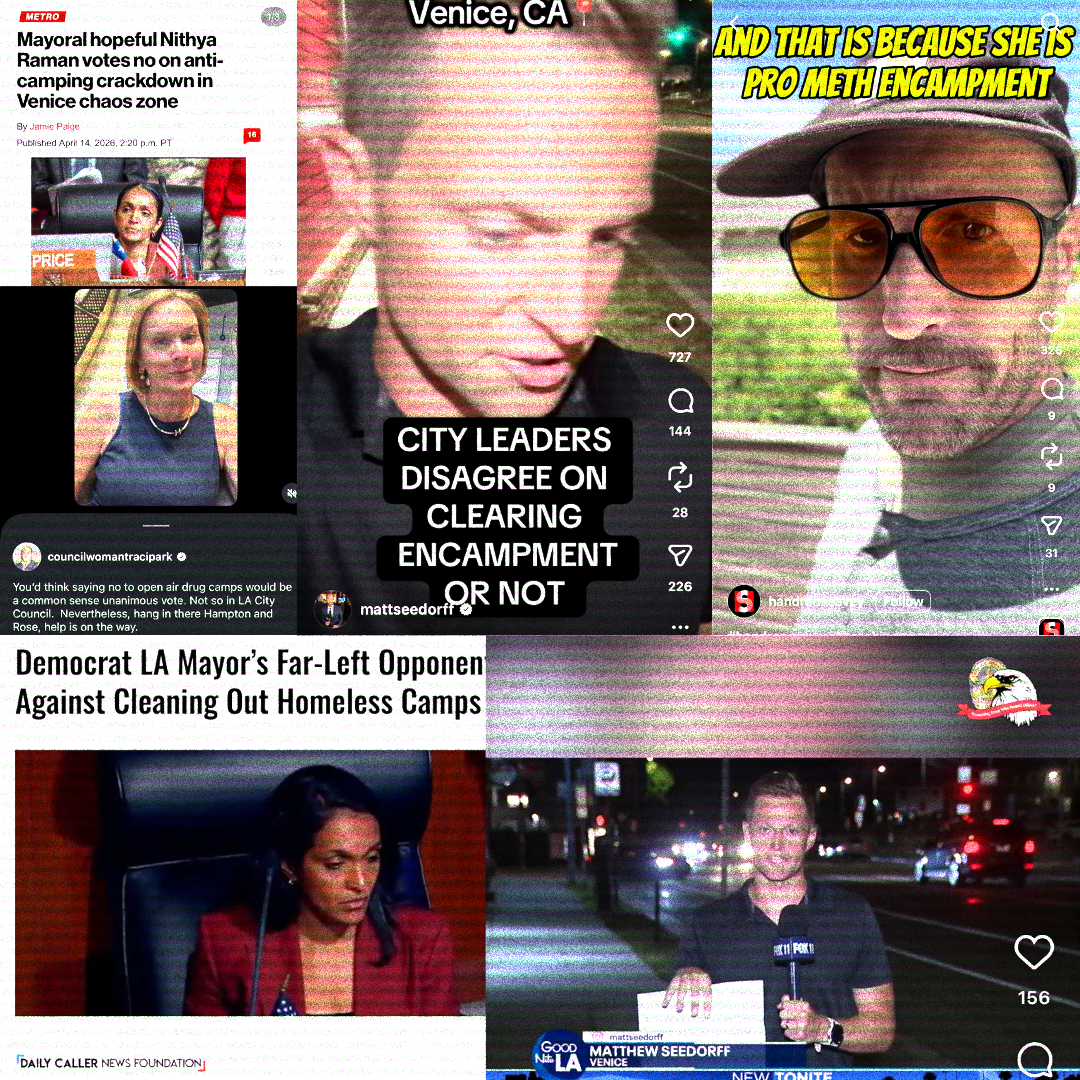
On April 14, LA City Council voted 11-4 to designate 220 Rose Avenue in Venice as a new enforcement zone under Municipal Code Section 41.18, banning sitting, lying, sleeping, or storing personal property within 500 feet of the Rose Avenue and Hampton Drive intersection. The resolution was introduced by CD11 Councilmember Traci Park.
To understand why people are camping there at all, you need a little geography and a little history. The Venice Bridge Home, a shelter a few blocks away on Main Street and Sunset Avenue, came with its own Special Enforcement and Cleaning Zone, a legally designated perimeter within which police enforced laws against unhoused people more aggressively and sanitation crews conducted systematic sweeps.
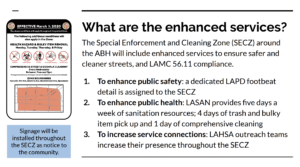
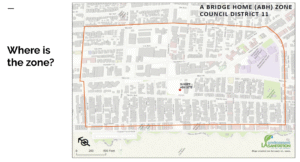
Park could have pushed to keep the Bridge Home open, but it closed on her watch, resulting in the loss of the on-site shelter beds that had been the only alternative to the street for people in that corridor. The special enforcement zone dissolved with it, people set up in the corridor the closure left behind, and the response is a new 41.18 zone to criminalize them for being there.
By any measure of Park’s record, the motion itself was otherwise routine. Since taking office she has introduced ten 41.18 resolutions across Council District 11, alongside a parallel campaign of oversized vehicle bans targeting people living in RVs and vans. What made this particular Tuesday different was what happened in the hours after the vote.
A Pre-Packaged Narrative
The piece that seeded the post-vote media narrative carried the byline of Jamie Paige in both the New York Post and its new West Coast subsidiary, the California Post, which launched in January 2026. The California Post is not a scrappy local startup. It is a well-funded Murdoch operation with more than 80 newsroom staff, an Australian editor imported from Melbourne, a Breitbart veteran running its opinion pages, and an explicit mandate to turn California into new territory for the Post’s brand of culture-war tabloid journalism.
The New York Times, reporting on the launch, noted that the Post had already identified Los Angeles homelessness as one of its signature targets. This is no accident. After all, homelessness is the tip of the fascist spear. It’s the issue that primes the public to accept dehumanization as common sense, to see vulnerable people as a problem to be cleared rather than neighbors to be helped, and to welcome increasingly punitive responses to poverty as reasonable. Once that groundwork is laid, the politics that follow are easier to sell, whether it’s mass deportations, defunding public services, or gutting civil liberties in the name of public order. The editor in chief described the publication’s mission as giving Californians permission “to say publicly what perhaps they’re frightened of saying themselves.”
Paige is not a disinterested observer of CD11 politics. She founded the Westside Current before leaving to serve as Traci Park’s Communications Deputy, and she is now producing homelessness coverage for the Murdoch operation. That pipeline, from a council communications office to a nationally ambitious right-wing tabloid, is the infrastructure through which a routine council vote became a national story on the day it happened.
From there the amplification was swift and coordinated. Fox News broadcast footage of the vote and the encampment, centering the story on the four no votes. The Daily Caller ran a piece headlined “Democrat LA Mayor’s Far-Left Opponent Votes Against Cleaning Out Homeless Camps,” explicitly citing the California Post as its source. The California Post piece was not just local coverage. It was designed as syndicated content for the broader right-wing media ecosystem, seeding the same narrative across multiple outlets simultaneously.
One influencer account mocked Raman by name, described her as “pro meth encampment,” and shared what appeared to be her home address. Another repeated nearly identical language. The Westside Current, the outlet Paige founded before joining Park’s office, published its own piece amplifying pushback from fellow councilmembers. The talking points were uniform across all of it. Raman, running for mayor, meddled in a district she doesn’t represent, voting against a common-sense cleanup and prioritizing ideology over the safety of Venice residents.
It’s a riveting story. It is just not accurate.
What the Narrative Gets Wrong
Raman opposes almost every 41.18 motion. This has been her consistent position throughout her tenure. So do her colleagues Hugo Soto-Martinez and Eunisses Hernandez, both of whom also voted no, along with Ysabel Jurado. None of those four votes were surprises to anyone who follows City Council.
Raman told the Westside Current that “this part of 41.18 duplicates laws we already have to regulate camping, and at best succeeds in moving homelessness around a neighborhood.” That is not a fringe position. It reflects the findings of a UCLA Luskin study of CARE+ operations in CD11, which found that sweeps primarily function as displacement rather than pathways to housing. It reflects RAND longitudinal research showing that reductions in visible homelessness in Venice have been driven largely by vehicle bans rather than housing placements, while the number of people “rough sleeping” (completely unsheltered) has risen. And it reflects a 2024 Human Rights Watch report finding that laws like 41.18 disrupt connections to outreach workers, destroy personal property, and set people back in their efforts to reach stability.
As for the claim that non-CD11 council members have no legitimate role here, under the council’s longstanding practice of member deference, motions affecting a specific district are typically rubber-stamped with minimal scrutiny from other members. A no vote from outside a district is precisely how council members signal principled opposition to a citywide policy. Treating it as scandalous interference is either a misunderstanding of council procedure or a deliberate distortion of it.
The Westside Current piece also included a quote from Councilmember Monica Rodriguez, who said Raman’s votes on 41.18 are “seemingly motivated by election cycles.” Rodriguez is part of the conservative faction on the council that has consistently aligned with Park’s enforcement-driven approach to poverty. She knows perfectly well that Raman votes no on most 41.18 motions because she has been there for the votes. Describing this one as a politically motivated aberration is not a good-faith observation, but a talking point that fed directly into the teed-up right-wing narrative.
What the Coverage Ignored
To accept the media narrative, you have to ignore quite a bit of context.
You have to ignore what Park actually means when she says people have been “offered housing.” What she means is a placement in interim shelter, not homes. Mayor Bass’ Inside Safe program demonstrates the failures of this approach. The City has spent more than $300 million since its December 2022 launch, and as of December 2025, roughly 40 percent of all participants had returned to the street. The program was designed to move people into permanent housing within 90 days, but the average stay is 362 days. Only about 2.5 percent of participants have been placed in permanent supportive housing. A community audit by Inside Safe participants found that more than two-thirds said no one had worked with them to find permanent housing, nearly 60 percent said conditions had grown more restrictive and carceral over time, and two out of three said the food had made them sick. Forty-four people died in the program. One participant wrote simply: “I was better off living in a tent.”
This is the “service” that people are refusing when they are labeled service resistant by politicians like Traci Park. It is not irrational to decline a motel room where staff conduct room checks multiple times a day, go through and steal personal belongings while residents sleep, and where the placement will expire after a year, returning people to an impossible rental market. “Service resistant” is a bureaucratic label that flattens an enormous amount of structural failure into an individual character defect.
The history of enforcement at this specific intersection makes the situation even harder to ignore. The 2024 Human Rights Watch report “You Have to Move!” devoted an entire case study to Hampton Drive just south of Rose Avenue, the precise location of Park’s new 41.18 zone. HRW documented that between October 2019 and January 2023, city agencies conducted 141 separate cleanings at this location, disposing of over 215,000 pounds of material. Despite that sustained investment, the encampment remained in place the entire time. It was not resolved by enforcement. It was resolved temporarily when Inside Safe moved people into interim motel placements. During those same years, LAHSA encountered 475 individuals in the area, and only about 11 percent attained any shelter or housing through the agency’s referrals.
The report documented in detail what those 141 cleanings meant for the people living there. Medications thrown into compactors. Identification documents destroyed. Diabetes equipment discarded. One resident returned from an errand to find LASAN crews dismantling his home. He begged for five more minutes. They refused. He stepped aside with a small backpack and a bicycle and watched as his phone, clothing, bedding, paperwork, identification, and both his mental health and diabetes medications were thrown into a trash compactor.
As ABC7’s Josh Haskell documented at the current encampment, at least one person there had their identification documents taken in a previous cleanup, leaving them unable to access employment, benefits, or housing regardless of what was being offered. This is not an edge case. It is the predictable result of a policy that routinely destroys survival documents and then labels the resulting inability to navigate bureaucratic systems as individual failure.
And you have to ignore that a man named Paul, displaced repeatedly by sweeps in this area, was found dead on Hampton Drive in February 2026. His death was a foreseeable consequence of a policy that treats displacement as a solution, and it received none of the breathless coverage that Nithya Raman’s no vote did.
The Limits of Park’s Framing
Park told the Westside Current that “allowing people to remain on the streets, untreated and in unsafe conditions, is not compassion. It’s neglect.” The claim that enforcement is the compassionate choice has become a staple of anti-camping rhetoric nationwide. It positions displacement as care and opposition to displacement as enabling suffering, a formulation that sounds reasonable but collapses under scrutiny.
Compassion requires somewhere for people to go. Real housing requires a door that stays open. The Westside entered 2026 with effectively no local winter shelter beds. The Venice Dell project, which would create deeply affordable housing on city-owned land in Venice, has remained stalled for years thanks to Park’s obstruction.
The public safety data cited in the council file, approximately 40 calls for service over 12 months including a shooting across the street, was presented in coverage as self-evidently damning, without any examination of who was calling, what the calls were for, or whether the people living at the encampment were the source of danger or also among its victims.
The Cycle Continues
The 41.18 zone at Rose Avenue will now go into effect. What is more likely than any meaningful improvement is that the people currently camping there will move. Some will enter motels and join the 40 percent who eventually return to the street. Others will find a different block. The enforcement gap the Bridge Home closure created will reappear somewhere nearby. And at some point people will find their way back to this stretch of Venice, because Venice remains one of the most expensive places to live in California, because there is nowhere near enough affordable housing or shelter to meet the need, and because displacement is not a solution.
When that happens, there will probably be another motion. And if there are four no votes, there will probably be another round of coverage telling the same story, generated through the same pipeline, amplified by the same accounts, stripped of the same context. The California Post’s editor in chief told the New York Times that the publication exists to give Californians permission “to say publicly what perhaps they’re frightened of saying themselves.” Applied to the Rose Avenue coverage, the mechanism is clear. Find the vote, find the villain, strip the context, and give the audience permission to be angry.