
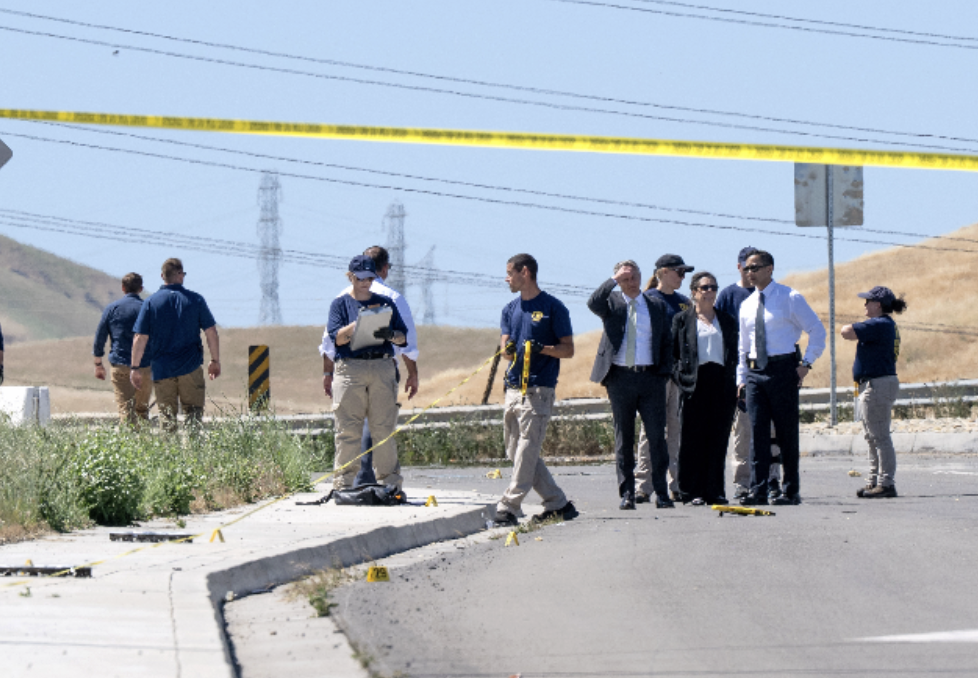
ICE raids and violence may be out of the headlines, but federal immigration enforcement operations continue to result in shootings across the country. The latest occurred on the morning of April 7, 2026, when Immigration and Customs Enforcement agents shot a man near Interstate 5 and Sperry Avenue in Patterson, a small city in Stanislaus County in California’s Central Valley. Carlos Iván Mendoza Hernández, 36, a Salvadoran national, was on his way to a job in the Bay Area when ICE agents shot him during a targeted immigration enforcement operation. A construction worker who rehabilitates fire-damaged buildings, Mendoza Hernández is the father of a 2-year-old daughter and is engaged to a U.S. citizen. He was taken to a local hospital in critical condition.
Acting ICE Director Todd Lyons said agents were conducting a targeted vehicle stop to arrest Mendoza Hernández, whom he described as a member of the 18th Street gang wanted in El Salvador in connection with a homicide. Lyons said Mendoza Hernández “weaponized his vehicle” and tried to run over an officer.
At a news conference the following morning, Mendoza Hernández’s lawyer, Patrick Kolasinski, disputed those claims entirely, saying his client has no criminal history. Kolasinski noted that Mendoza Hernández had been stopped and cited the previous week in Turlock for a cracked windshield, and that a vehicle was spotted outside their home days later. “We believe that may have led this encounter with ICE,” Kolasinski said, suggesting an informant may have provided inaccurate information. “ICE got bad information and acted on it in line with bad training.”
There is mounting evidence from other incidents that federal immigration agents are providing false accounts of their own use of force. Just one day before the Patterson shooting, the city of Minneapolis released surveillance footage of a January 14 ICE shooting that dismantled the federal government’s account of that incident entirely. Early statements from federal authorities said several men assaulted an immigration agent with a snow shovel and a broomstick before the agent fired in self-defense. The two men, Venezuelan immigrants Julio Cesar Sosa-Celis and Alfredo Alejandro Aljorna, were charged with assaulting a federal officer.
The nine-minute city traffic-camera recording told a completely different story. It captures roughly 12 seconds of struggling between the agent and the two men near the entrance of a duplex. A snow shovel visible at the start of the clip is tossed aside before the scuffle begins and does not appear to be used as a weapon. The sequence that the agent described as lasting longer than three minutes appears in the video to last less than 12 seconds before the two men pull away toward the house. Witnesses maintained that the ICE agent fired after the men fled into the house, striking Sosa-Celis in the thigh. Evidence later proved that a bullet pierced the door, undermining the officer’s self-defense claim.
The Department of Justice dropped all charges against both men, citing “newly discovered evidence” that was materially inconsistent with what federal prosecutors had told the court. A criminal probe was opened into whether the ICE agents lied under oath. The New York Times reported that authorities had access to the footage within hours of the shooting, and yet prosecutors did not watch it until three weeks after filing charges, instead relying on the ICE agent’s statement and an FBI affidavit describing the footage. That the FBI’s own affidavit in Minneapolis was used to prop up a version of events that video evidence later proved false is particularly troubling in the context of Patterson, where Trump’s FBI is now the sole agency leading the investigation, with no local law enforcement involvement and no independent oversight of its findings.
“The video makes it crystal clear that, just like in other situations during Operation Metro Surge, the federal government’s account of what happened simply does not match the facts,” Minneapolis Mayor Jacob Frey said.
Minneapolis is not the only case. In August 2025, Border Patrol agents opened fire on Francisco Longoria, his 18-year-old son, and 23-year-old son-in-law after breaking the driver’s side window of his truck, prompting him to drive off. Homeland Security officials accused Longoria of driving toward agents and injuring them. Surveillance video from across the street appeared to show they were lying. Former Homeland Security Secretary Kristi Noem falsely claimed that slain Minneapolis intensive care nurse Alex Pretti had aimed “to inflict maximum damage on individuals and to kill law enforcement.” Video footage showed Pretti never drew his handgun during his confrontation with federal immigration officers, and clearly showed that officers disarmed him before they opened fire.
The pattern extends to how ICE labels the people it targets. ICE descriptions of gang affiliation have repeatedly been called into question. Hundreds of Venezuelan asylum seekers were deported to maximum security prisons in El Salvador, some identified by ICE as gang members. Many of those cases were later challenged in court, where documents revealed agents relied on evidence such as everyday tattoos to make those accusations.
The Patterson shooting marks the sixth shooting involving federal immigration agents in California since August 2025, and the second this year. According to an analysis by NBC News, ICE agents were involved in at least 14 shootings between September 2025 and February 2026. It is not clear how many of those shootings federal authorities have fully investigated, as there have been no public reports of any findings.
Carlos Iván Mendoza Hernández remains in a Modesto hospital recovering from surgery. His fiancée and attorney have been largely shut out, receiving only the barest updates through a hospital social worker. The FBI investigation into the circumstances of his shooting is in its early stages. Given the documented record of federal agents filing accounts that video evidence later contradicted, and given that the FBI’s own affidavit process has already failed once in nearly identical circumstances, advocates and legal observers say the public should demand full transparency, including any available footage, before accepting the government’s version of events.