
UPDATE (March 26, 2026): The Metro Board voted unanimously Thursday to approve the San Vicente-Fairfax alignment as the locally preferred route for the K Line Northern Extension, the vote this article anticipated. The approval came after a last-minute compromise in which Mayor Karen Bass backed away from pushing for indefinite delays, agreeing instead to additional community engagement in the Mid-City section without halting the project’s progress. The full extension is now expected to serve roughly 100,000 riders daily and connect the Metro B, D, and E Lines. Read Streetsblog LA’s full coverage here.
The Metro Board of Directors is scheduled to vote Thursday morning on a preferred alignment for the northern extension of the K Line, a decision that has been delayed for 18 months and that arrives amid serious questions about whether two board members with financial stakes in the outcome have been improperly influencing the process.
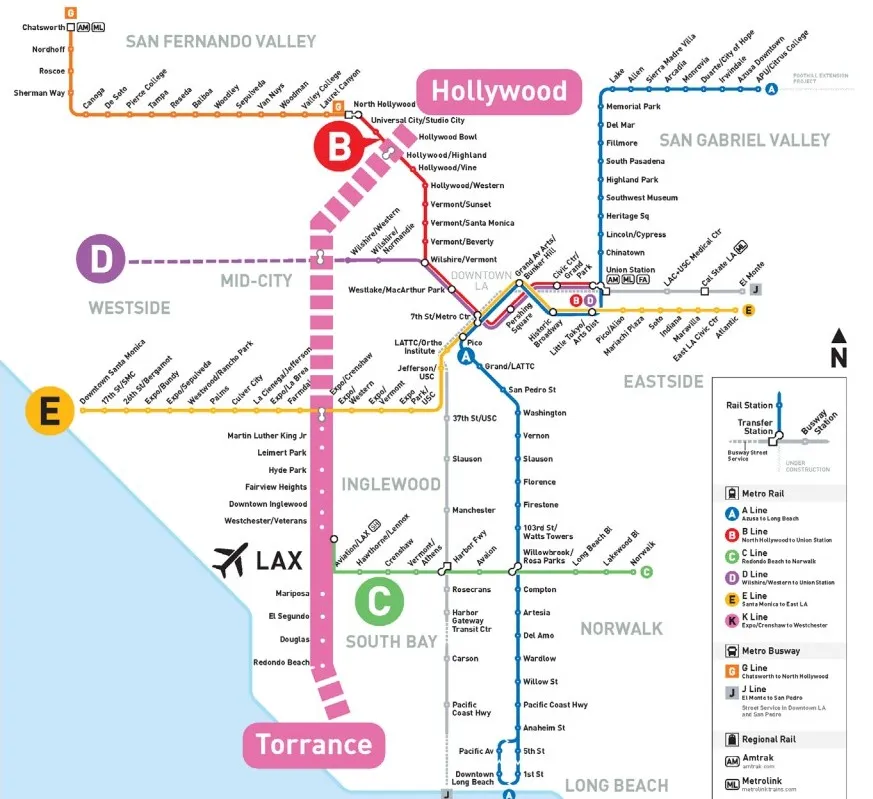
Metro staff is recommending the San Vicente-Fairfax route, which would extend the K Line from its current northern terminus through Mid-City and West Hollywood to the Hollywood Bowl, with nine stations along the way. The line would connect to the D Line on Wilshire and the B Line in Hollywood, creating a north-south rail corridor that does not currently exist in Metro’s network. Staff projects the route would attract 60,000 daily trips, the most of any of the alignments studied, and would reach a higher number of residents and jobs within a half-mile of its stations than the alternatives.
West Hollywood has committed to covering at least 25 percent of total capital costs through an Enhanced Infrastructure Financing District, a mechanism that captures future property tax growth near the line without raising taxes. City analysis shows the district could generate more than $2 billion over 75 years. Measure M, the 2016 countywide sales tax measure that partially funds the project, does not release construction money for K North until 2041. The local financing would allow construction to begin as early as 2029.
The project has been delayed since late 2024, when the Metro Board directed staff to conduct additional community outreach and study alternative tunnel alignments following objections from residents of Lafayette Square, a historic Mid-City neighborhood. Residents have expressed concerns about vibrations and property values from tunneling that would pass 80 to 120 feet beneath their homes. Metro’s studies, including an additional $2.3 million in analysis conducted after the delay was granted, found that tunneling at that depth produces no detectable effects at the surface. Independent peer review supported the same conclusion. Staff modified the proposed alignment to reduce the number of homes with tunnels passing beneath them, at a cost of $165 million and 28 seconds of additional travel time per trip, but 22 homes remain on the alignment. Lafayette Square residents said at the March 18 Planning and Programming Committee meeting that the modification was insufficient. The committee declined to advance a recommendation to the full board.
Two board members who live in Lafayette Square, Holly Mitchell and Jacquelyn Dupont-Walker, have recused themselves from voting on the item. But questions have emerged about how each handled that recusal and what each has done since. Mitchell sought a formal opinion from Metro counsel, which produced a public letter confirming she was required to recuse not only from the vote but from influencing the vote in any way. Transit advocates and researchers say Mitchell appears to have respected that requirement since the opinion was issued, though they note she was involved in pushing for the delays and additional studies for roughly two years before the formal recusal was obtained.
Dupont-Walker’s handling of her recusal has drawn sharper scrutiny. Rather than seeking an opinion from Metro counsel, she obtained guidance from her personal attorney, which means the opinion is shielded from public view under attorney-client privilege. She has described her recusal as voluntary and characterized her conflict of interest as merely perceived. Because her circumstances are, by most accounts, nearly identical to Mitchell’s, critics say she would have received the same guidance as Mitchell had she gone through Metro counsel, and that her choice to use personal counsel appears designed to avoid public disclosure of that fact.
Dupont-Walker is a Bass appointee to the Metro board and the former president of the Lafayette Square Homeowners Association, the neighborhood organization that has led opposition to the tunneling. Bass’s office confirmed to LAist that Dupont-Walker attended private meetings with Lafayette Square residents on March 11 and March 16, despite her recusal from public proceedings on the matter. Multiple sources say she has also been present at Metro headquarters in recent days, directly lobbying other board members on the vote. Transit researchers who reviewed publicly available maps and records say the proposed tunnel alignment appears to pass beneath Dupont-Walker’s own property, which would give her a direct financial interest in the outcome beyond her general proximity to the project.
Mayor Karen Bass, who holds a seat on the Metro board and appoints three additional members including Dupont-Walker, has been involved in the Lafayette Square discussions. Her office has said she supports the K Line Northern Extension but has not specified whether that support extends to the staff-recommended alignment. Ahead of today’s meeting Bass publicly called reports that she intended to delay the project further deliberate misinformation, then released the text of a motion that critics say would do exactly that.
The pattern has drawn comparisons to the K Line’s southern extension, which went through a similar sequence of committee delay and board-level intervention earlier this year. The full Metro board voted in January to effectively kill that project by acceding to homeowner insistence on an excessively costly, likely unbuildable, alternative.
Supervisor Lindsey Horvath, who previously served on the West Hollywood City Council and has been among the project’s most consistent supporters on the Metro board, said this week that the vote represents a test of Metro’s commitment to its transit mission. “Are they interested in being serious partners in building infrastructure when people come to the table with billions of dollars to invest,” she said, “or are we going to move in a different direction?”
The meeting begins at 10 a.m. at Metro Headquarters, One Gateway Plaza in Downtown Los Angeles.