
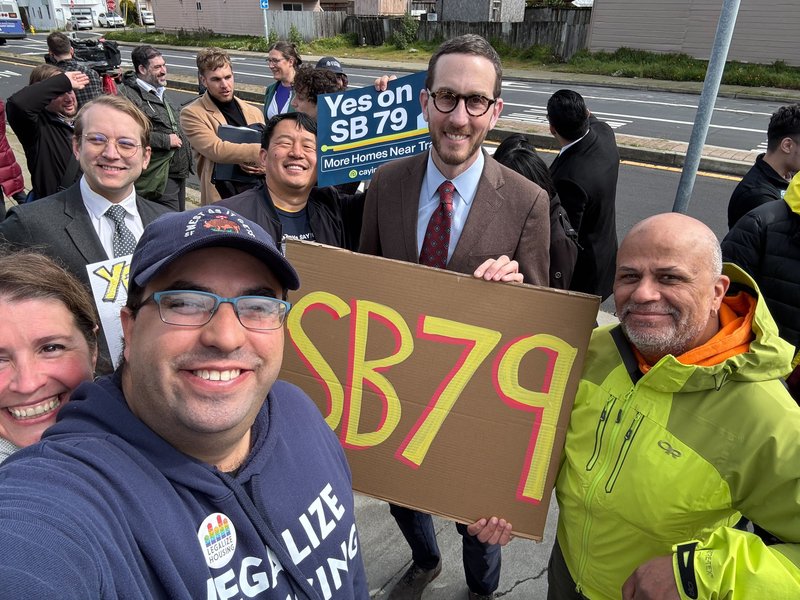
Los Angeles took another step toward deciding how it will implement SB 79 this week as the City Council’s Planning and Land Use Management Committee held its first public discussion of the law’s rollout. The item stems from a motion introduced last fall by Councilmember Traci Park, an outspoken opponent of the state law who helped lead the City Council’s effort to formally oppose SB 79 while it was moving through the Legislature.
During that debate last year, Park argued the bill would strip cities of control over local land use decisions and warned that Sacramento was overriding local planning and ignoring neighborhood safety and infrastructure concerns. The resolution she introduced helped lead to an 8–5 council vote opposing the bill even as it ultimately passed in Sacramento and became state law.
Now that SB 79 is set to take effect July 1, 2026, the city must decide how it will implement it. Park’s motion directing the Planning Department to study delay options and exemptions places the City Council at the center of that process, extending her earlier opposition to the law into its implementation.
SB 79 requires cities in transit-rich counties to allow significantly more housing within a half mile of rail stations and certain bus corridors. The law establishes minimum zoning standards for height, density, and floor area ratio in these areas, potentially allowing five to nine story apartment buildings on parcels that today are zoned for much lower density housing.
The Planning Department’s report outlines several possible paths forward. The city could allow SB 79 to take effect automatically next summer. It could adopt a delayed effectuation ordinance that temporarily postpones the law in certain areas until roughly 2030. Or it could eventually develop a local alternative plan that replaces the state standards with a city-specific transit oriented development framework while still meeting the state’s capacity requirements.
Planning staff emphasized that the timeline for making these decisions is tight. Any ordinance delaying the law would need to be adopted and submitted to the state housing department in time for its review process, while additional mapping and modeling work is still underway to determine where delays may be legally permitted.
Park’s motion directing the report focused on identifying the exemptions and delay options available under the state law. The Planning Department’s analysis now examines those same categories, including areas in very high fire hazard zones, historic districts, low resource neighborhoods, industrial hubs, and parcels located more than a mile from transit. Planning also recommends beginning work on a longer term transit oriented development framework that could eventually replace the state standards while maintaining equivalent housing capacity.
Public comment at the committee reflected the broader debate surrounding the law. Several speakers urged the city to move forward with robust implementation in order to expand housing near transit and address the region’s affordability crisis.
Chris Rhee of Urban Environmentalists LA told the committee that concentrating housing near transit can also reduce environmental impacts. “Concentrating housing near transit, jobs and services reduces sprawl into high fire risk areas at the urban edge,” he said, arguing that making it easier for people to live near transit can reduce driving and greenhouse gas emissions.
Thomas Irwin of Eastside Housing for All described SB 79 as a major opportunity for the city. “We believe this is one of the biggest opportunities this city has to build housing in high opportunity neighborhoods,” he said, noting that Los Angeles permitted fewer than 10,000 multifamily units in 2025.
Other commenters raised concerns about wildfire evacuation routes, infrastructure capacity, and the possibility of higher density development in hillside communities, urging the city to proceed cautiously and make use of the delay tools available in the law.
The committee ultimately did not take a final position on how Los Angeles should proceed. Instead, the hearing served as an early review of the Planning Department’s analysis and the implementation options now before the Council.
The stakes are significant. Preliminary mapping suggests that roughly 150 station areas across Los Angeles could fall within SB 79’s transit zones, covering large portions of the city’s rail network and major bus corridors. If implemented broadly, the law could reshape development patterns by allowing much more housing near transit across the city.
City staff are expected to continue refining their modeling and return with additional recommendations in the coming months as Los Angeles approaches key deadlines tied to the law’s July 2026 start date.